
19 January 2026 The Future is the Product of the Past

Rare Medieval Amethyst Jewel Discovered in Castle Kolno’s Moat

A stunning medieval amethyst jewel, believed to date back over 600 years, has been discovered in the moat of the ruined Castle Kolno in southwestern Poland. This rare archaeological find offers a remarkable glimpse into the lives of the medieval aristocracy and sheds new light on the castle’s dramatic history.

The jewel was unearthed in the sediment between the timber posts of a collapsed bridge that once spanned the castle’s moat. Based on stratigraphic and dendrochronological evidence, experts have dated the artifact to between the early 14th and mid-15th centuries—a time when Castle Kolno was an active stronghold and aristocratic residence.

An Uncommon Jewel in an Unlikely Place

The discovery is extraordinary not only because of the jewel’s craftsmanship but also due to its context. Medieval jewelry is rarely found in settlement sites. Typically, gold and silver ornaments from this period are recovered from graves or hidden hoards, not from domestic environments such as castles or urban dwellings.

Archaeologists believe the amethyst may have been lost by its noble owner while crossing the bridge that once connected the castle to the surrounding area. The find challenges common assumptions about the circulation and deposition of high-value items in medieval Poland.

“This is a unique object to discover in a moat,” said Dr. Lech Marek, an archaeologist at the University of Wrocław. “The artifact likely belonged to a noble visitor and may have been part of a brooch, or possibly a coronet.”


📣 Our WhatsApp channel is now LIVE! Stay up-to-date with the latest news and updates, just click here to follow us on WhatsApp and never miss a thing!!


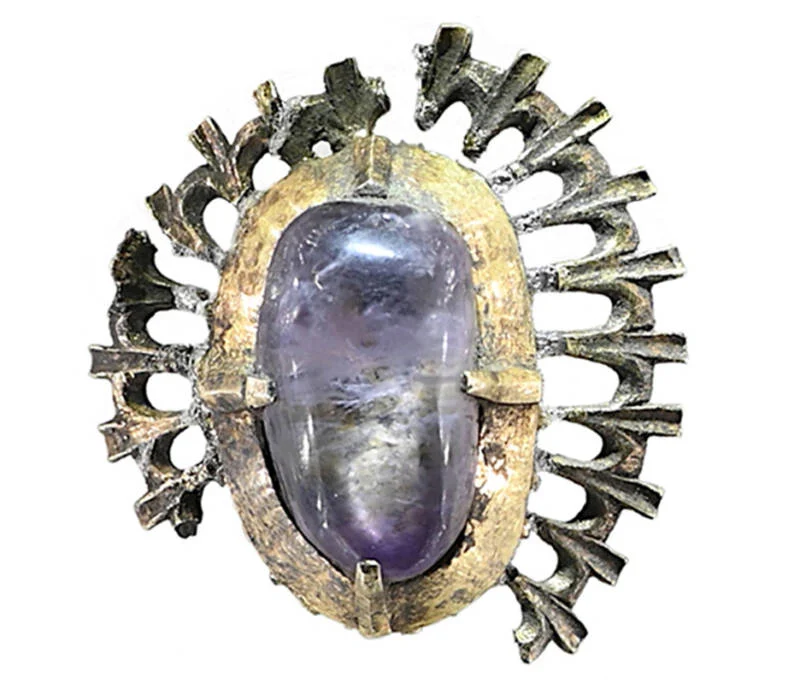
The amethyst was discovered at the bottom of the former moat that once encircled Poland’s Castle Kolno. Credit: Lech Marek/Antiquity

Analysis and Craftsmanship

The jewel was identified as a cabochon-cut amethyst using Raman spectroscopic analysis, a technique that determines a gem’s molecular composition with laser light. The surrounding metal was confirmed to be fire-gilded silver through X-ray fluorescence analysis.

The design features a central amethyst encircled by a radiating pattern resembling petals or palmettes, suggesting the piece was once part of a larger decorative setting. Remnants of a silver pin and lead solder on the back support the theory that it was originally affixed to another item—most likely a luxurious brooch.

This style of gem setting was popular in the international courtly tradition of the 13th and 14th centuries. Comparable examples can be found in royal collections and cathedral treasuries across Europe, such as those from Toledo, Cracow’s Wawel Cathedral, and Środa Śląska, reinforcing the jewel’s aristocratic association.

Castle Kolno: A Site of Power and Conflict

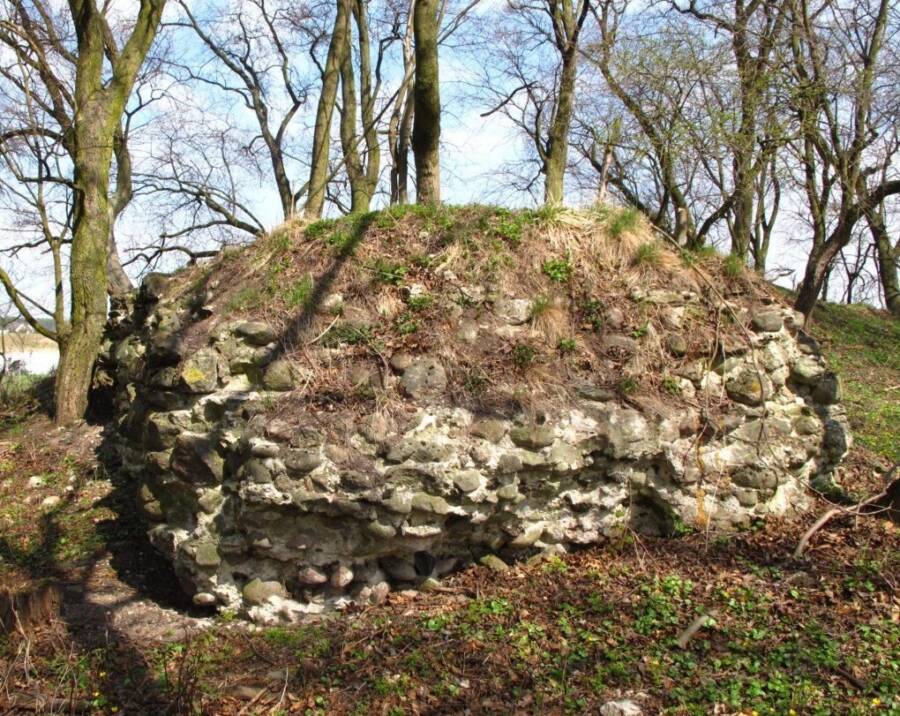
Castle Kolno was established in the 13th century by Duke Bolesław III of Brzeg. Initially serving as a fortress and administrative hub—particularly for regulating the timber trade—it was later sold to local nobles. The castle changed hands several times before being burned down in 1443, likely during violent clashes between rival duchies in the aftermath of the Hussite Wars.

Since 2010, archaeologists have been excavating the ruins, uncovering artifacts ranging from military gear to ceramics, most dating to the castle’s 14th- and 15th-century heyday. The amethyst jewel stands out as one of the most significant and symbolic discoveries to date.
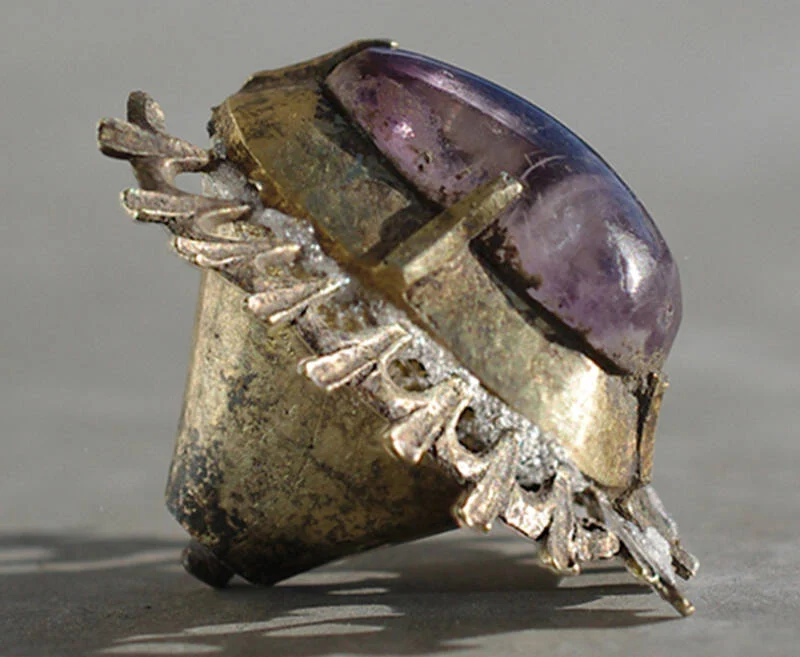
The amethyst may have been part of a bigger setting, such as a brooch or a crown.

More Than Just a Gem

Beyond its aesthetic value, the amethyst carries symbolic significance. In the medieval period, amethysts were believed to have protective and spiritual powers, defending the wearer from various dangers—including intoxication, treason, and even enchantment. Such symbolism would have increased the jewel’s importance to its original owner.

“In the sophisticated medieval play of symbols, the choice of gems always had a deeper meaning,” said Marek. “A stone believed to possess supernatural powers quickly rose in both social and monetary value.”

An Ongoing Mystery

Despite the insights the jewel provides, one key question remains unanswered: how and why was it lost? Whether dropped accidentally or intentionally discarded, the jewel’s journey into the moat remains a mystery.

Excavations at Castle Kolno continue, with archaeologists hopeful that more artifacts will emerge to help reconstruct the rich and complex narrative of this once-powerful medieval site.

Marek, L., & Miazga, B. (2025). A jewel worthy of a duke from the moat of Castle Kolno. Antiquity, 1–6. doi:10.15184/aqy.2025.10097

Cover Image Credit: Castle Kolno was destroyed in the 1400s, and only its ruins remain today. Credit: National Institute of Cultural Heritage

Related Articles

Egypt dig unearths 41 mln-year-old Whale in desert -Tutcetus rayanensis-

12 August 2023

12 August 2023

Paleontologists in Egypt announced the discovery of a new species of extinct whale that inhabited the sea covering present-day Egypt...

Climate Change Negatively Impacts 45 000-year-old Cave Paintings in Indonesia

13 May 2021

13 May 2021

Cave paintings from 20,000 to 50,000 years ago in Indonesia are in danger of extinction due to climate change. Indonesia...

Anaweka Waka: New Zealand’s Most Significant Archaeological Find Gets a Permanent Home

29 July 2025

29 July 2025

Discovered in 2012, New Zealand’s most significant archaeological find may soon become the centerpiece of a purpose-built wharewaka in Golden...

From Bronze Age to Buddhism: Xinjiang’s Archaeological Journey Through Time and Recent Discoveries

4 March 2025

4 March 2025

Recent archaeological investigations in the Xinjiang Uygur Autonomous Region have significantly enhanced our understanding of the area’s historical context and...

Artificial intelligence is Detecting New Archaeological Sites in the Arabian desert

5 October 2024

5 October 2024

A team of researchers at Khalifa University in Abu Dhabi has developed a machine-learning algorithm to help them trawl vast...

A Rare Design in Roman Military Architecture: Triangular Stone Tower Discovered Near Sofia

22 July 2025

22 July 2025

Bulgarian archaeologists have uncovered a triangular stone tower — a rare architectural form in Roman military design — at the...

Researchers find the earliest record of aurora in old Chinese documents

15 April 2022

15 April 2022

Researchers have found the oldest known reference to a candidate aurora in a celestial event, described in an ancient Chinese...

An ancient structure of unknown purpose discovered in northeastern Italy

25 March 2023

25 March 2023

A mysterious structure of unknown purpose has been unearthed in the Friuli Venezia Giulia region in northeastern Italy. The discovery...

Deadly Omens Revealed from 4,000-year-old Babylonian Tablets

10 August 2024

10 August 2024

Researchers successfully deciphered 4,000-year-old cuneiform tablets discovered over a century ago in what is now Iraq.  The tablets, housed at...

3,500-Year-Old Cuneiform Tablets and Seal of Unknown Hittite Prince Unearthed in Türkiye

19 October 2025

19 October 2025

In the ancient heart of southern Türkiye, history has once again spoken through the clay. Archaeologists excavating the site of...

What If Ancient Statues Smelled Wonderful? The Surprising Secrets of Greco-Roman Sculptures

16 March 2025

16 March 2025

A new study published in the Oxford Journal of Archaeology has shed light on an often-overlooked aspect of ancient Greek...

Who will solve the puzzle of Bronze Age tin? Origin of tin ingots from Uluburun shipwreck disputed – the metal may have come from Cornwall

3 October 2023

3 October 2023

The exact origin of tin in the Bronze Age is the Holy Grail of archaeometallurgists: For 150 years, experts have...

Evidence of Intentional Roman Use of Narcotic Seeds, Found in Bone Vessel in the Netherlands

8 February 2024

8 February 2024

Archaeologists have discovered the first conclusive evidence of the existence of a hallucinogenic and poisonous plant thought to have been...

A Scientific Surprise: Bering Land Bridge formed surprisingly late during last ice age

1 January 2023

1 January 2023

A new study shows that the Bering Land Bridge, the strip of land that once connected Asia to Alaska, emerged...

Rare Tales of Merlin and King Arthur Found in 13th Century Manuscript

17 April 2025

17 April 2025

In a remarkable discovery, a fragile manuscript fragment dating back to the 13th century has been found hidden within the...