
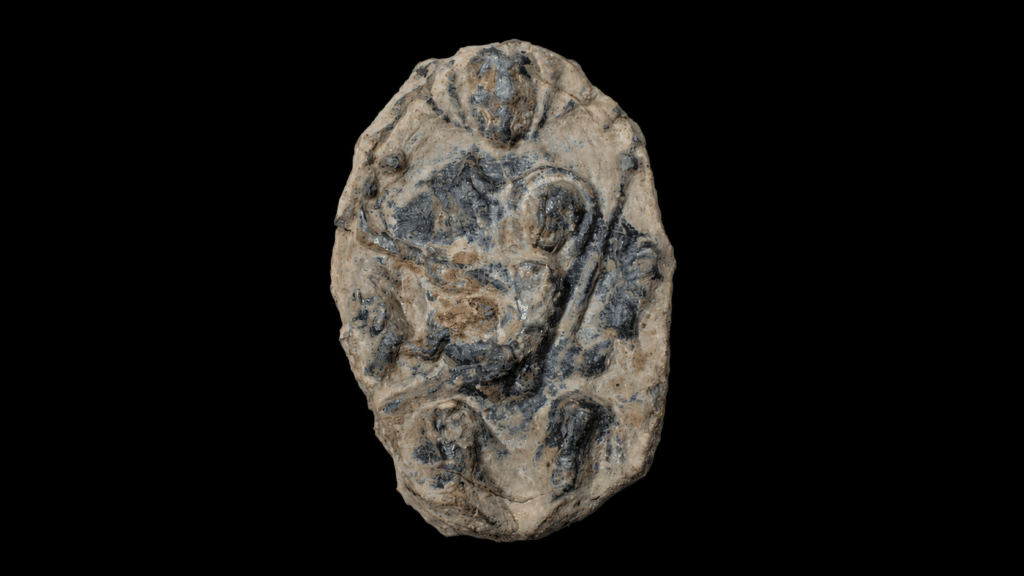
A broken piece of pewter found in a field in South-West Finland has turned out to be far more than a worn medieval trinket. Researchers have identified it as a Livonian pilgrim badge, a type so rare that only six or seven comparable examples are known from across Europe.
The small object, discovered in 2016 at Juva Farm in Masku, carries the image of the Virgin Mary with the Christ Child. Its surface is damaged, and its edges are missing, but a few surviving details were enough to place it among a tiny group of badges connected with medieval Livonia, a region once closely tied to the cult of St Mary and Baltic pilgrimage.
For Finland, the find is unusually important. It brings one of the northernmost known examples of this rare devotional object into a landscape where archaeology and written records still leave many questions unanswered. How the badge reached Masku, who wore it, and why it ended up in a field near the Maskunjoki River remain unresolved.
The identification was made by Visa Immonen of the University of Bergen and published in Fornvännen: Journal of Swedish Antiquarian Research.
A small object from a much wider world
The badge was found on the north side of the Maskunjoki River, about 3 kilometers northeast of Masku’s medieval church. The field has produced material dating broadly from the Late Iron Age and the Middle Ages, but this particular object stood apart.
Its front shows the Virgin Mary seated with the Christ Child on her lap. Both figures are haloed. The reverse is plain, but the remains of a fastening pin show that the object was designed to be worn, probably attached to clothing, a hat, or a pilgrim’s belongings.
In medieval Europe, pilgrim badges were more than souvenirs. They were proof of travel, signs of devotion, and portable memories of sacred places. A person who returned with such an object had not only visited a shrine, but also carried its spiritual prestige back home.
The clue hidden in Mary’s hand
At first, the Masku badge seems to resemble the famous pilgrim badges from Rocamadour in France, one of medieval Europe’s major Marian pilgrimage centers. Rocamadour badges were almond-shaped, usually carried an inscription around the edge, and showed the Virgin and Child.
But the Masku fragment contains a telling difference. On Rocamadour badges, the Virgin typically holds a lily-topped sceptre on her right side. On the Masku badge, the sceptre appears on her left.
That small shift matters. It links the Finnish find not to France directly, but to a small group of badges associated with Livonia, a medieval region around present-day Latvia and Estonia. These Livonian badges used a similar format but carried a different message: “The sign of St Mary for the forgiveness of sins in Livonia.”
In this group, the Virgin holds the lily sceptre in the crook of her left arm, while the Christ Child carries a Greek cross. Even though the Masku badge is fragmentary, Immonen argues that its surviving features are strong enough to place it within the Livonian group.
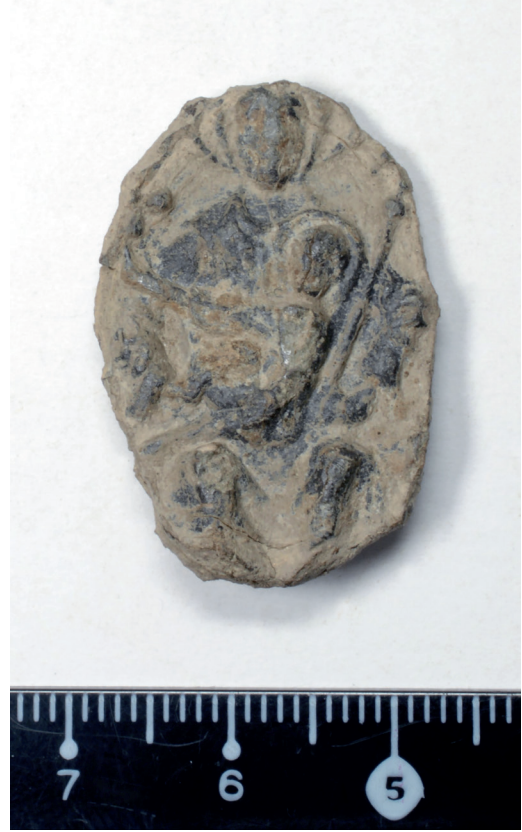
41582:1). Size c. 3 x 2 x 0.6 cm. Photo: the Archaeological Collections, Finnish Heritage Agency. Credit: Immonen, V. (2026)
A rare trace of Baltic pilgrimage
Livonian pilgrim badges are exceptionally scarce. Two have been reported from Latvia, one from Sweden, and four from Germany. Examples have been found in places such as Kuldīga, Riga, Lödöse, Kiel, Lübeck’s surroundings, and Wismar.
Their distribution points toward movement across the Baltic Sea, through ports, towns, and religious networks tied to trade as much as faith. The badges are generally dated to the later 13th or early 14th century, a dating that can also be applied to the Masku find.
For Finland, the object adds an unusually concrete sign of contact with the medieval pilgrimage world of Livonia. It suggests that people in the region were not isolated at the edge of Latin Christendom. They were part of a wider religious geography, one that stretched across the Baltic and linked local communities to major ecclesiastical centers.
Was Riga the destination?
The exact origin of the Livonian badges remains debated because the inscription names Livonia only generally. But many scholars have argued that Riga was the most likely pilgrimage destination.
The argument is plausible. Riga’s cathedral was dedicated to the Virgin Mary and known in medieval sources as St Mary’s Church. Written records also refer to pilgrim journeys from the Nordic countries to Riga. If the Masku badge came from such a route, it may represent the journey of a medieval pilgrim who traveled from Finland, or through Finland, toward one of the Baltic’s most important religious centers.
There is another intriguing possibility. Scholars have suggested that the Livonian badges may have been inspired by Rocamadour models, perhaps even cast from a Rocamadour badge used as a template. If so, the Masku object carries a layered story: a French Marian image reshaped in Livonia, then carried or lost in Finland.
The mystery of Juva Farm
The findspot adds another layer of uncertainty. Masku was one of Finland’s oldest and wealthiest medieval parishes, and the Maskunjoki River Valley was densely settled during the Late Iron Age and the Middle Ages. Written sources mention Masku in the early 13th century.
Juva Farm, however, is more difficult to read archaeologically. Although several Late Iron Age and medieval finds were recovered from the field, no clear archaeological site has yet been identified there or nearby. In written records, Juva appears only once during the Middle Ages, in a 1416 donation connected with Turku Cathedral.
That leaves the badge suspended between evidence and absence. Was it lost by a local pilgrim returning from Livonia? Did it arrive through trade, clerical travel or movement along the river valley? Was there an undiscovered medieval activity area near Juva Farm?
For now, the object answers one question while opening several others. It shows that a rare Livonian pilgrim badge reached South-West Finland. But the person who wore it, the journey it marked, and the reason it ended up in a field beside the Maskunjoki River remain unknown.
Immonen, V. (2026). A Livonian pilgrim badge from Masku, South-West Finland. Fornvännen: Journal of Swedish Antiquarian Research, 121(2), 148–150. https://doi.org/10.66449/fornvn.v121i2.64011
Cover Image Credit: Archaeological Collections, Finnish Heritage Agency. Immonen, V. (2026)
