7 December 2025 The Future is the Product of the Past

3,000-Year-Old Twisted Gold Torc Discovered in Essex, southeast England

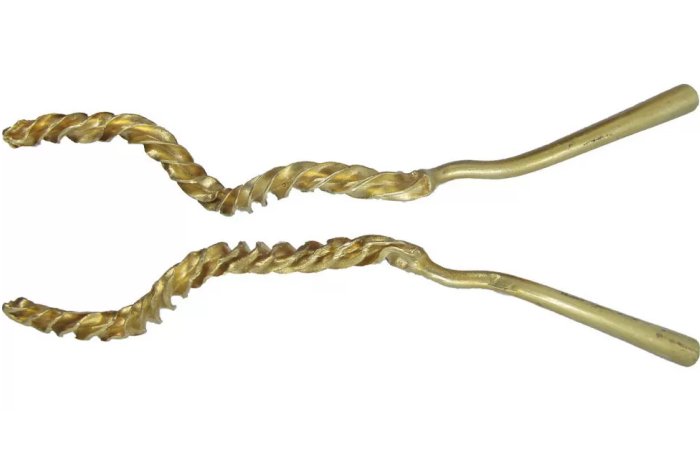
A metal detectorist has discovered a 3,000-year-old part of a twisted gold torc in a field near Mistley, on the River Stour in Essex, UK.

The gold torc has been examined by experts and declared a treasure by a coroner. It is the “first-ever” torc “reported as treasure from Essex.”

Torcs were ostentatious neck rings clearly marking the high social status of their wearers. The item comes from the Middle Bronze Age and dates to about 1300 BC.

The detectorist reported the find to the Portable Antiquities Scheme three years ago. British Museum experts confirmed the jewelry was made from at least 75% gold, about 18% silver, and some copper.

The torc, which is 147mm long (5.7in) long, was crafted from a rectangular rod with four grooves cut into it.


📣 Our WhatsApp channel is now LIVE! Stay up-to-date with the latest news and updates, just click here to follow us on WhatsApp and never miss a thing!!


Amazing Bronze Age hoards that shed light on the evolution of metallurgy and ritual practice in ancient Britain have been found strewn about the landscape. It’s unclear if these items were just the metalworker’s tools that he or she had buried in the ground and left there, whether on purpose or accidentally.

Finds liaison officer Lori Rogerson said despite being made of prehistoric gold “it could have been made yesterday”, which is “mind-blowing”.

“Gold metalwork from the Bronze Age is rare from Essex.  It’s always nice to work with prehistoric gold, but you have to remind yourself it is over 3,000 years old,”  Rogerson told the BBC.

Miss Rogerson said a “highly skilled” goldsmith worked on it and “would have had to twist it, it’s a really soft material so it is at risk of tearing,”

“He or she would have known just the right point to stop before it broke while getting those twists in,” she added.

Colchester Museum hopes to acquire it.

Cover Photo: Precious objects like this damaged torc were often buried on their own. COLCHESTER AND IPSWICH MUSEUM SERVICE

Related Articles

Prehistoric Settlement Unearthed in Ogovo: Remarkable New Archaeological Discoveries in Belarus

14 August 2025

14 August 2025

Recent archaeological research in Belarus has unveiled insights into the country’s prehistoric past. A series of excavations and underwater studies,...

A Christian monastery, possibly pre-dating Islam, found in UAE

6 November 2022

6 November 2022

A Christian monastery has been discovered on the island of Siniyah off the coast of the United Arab Emirates (UAE),...

Rare Scandinavian Chain Unearthed by Archaeologists in Novorzhev District, Russia

14 August 2025

14 August 2025

Archaeologists have discovered a remarkably well-preserved Scandinavian-style chain during excavations in the southeastern part of the Gorozhane settlement in the...

Builders of Massive 6000-year-old Menga Dolmen Likely Understood Geometry and other “Early Science” Concepts

25 August 2024

25 August 2024

Researchers say that a new analysis of the 6000-year-old stone Menga (also known as the Dolmen of Menga), supported by...

In Neolithic China, Death Was Gendered: Men for the Gates, Women for the Elites

2 December 2025

2 December 2025

Human sacrifice was not just a ritual act in Neolithic China—it was a carefully engineered system, and nowhere is this...

In Ryazan, the first birch bark letters were discovered

13 September 2021

13 September 2021

The first birch bark letters were found at the Vvedensky excavation site in the Kremlin in Pereyaslavl Ryazan (modern Ryazan)....

3,000-Year-Old Hazelnut Shells Discovered in the Sacred Hittite City of Nerik

30 July 2024

30 July 2024

In the sacred Hittite city of Nerik, located in the northern Vezirköprü district of Samsun province in the Central Black...

5000-year-old fingerprint found in Orkney pottery

23 April 2021

23 April 2021

Fingerprints were found on a pottery dating back 5,000 years in the Orkney archipelago, located in the northern region of...

Anglo-Saxon monasteries were more resilient to Viking attacks than thought

31 January 2023

31 January 2023

Researchers from the University of Reading’s Department of Archaeology have found new evidence that Anglo-Saxon monastic communities were more resistant...

Centuries-old burials discovered near Antandros Ancient City in Turkey

10 January 2022

10 January 2022

Ancient tombs were discovered during a foundation excavation at a building site near the ancient city of Antandros, which is...

Archaeologists discovered a sunken prehistoric fort in Clew Bay island

1 April 2024

1 April 2024

A sunken prehistoric fort has been discovered on Clew Bay island off the north Mayo coast, Ireland. It has been...

The Mysterious Stone Structure Overlooking Ani: A Hidden Monument Raising New Questions

14 November 2025

14 November 2025

A lone stone structure standing silently on a windswept hill near Kars has begun to draw growing curiosity. Rising from...

A Baptismal Surprise: Triton Baths in Southeastern Rome Converted into Early Christian Church

7 May 2025

7 May 2025

Recent archaeological excavations within the monumental complex of the Villa di Sette Bassi, situated in the southeastern outskirts of Rome,...

Romania’s 1.95 Million-Year-Old Hominin Evidence Pushes Back the Timeline of Human Presence in Europe

25 January 2025

25 January 2025

A recent study revealed evidence of “hominin activity” in Romania that dates back at least 1.95 million years, making it...

Medieval Masterpiece: Rare Jesus Christ Relief from Ani Ruins Unveiled After 130 Years

14 August 2025

14 August 2025

A significant archaeological artifact depicting Jesus Christ has been put on public display for the first time at the Kars...