2 December 2025 The Future is the Product of the Past

1500-year-old Stunning Pendant Amulet Depicting the Prophet Solomon Spearing the Devil on Horseback Found in Türkiye

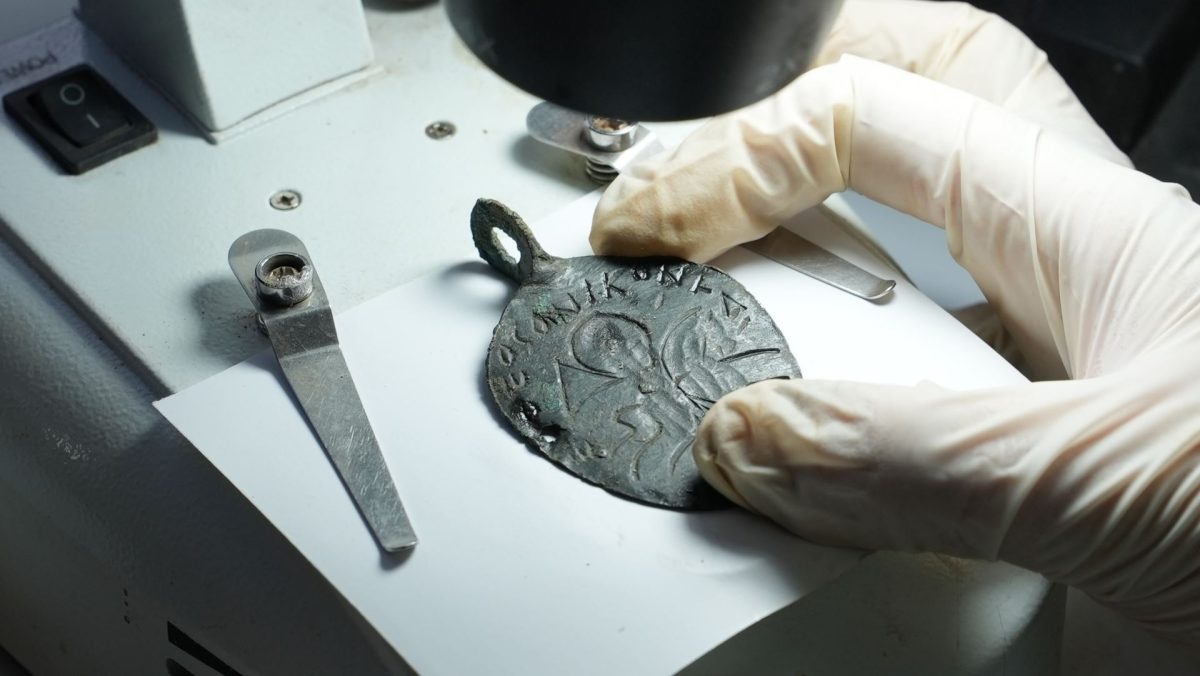
During the excavations in the ancient city of Hadrianopolis in Eskipazar district of Karabük, Türkiye, an amulet from the 5th century A.D. depicting the Prophet Solomon spearing the devil on horseback was unearthed.

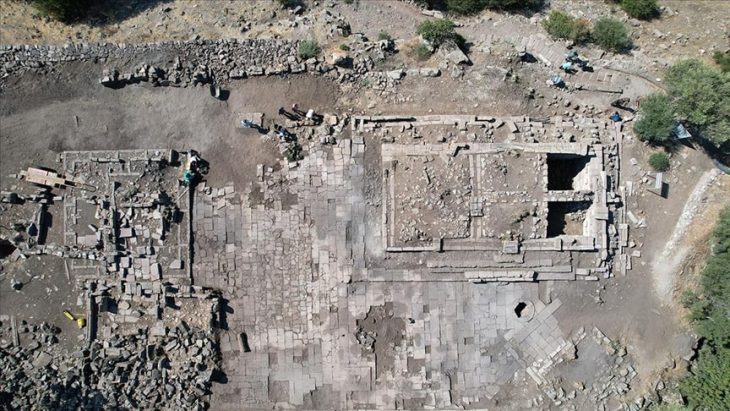
The ancient city, which served as a settlement in the late Chalcolithic, Roman, and early Byzantine eras, is still undergoing excavation and restoration work under the direction of associate professor Ersin Çelikbaş from the Department of Archaeology at Karabük University’s Faculty of Literature.

During excavations at the ancient city, known as the “Zeugma of the Black Sea,” an amulet pendant depicting the Prophet Solomon from the fifth century A.D. was discovered.

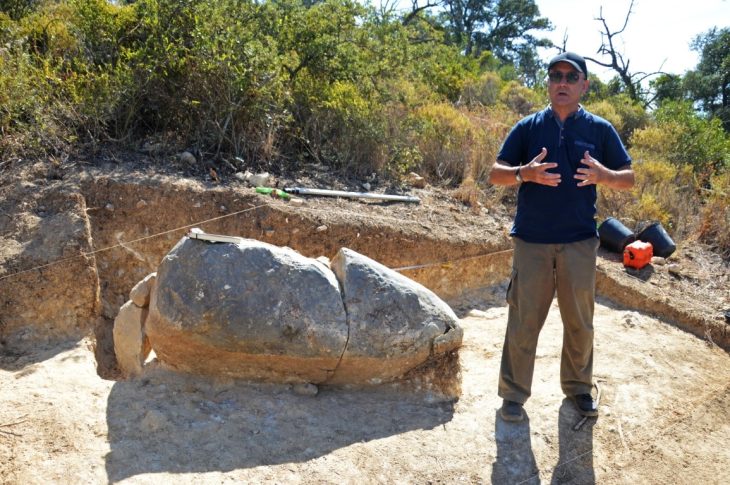
Çelikbaş explained that work on the project continues in the ancient city. Noting that significant finds were found, saying, “One of them was uncovered this week during the excavation of the structure we named ‘SDJ-3.’ We believe it is a significant artifact for Anatolian archaeology since no similar examples have been found in this region before. It is actually an amulet pendant.”
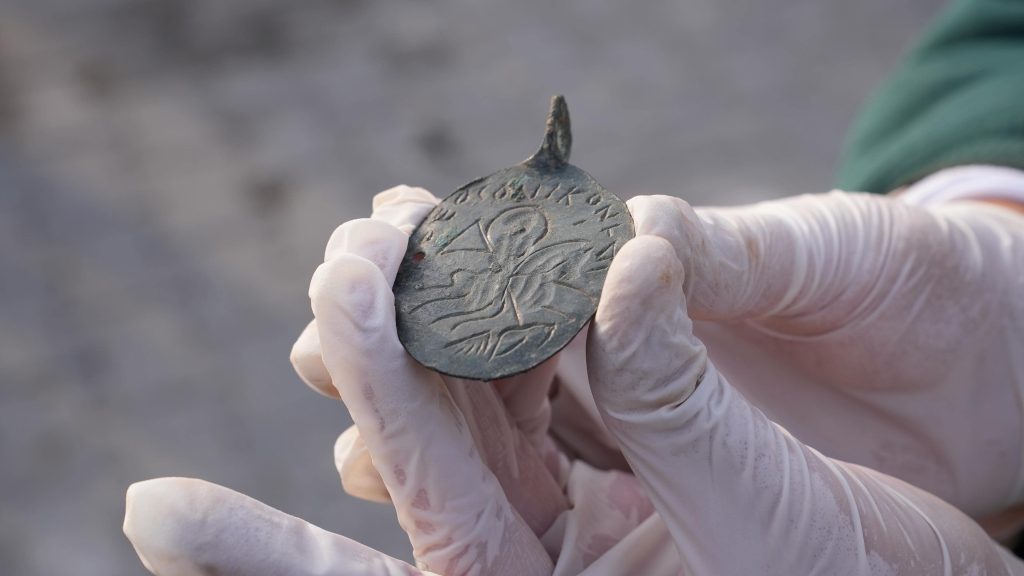
Image Credit: Karabük University

Karabuk University Faculty of Letters, Department of Archaeology Assoc. Prof. Dr. Ersin Çelikbaş stated that this artifact is a very important discovery for Anatolian archaeology, “The depiction shows the Prophet Solomon on horseback, spearing a demon. Why this depiction? Because the Prophet Solomon is important in all three major religions. He is noted as a ruler in Judaism and the Bible and in Islam, he is recognized not only as a ruler but also as a prophet. Therefore, the depiction of the Prophet Solomon, important in monotheistic religions, on this pendant both surprised us and showed us its importance for Anatolian archaeology.”


📣 Our WhatsApp channel is now LIVE! Stay up-to-date with the latest news and updates, just click here to follow us on WhatsApp and never miss a thing!!


Çelikbaş noted that the inscription on the pendant reads “Our Lord has overcome evil” and said: “Why was this pendant, this amulet, found here? In fact, it has to do with the military character of Hadrianopolis. We have previously identified evidence of a cavalry unit here through archaeological finds.”
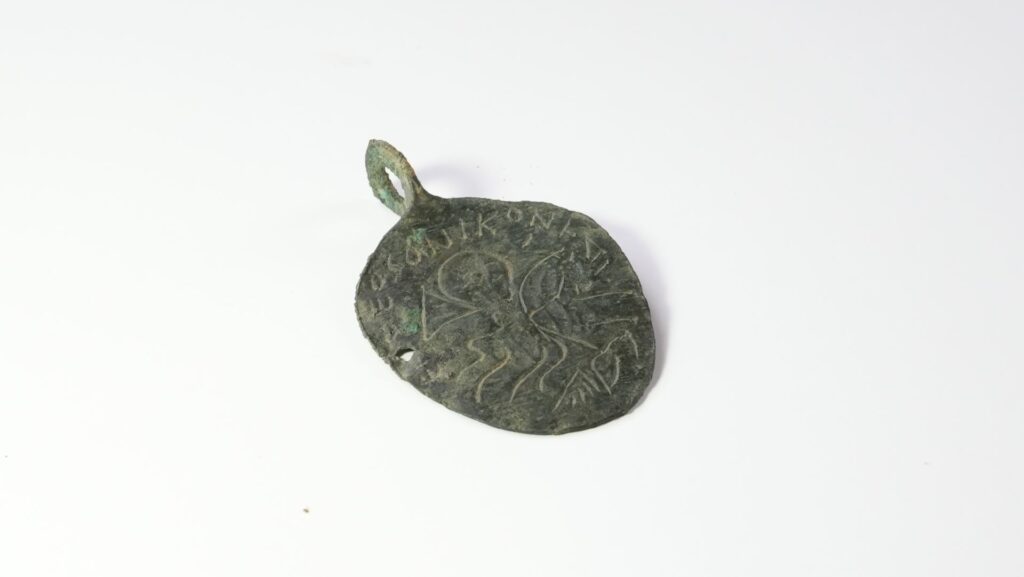
Image Credit: Karabük University

Çelikbaş noted that the inscription on the pendant reads “Our Lord has overcome evil” and said: “Why was this pendant, this amulet, found here? In fact, it has to do with the military character of Hadrianopolis. We have previously identified evidence of a cavalry unit here through archaeological finds. Solomon is also known as the commander of armies. We understand that he was also considered as a protective figure for the Roman and Byzantine cavalry at Hadrianopolis.”

Çelikbaş said: “The front depicts the Prophet Solomon and mentions God’s triumph over evil, while the back bears the names of our four holy angels: Azrael, Gabriel, Michael, and Israfil. This is also very significant. No similar artifact has been found in Anatolian archaeology to date. Only one comparable example in terms of depiction has been found in Jerusalem. The appearance of two similar artifacts over such great distances indicates that this area was an important religious center in antiquity. Based on the fonts of the inscriptions and stratigraphic data from our studies, we date the artifact to the fifth century A.D.”

According to the static graphic analyses, the amulet was dated to the 5th century AD. It was stated that this discovery once again reveals the historical and religious importance of Anatolia.

Karabük University

Cover Image Credit: Karabük University
Related Articles

It is Thought That an Ancient Port will be Reached in Istanbul Metro Excavations

11 April 2021

11 April 2021

New findings were found in the Kabataş excavations, which started a year ago under the presidency of the Istanbul Archeology...

Christians Supplied Medieval Pagans with Horses for Sacrifice for Funeral Rituals

20 May 2024

20 May 2024

In the late medieval period, pagans in the Baltic region of northern Europe imported horses from neighboring Christian nations for...

Three-room Urartian tomb with liquid offering area (libation) found in eastern Turkey

18 January 2023

18 January 2023

A three-room Urartian tomb with a rock-cut libation (liquid offering area) to offer gifts to the gods was unearthed in...

Archaeologists unearthed the earliest known evidence of body perforation in skeletons dating back 11,000 years at the Boncuklu Tarla in Türkiye

11 March 2024

11 March 2024

Archaeologists have unearthed the earliest known evidence of body perforation in skeletons dating back 11,000 years at the Boncuklu Tarla...

Drought accelerated Hittite Empire’s collapse

9 February 2023

9 February 2023

Researchers have offered new insight into the abrupt collapse of the  Hittite Empire in the Late Bronze Age, with an...

Prehistoric Star Map Carved in Stone Discovered in Bulgaria

14 July 2025

14 July 2025

A recently uncovered archaeological site in the Rhodope Mountains of southern Bulgaria is now entering the scientific spotlight. In a...

The two sarcophagi discovered beneath Notre Dame start to reveal their secrets

12 December 2022

12 December 2022

The owner of one of the two sarcophagi that were found in an excavation at the intersection of Notre Dame...

In northern Iran, a hand-dug passageway was discovered used for military purposes during the Qajar era

1 August 2021

1 August 2021

A hand-dug underground passage dating from the Qajar era (1794-1925), once believed to have served military purposes, has been discovered...

INAH archaeologists discovered a nose ornament made of human bone in Mexico

31 August 2023

31 August 2023

Archaeologists from the National Institute of Anthropology and History (INAH) have discovered a nose ornament made of human bone in...

A protected Punic-Roman tower “Tal-Wilġa” has been turned into a building site

15 August 2021

15 August 2021

The Tal-Wilga tower, one of Malta’s Punic-Roman heritage sites, is in danger from construction work near it. The Superintendent of...

Recent excavations at Girsu uncovered innovative civilization-saving technology of Ancient Sumerians

19 November 2023

19 November 2023

In ancient city Girsu, located near the modern city of Nasiriyah in southern Iraq, revealed through a recent excavation by...

During roadwork in Oregon, a woolly mammoth tusk was discovered

21 June 2021

21 June 2021

A 12,000-year-old woolly mammoth tusk was discovered beneath the street by crews rerouting a gas line in Corvallis, Oregon. “Whenever...

An ancient structure of unknown purpose discovered in northeastern Italy

25 March 2023

25 March 2023

A mysterious structure of unknown purpose has been unearthed in the Friuli Venezia Giulia region in northeastern Italy. The discovery...

Doune Pistols: The Spark That Ignited a Revolution Returns Home

5 May 2025

5 May 2025

A remarkable piece of Scottish history has returned to its roots as a collection of ten exquisite 18th-century pistols, crafted...

Archaeologists have unearthed part of Hadrian’s Aqueduct, one of the Largest Hydraulic Works of the 2nd century AD, and Extremely Rare Greek Coins

11 January 2024

11 January 2024

Archaeologists have unearthed part of Hadrian’s aqueduct, one of the largest hydraulic works of the 2nd century AD, and a...