
23 June 2026 The Future is the Product of the Past

1.5 tons of bronze coins found in east China

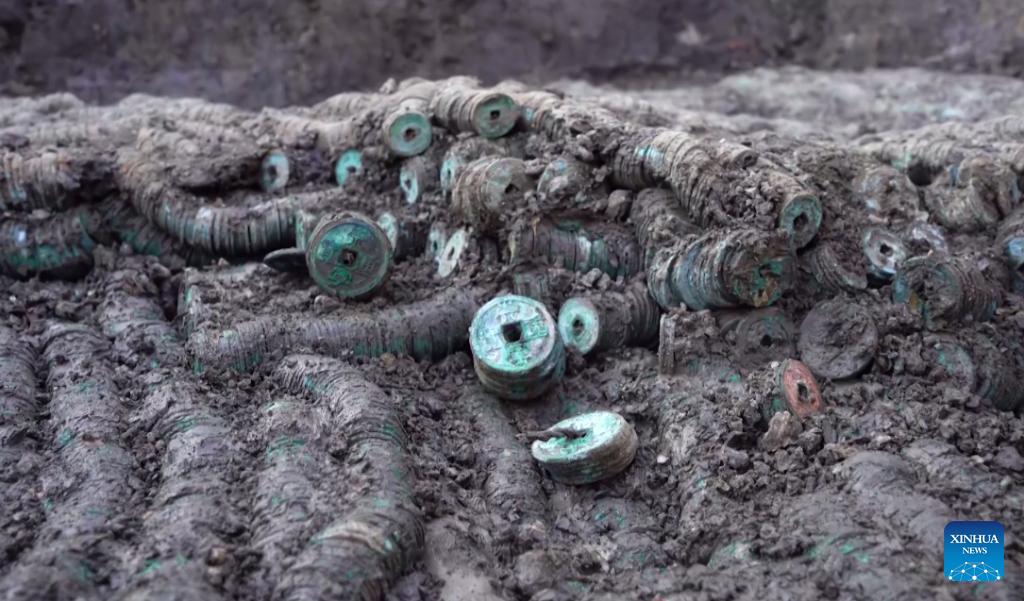
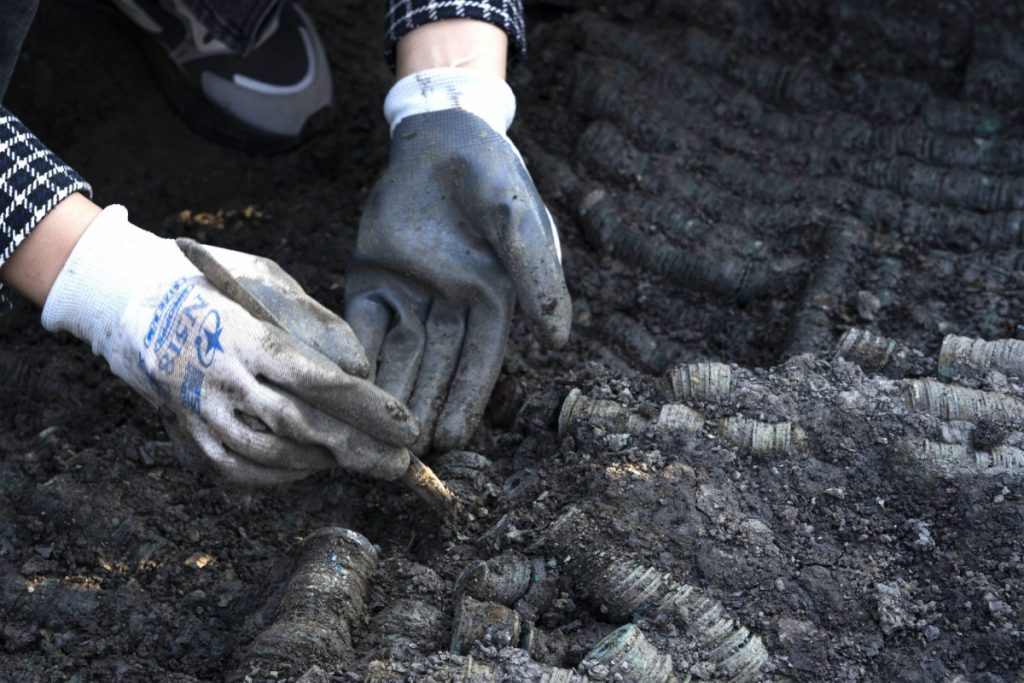
An ancient coin hoard containing 1.5 tonnes of coins from the Tang (618-907) and Song (960-1279) dynasties has been discovered in Jiangsu Province, east China. The coins were strong together with straw ropes and arranged in tidy stacks.

The underground remains were unearthed in Shuangdun Village, Jianhu County of Yancheng City. The pit mouth of the hoard was square, 1.63 meters long, 1.58 meters wide, and 0.5 meters deep. Bronze coins connected in series with straw ropes were neatly layered and paved inside. Most were from the Song Dynasty.

The coins that were discovered were well-preserved, and the majority of them had legible inscriptions, indicating a significant value for further study.
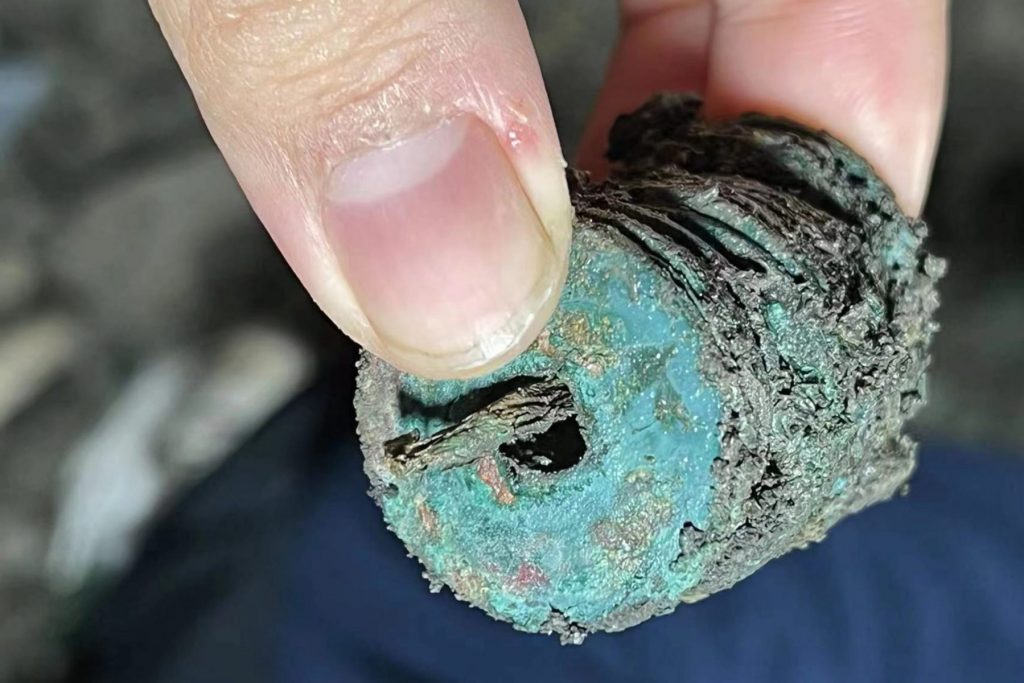
Photo: Xinhua

In ancient China, such hoards were often buried in the ground so as to preserve precious porcelain, coins, metal tools, and other valuables, said the researchers.

Seventy wells were also found around the coin hoard, which was near the battle frontline of the Song and Jin troops, making the researchers wonder whether the excavation site belonged to a hutted camp.


📣 Our WhatsApp channel is now LIVE! Stay up-to-date with the latest news and updates, just click here to follow us on WhatsApp and never miss a thing!!


Photo: Xinhua

The majority of the coins in the hoard are Song dynasty wens. Bronze wens were the common currency until a severe copper shortage forced the Southern Song dynasty (1127-1279) to issue lower-quality and lower-value coins. Iron was difficult to mint and rusted quickly once in circulation. Due to a lack of bronze coinage, the government was forced to cut military wages in half in 1161, resulting in the invention of paper money. In 1170, the state began to require that half of all taxes be paid with Huizi paper currency stepped into the breach.

Cover Photo: Xinhua

Related Articles

1800 Years Old Roman Milestone Used as Seat at Turkish Mosque

7 November 2024

7 November 2024

A milestone from the Roman Emperor Gordianus III period, which dates to 239 AD, was discovered in the Fatsa district...

A Small Sandstone Carved With A Viking Ship May Be Oldest Picture Ever Found In Iceland

16 June 2023

16 June 2023

Archaeologists in East Iceland have found a sandstone carved with a Viking ship that may be the oldest picture ever...

3,300-Year-Old Egyptian Papyrus Reignites Debate Over Biblical Giants

26 February 2026

26 February 2026

Stories of giants have always stood at the uneasy crossroads of faith, folklore, and archaeology. Now, a 3,300-year-old Egyptian text...

The free online course from the Colchester Museums and University of Reading Department of Archeology

12 July 2021

12 July 2021

The opportunity to be among the first to examine 2,000-year-old cremated remains from Roman Britain and learn about the origins...

Syria uncovered a large intact mosaic that dates back to the Roman era

12 October 2022

12 October 2022

Syria uncovered a large intact mosaic that dates back to the Roman era, in the central town of Rastan, describing...

Drought Unveils Lost Hellenistic-Era City and Cemetery Beneath Mosul Dam

30 August 2025

30 August 2025

Severe drought conditions in northern Iraq have uncovered a remarkable archaeological treasure. The discovery, revealed as water levels at the...

Millennia-Old İron Production Facilities Found in Iran

2 May 2021

2 May 2021

Archaeologists have uncovered many millennia-old iron manufacturing sites in a historical village in southcentral Iran. A local tourism official declared...

Archaeologists Find the “Lost” House of the Last Anglo-Saxon King Depicted on the Bayeux Tapestry

28 January 2025

28 January 2025

A team from Newcastle University and the University of Exeter have uncovered evidence that a house in England is the...

On a 5,300-year-old skull, archaeologists find evidence of the first known ear surgery

20 February 2022

20 February 2022

Humans may have begun performing ear surgery more than 5,000 years ago, say Spanish archaeologists. Spanish researchers say the skull...

Vindolanda marks the 1900th anniversary of Hadrian’s Wall with an altar discovery

9 February 2022

9 February 2022

The excavation season hasn’t started yet, but the Vindolanda Roman fort has kicked off Hadrian’s Wall’s 1900th anniversary year with...

They Worshipped the Olympian Gods Until the 9th Century — DNA Reveals the Hidden Descendants of Ancient Hellenes

5 February 2026

5 February 2026

A new Oxford-led DNA study reveals that the isolated Deep Mani Greeks preserved ancient Hellenic ancestry and continued pagan Olympian...

Medieval Cannonballs Found Beneath Future Administrative Centre in Belgium’s Nieuwpoort

28 April 2026

28 April 2026

A future civic building in Nieuwpoort has unexpectedly opened a window onto the Belgian city’s defensive past. Archaeologists working on...

Archaeological Finding Traces Chinese Tea Culture Back To 400 BC

7 February 2022

7 February 2022

An archaeological team from Shandong University, east China’s Shandong Province, has found the earliest known tea remains in the world...

This Roman City May Offer the Strongest Archaeological Support for the New Testament

10 January 2026

10 January 2026

Along the Mediterranean coast of modern Israel lies Caesarea Maritima—a Roman city that stands at the crossroads of imperial power...

Name of Iranian city identified on 1800-year-old Sassanid clay seal

9 April 2024

9 April 2024

In a stunning archaeological find, the name “Shiraz” was identified on a clay sealing from the Sassanid era written in...