
12 February 2026 The Future is the Product of the Past

1,600-Year-Old Tomb of First Maya King Discovered in Caracol, Belize

Archaeologists have unearthed the 1,600-Year-Old Tomb of First Maya King at Caracol, Belize, marking one of the most significant Maya discoveries in recent decades.

In a landmark archaeological breakthrough, researchers from the University of Houston have discovered the tomb of Te K’ab Chaak, the founding ruler of Caracol, a once-thriving Maya metropolis located in present-day Belize.

This find marks the first identifiable royal tomb at the site since excavations began over four decades ago, led by renowned archaeologists Drs. Arlen and Diane Chase.

Te K’ab Chaak, who ascended the throne in 331 AD, was interred around AD 350 in the Northeast Acropolis of Caracol. His burial included a rich assemblage of ceremonial objects, including jadeite jewelry, mosaic masks, carved bone tubes, and Pacific spondylus shells, highlighting his elite status.
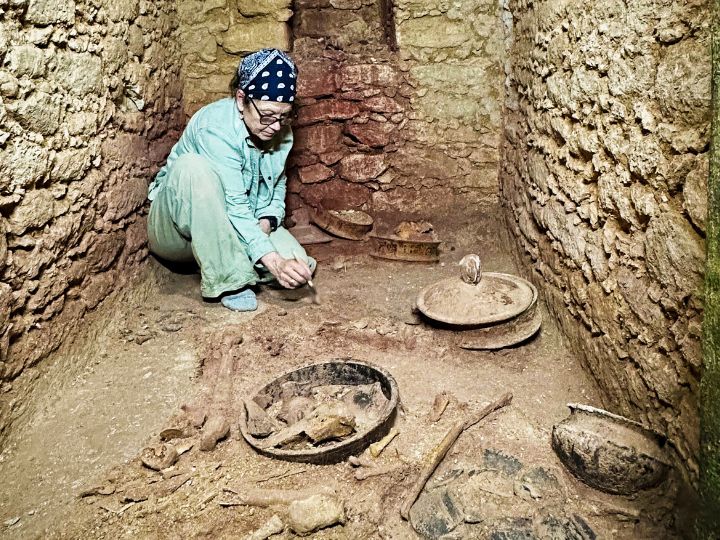
Archaeologist Diane Chase in the recently excavated tomb. Credit: University of Houston

Pottery vessels found in the tomb depicted scenes of ritual offerings, bound captives, and Maya deities like Ek Chuah, the god of trade. Some of the artifacts even bore motifs, such as the coatimundi, that were later adopted by future Caracol rulers in their royal names.


📣 Our WhatsApp channel is now LIVE! Stay up-to-date with the latest news and updates, just click here to follow us on WhatsApp and never miss a thing!!


Te K’ab Chaak’s remains suggest he died at an advanced age, standing approximately 5’7” (1.70 m) and notably, without any remaining teeth. His tomb was the first of three elite burials found in the same residential complex, all dating to around AD 350—a time that also reflects early interaction between the Maya and central Mexico’s Teotihuacan.

One of these burials, a cremation placed in the plaza center, included obsidian blades, atlatl points, and ceramic vessels traced to Teotihuacan—suggesting ritual practices foreign to traditional Maya customs. These items indicate that individuals in Caracol’s royal court may have adopted Teotihuacan funerary customs, or perhaps even lived and trained in that distant city before returning.
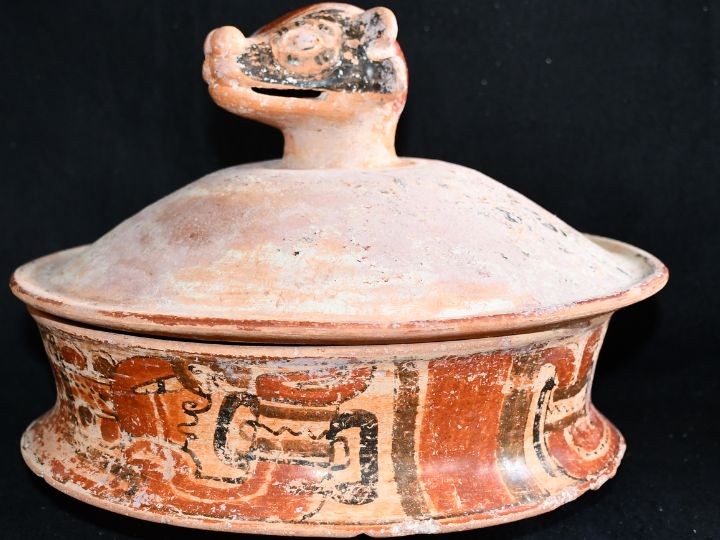
Maya pottery basal flange bowl with a coatimundi head. Credit: University of Houston

“This discovery suggests that Maya–Teotihuacan connections were well established before the major 378 AD event known as the entrada,” said Dr. Diane Chase, Provost at the University of Houston. “Our data suggest these ties were more complex than a single invasion or cultural transfer—they were part of sustained, elite-level interactions across Mesoamerica.”

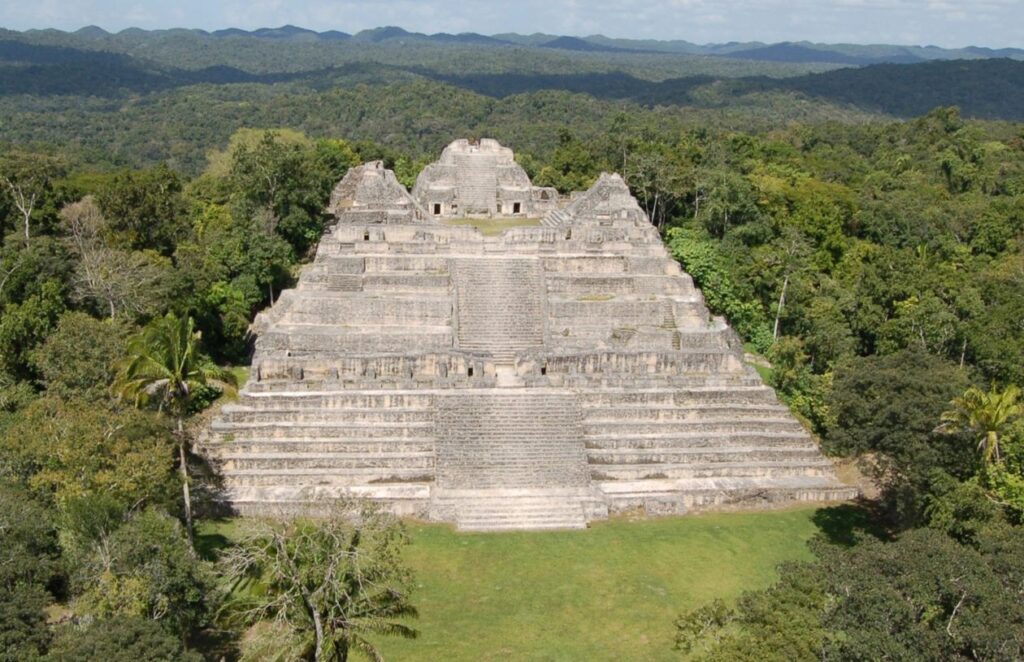
Located deep in the highland jungles of Belize’s Cayo District, Caracol was once home to over 100,000 people and spanned more than 68 square miles, making it one of the largest and most powerful cities in the Maya Lowlands. Its monumental structures, including the 140-foot-tall Caana pyramid, rival those of other iconic Maya centers like Tikal.

The University of Houston team, in partnership with Belize’s Institute of Archaeology and supported by organizations like the Alphawood Foundation and Ford Foundation, continues its research at Caracol. Work is underway to reconstruct the jadeite death mask and conduct ancient DNA and stable isotope analyses on Te K’ab Chaak’s remains.
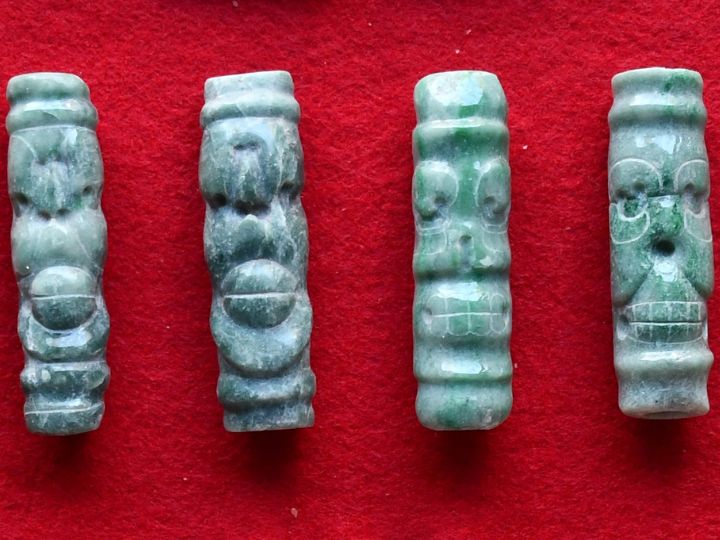
Four jadeite tubular beads showing live and dead spider monkeys. Credit: University of Houston

The findings will be formally presented at the Santa Fe Institute in August 2025 during a conference on Maya–Teotihuacan interaction.

This groundbreaking discovery not only sheds light on the foundations of Caracol’s royal dynasty, which lasted over 460 years, but also redefines our understanding of how ancient Mesoamerican civilizations interacted, traveled, and exchanged ideas across vast distances.

University of Houston

Cover Image Credit: Caana, the central architectural complex at Caracol, Belize, uncovered by Diane and Arlen Chase in the 1980s. University of Houston

Related Articles

2000-year-old ancient Roman Road, described as the most important in Scottish history, has been discovered

3 November 2023

3 November 2023

A 2000-year-old ancient Roman road was unearthed in Old Inn Cottage’s garden near Stirling, Scotland. The site is located a...

New Study shows Early Native Americans in Alaska were freshwater fishermen 13,000 years ago

15 June 2023

15 June 2023

A team led by the University of Alaska Fairbanks researchers has discovered the earliest known evidence that Native Americans living...

The Latest Surprises Revealed by Investigations Inside the Tomb of Cerberus in Giugliano

24 July 2024

24 July 2024

The latest surprise revealed by investigations at the Tomb of Cerberus in Giugliano: The remains of a corpse covered with...

A 1,700-Year-Old Roman Merchant Ship Lies Just Two Meters Below the Surface off Mallorca’s Playa de Palma

4 November 2025

4 November 2025

Just two meters beneath the turquoise waters of Playa de Palma, archaeologists have uncovered a remarkably preserved Roman merchant ship...

Unprecedented necropolis site found in Cappadocia, one of Türkiye’s most important tourism centers

8 July 2024

8 July 2024

In Cappadocia, located in the Central Anatolia Region of Türkiye, known for its unique moon-like landscape, underground cities, cave churches,...

Roman-era structures unearthed in northwestern Turkiye dam site rescue excavations

18 May 2024

18 May 2024

Rescue excavations at the Reşitköy Dam site in the northwestern Turkiye province of Balıkesir have unearthed Roman structures, including a...

Buried Secrets: How a Roman Sailor’s Gravestone Resurfaced in a New Orleans Yard

9 October 2025

9 October 2025

A routine yard cleanup in New Orleans turned into an international archaeological mystery when a homeowner uncovered a 2nd-century Roman...

Scientists may have discovered pieces of the Asteroid that caused the extinction of the Dinosaurs

14 May 2022

14 May 2022

Scientists are piecing together remnants of the day the extinction of the dinosaurs began. A tiny fragment of the asteroid...

Archaeologists discovered a sunken prehistoric fort in Clew Bay island

1 April 2024

1 April 2024

A sunken prehistoric fort has been discovered on Clew Bay island off the north Mayo coast, Ireland. It has been...

2,000-year-old altar found in Alexandria Troas

9 October 2021

9 October 2021

A 2,000-year-old altar was unearthed during the ongoing excavations in the ancient city of Alexandria Troas, in a region close...

Possible Remains of a Monumental Persian Garden Complex Identified Near Tabriz

6 February 2026

6 February 2026

A vast, long-lost landscape may once have shaped the southern edge of historic Tabriz. Using declassified military aerial photographs and...

Construction Workers Discovered Ancient Sarcophagus in Turkey

2 March 2021

2 March 2021

On Monday, reports said that during excavations in the Seyitgazi region of Eskisehir Province in northwestern Turkey, municipal staff unexpectedly...

A surprising discovery in Lublin countryside! Ancient figurines of Egyptian and Roman gods found

6 May 2023

6 May 2023

Two ancient figurines depicting the Egyptian god Osiris and a bust of the Roman god Bacchus were found in the...

This Roman City May Offer the Strongest Archaeological Support for the New Testament

10 January 2026

10 January 2026

Along the Mediterranean coast of modern Israel lies Caesarea Maritima—a Roman city that stands at the crossroads of imperial power...

Archaeologists Discovered Submerged Stoa Complex in Ancient Salamis, Greece

27 October 2023

27 October 2023

Archaeologists exploring the east coast of Salamis, the largest Greek island in the Saronic Gulf, discovered a large, long, and...