20 December 2025 The Future is the Product of the Past

World’s Smallest Stegosaurus Track Found

The smallest trace of stegosaurus in the world that lived 155 million years ago was found. Stegosaurus, a herbivorous dinosaur, draws attention with its large and slow size. The smallest stegosaurus fossil track in the world will provide new information about this dinosaur species.

The most complete stegosaurus skeleton ever found was displayed in the World Hall of the Natural History Museum in December 2014. The world’s smallest stegosaurus fossil found in China’s Xinjiang Uygur autonomous region will renew information about this dinosaur species.

A group of international paleontologists said in a newly published article that they found the smallest stegosaurus trace in the world in the Xinjiang Uygur Autonomous Region. The track measures 5.7 cm long.

This discovery will help scientists better understand the diversity of dinosaur fauna from 145 million to 66 million years ago in Xinjiang from the Cretaceous period, as well as the growth of stegosaurus and related ancient environmental information.

A track left by a juvenille stegosaurus discovered in Xinjiang Ugyur autonomous region. The track measures 5.7 centimeters. [Photo: China Daily]
A track left by a juvenile stegosaurus discovered in Xinjiang Uygur autonomous region. The track measures 5.7 centimeters. [Photo: China Daily]
The stegosaurus that made this track smaller was estimated to be about 1 meter long, the size of a typical juvenile. The track is only 15 percent the size of common footprints made by stegosaurus that lived in Xinjiang tens of millions of years ago.


📣 Our WhatsApp channel is now LIVE! Stay up-to-date with the latest news and updates, just click here to follow us on WhatsApp and never miss a thing!!


Scientists such as Xing Lida, associate professor at the China University of Geosciences, and Martin Lockley from the University of Colorado reported on the fossil trail in an essay published in the Palaios sedimentary geology journal.

A track left by an adult stegosaurus. [Photo provided to China Daily]
A track left by an adult stegosaurus. [Photo: China Daily]

Stegosaurus’s brain was as big as a sausage

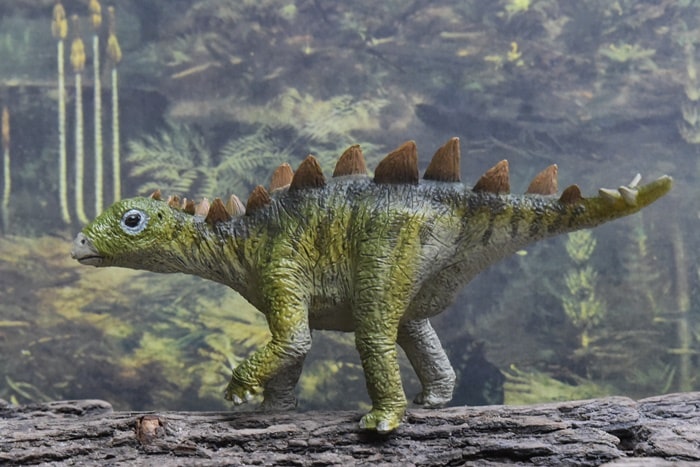
Stegosaurus was seen especially in western North America in the late Jurassic period about 150.8 to 155.7 million years ago. Stegosaurus is a large herbivorous dinosaur. Its size is about the size of a bus. It had two rows of bony plates on its back, making the stegosaurus even bigger.

Despite its huge size, Stegosaurus has a very small brain. So, Kenneth Carpenter, an armored dinosaur expert, director of the USU Eastern Prehistoric Museum in Utah, said about the stegosaurus’s brain, “it was long thought to be the size of a walnut, but it actually had the size and shape of a bent hot dog.”

Related Articles

Truncated conical tombs 3,000 years old found in the Chapultepec Forest

26 November 2023

26 November 2023

Archaeologists from the National Institute of Anthropology and History (INAH) unearthed 10 truncated conical tombs, approximately 3,000 years old, at...

Archaeologists find a 3,000-year-old bronze sword in Germany

15 June 2023

15 June 2023

Archaeologists discovered a bronze sword more than 3,000 years old during excavations in the town of Nördlingen in Bavaria, Germany....

Women May Have Ruled El Algar in the Bronze Age

12 March 2021

12 March 2021

The diadem found in the Bronze Age tomb belonging to the El Algar culture may have belonged to a queen....

Persian-era plaster walls were discovered during excavations at Zeyve Höyük in central Turkey

2 August 2022

2 August 2022

This year’s excavations at Porsuk-Zeyve Höyük (Zeyve Mound) near the Porsuk village of the Ulukışla district of Niğde, located in...

Scientists Ancient Landscape Not Seen For 14 Million Years Discovered Beneath Antarctic Ice

26 October 2023

26 October 2023

Researchers have uncovered an ancient landscape that remained hidden beneath the East Antarctic Ice Sheet (EAIS) for at least 14...

Ushabti figurines on display at Izmir Archeology Museum

18 September 2021

18 September 2021

The 2,700-year-old “Ushabti” statuettes, discovered in archaeological digs in western Turkey and used in Egyptian burial ceremonies, are being shown...

An unknown human group is revealed in a 7,200-year-old skeleton discovered in Indonesia

27 August 2021

27 August 2021

According to a study released this week, archaeologists uncovered the bones of a 7,200-year-old skeleton from a female hunter-gatherer in...

Małopolskie Region Reveals Oldest Evidence of Metal Mining in Poland, Dating Back 1,000 Years Earlier Than Previously Thought

16 February 2025

16 February 2025

Researchers have uncovered the oldest confirmed evidence of metal ore mining and metallurgy in Poland through the study of lead...

Assyrian Art at Getty Villa

22 June 2021

22 June 2021

The Getty Villa in Malibu, California’s arts complex is showcasing superbly-restored gypsum reliefs from the Assyrian Empire’s palaces for its...

Deadly Omens Revealed from 4,000-year-old Babylonian Tablets

10 August 2024

10 August 2024

Researchers successfully deciphered 4,000-year-old cuneiform tablets discovered over a century ago in what is now Iraq.  The tablets, housed at...

Lovingly gazing mosaics restored in Turkey’s Metropolis

16 October 2021

16 October 2021

In the ancient city of Metropolis in the Torbali district of the western Izmir province, mosaics portraying Eros, the Greek...

The first ivory work of art recovered from the World Heritage cave Hohle Fels was believed to be a horse – until archaeologists made a new discovery-

30 July 2023

30 July 2023

For more than 20 years, the first ivory work of art recovered from the World Heritage cave Hohle Fels was...

Luxurious Ancient Roman Home With Magnificent Mosaic Wall uncovered between the Roman Forum and the Palatine Hill

14 December 2023

14 December 2023

Archaeologists have uncovered a luxurious Roman home between Rome’s Palatine Hill and the Roman Forum, boasting an “unparalleled” mosaic featuring...

Evidence of Medieval Scotland in Inverness revealed by building work

19 June 2021

19 June 2021

Archaeologists in Scotland have discovered medieval remains during excavations for construction work, and they are exposing mysteries about the industrial...

A 4000-Year-Old Seal Found in the prehistoric coastal site of Kalba on the Gulf of Oman

5 April 2024

5 April 2024

Archaeologists discovered a Gulf-type seal made of soft stone dating to the end of the third millennium BC at Kalba,...