
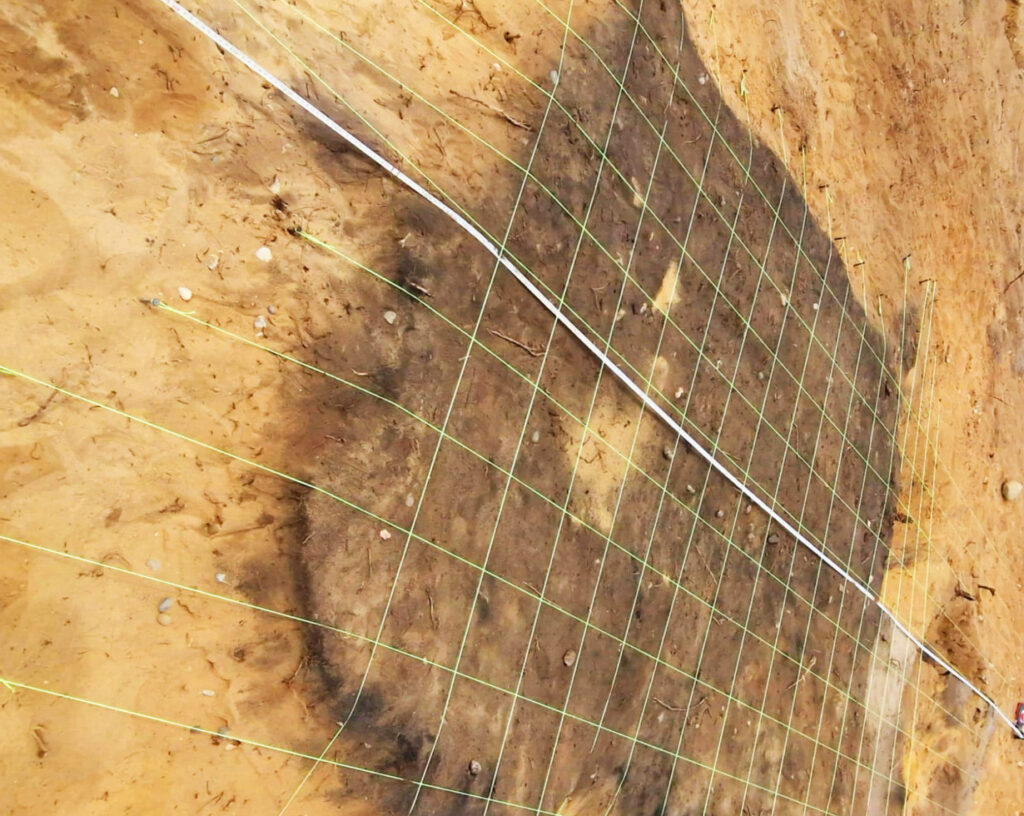
A rare funeral pyre at Sizewell C is giving archaeologists an unusual glimpse into how ancient communities on England’s Suffolk coast may have cremated and honoured their dead thousands of years ago.
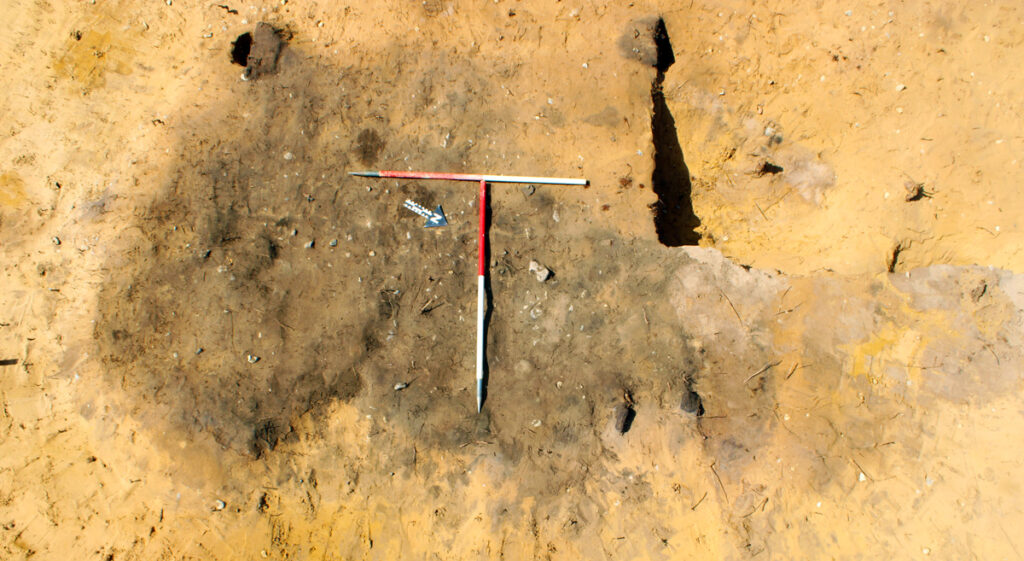
The discovery was made at Goose Hill, one of the archaeological sites being investigated as part of the Sizewell C works. At first glance, the feature appeared as a dark, roughly rectangular spread of charcoal-rich soil. But closer study revealed something far more significant: the remains of a pyre, probably built from stacked timbers and used in a cremation rite.
Funeral pyres are difficult to find in the archaeological record. Unlike graves cut into the ground, pyres were usually built on the surface. Once the fire burned out, the remains could be collected, moved, buried elsewhere, or scattered. Centuries of ploughing, erosion and later disturbance often erase almost every trace.
That makes the Goose Hill discovery especially important.
A cremation platform overlooking the coast
The pyre was found on a slope with a wide view south toward what is now the coastline. Archaeologists believe it may originally have been constructed as a timber lattice measuring about 3 metres by 2 metres, possibly rising as high as 1.5 metres. Kindling and heath scrub may have formed the core of the structure, while posts around the edges helped support the platform.
On this raised structure, the body of the deceased would have been placed before the pyre was lit.
The surviving evidence is fragmentary but revealing. The soil was blackened by charcoal, and small pieces of burnt bone were found within it. Nearby sandy patches had turned pink from intense heat. Up to six postholes were recorded around the feature, suggesting a built structure rather than a simple fire pit.
The bone fragments will now be analysed to confirm whether they are human. If preservation allows, they may also provide clues about the individual’s age, sex, health and possible disease.
Why so little bone was left behind
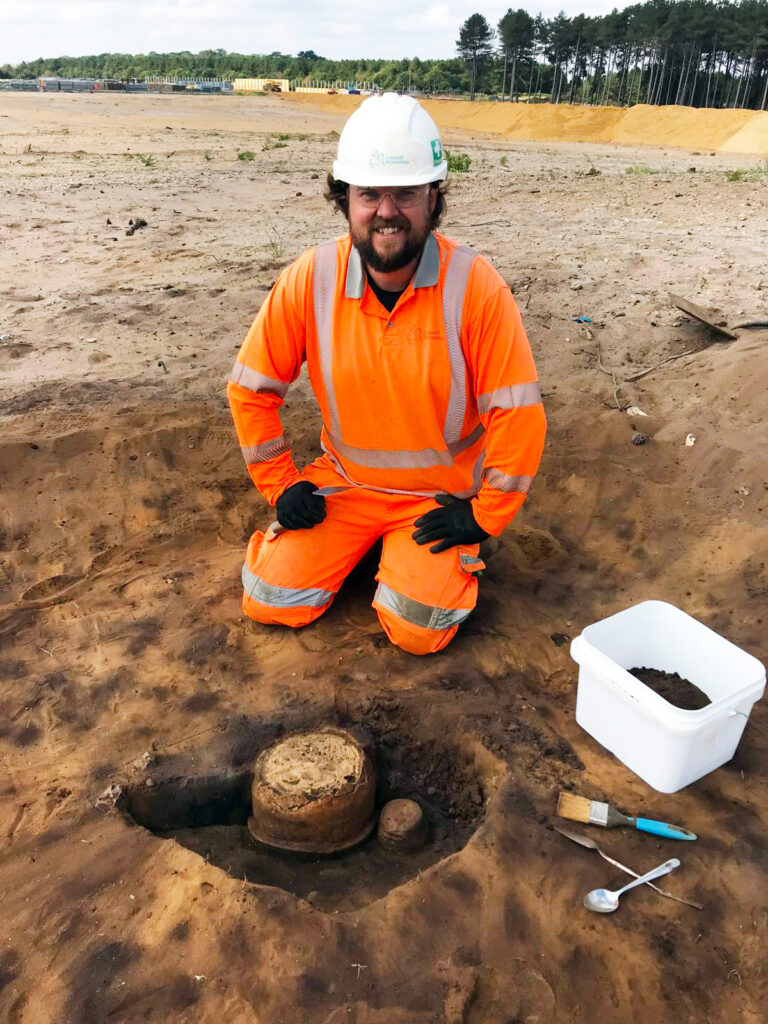
One of the most interesting details is what the pyre did not contain. Only a small amount of burnt bone survived at the site.
That absence may be meaningful. Archaeologists think much of the cremated material could have been collected after the ceremony and buried elsewhere, perhaps in a pottery urn. This would fit wider prehistoric funerary traditions in Britain, where cremated remains were often placed in urns or deposited in carefully selected locations.
At Goose Hill, however, burials are rare. The site has produced a Bronze Age cremation burial in a Collared Urn, dating to roughly 1950–1600 BC, and one other possible urned cremation. This makes the newly discovered pyre even more valuable because it may preserve part of a ritual sequence normally missing from the archaeological record.
A lost mound may have protected the pyre
The pyre was found off-centre inside a ring ditch, a circular or near-circular feature often linked with burial mounds or barrows. Archaeologists think the pyre may have survived because it was once protected beneath a mound that has since disappeared through ploughing.
The relationship between the pyre and the ring ditch remains uncertain. The pyre may have been part of the original monument, or it may have been inserted later into the edge of an existing barrow.
No central burial was found inside the ring ditch, although this does not mean one was never there. A later ditch cut through the centre of the mound area and may have destroyed earlier evidence.
The ring ditch itself must pre-date the Iron Age, since an Iron Age pit cut into its already filled ditch. A polished flint axe from the Early Neolithic period was also recovered from a later ditch, although archaeologists believe it was residual, meaning it had been in circulation or already old before it entered the deposit.
A prehistoric ritual, not an Anglo-Saxon one?
Cremation was practised in many periods, including prehistory, the Roman era and the Early Anglo-Saxon period. Suffolk also has important Anglo-Saxon funerary landscapes, including Snape, about 8 kilometres south-west of Goose Hill, where an Anglo-Saxon pyre has been found.
But the Goose Hill evidence currently points more strongly toward a prehistoric date. Archaeologists note that there is little activity at Goose Hill from the Anglo-Saxon period, making a Bronze Age or Iron Age date more likely.
Radiocarbon dating may eventually clarify the age of the pyre. Samples of bone and charcoal could help establish when the cremation took place, while analysis of charcoal and burnt plant remains may reveal what fuel was used and what the local environment looked like at the time.
Sizewell C is revealing a deep coastal history
The discovery adds another layer to the growing archaeological picture at Sizewell C. Excavations around the project have already revealed evidence of Early Bronze Age farming, Beaker-period activity, Roman salt production, medieval ovens, Second World War defences and an early medieval burial ground of national importance.
Goose Hill sits within a coastal landscape that has been repeatedly used, reshaped and remembered by human communities. For prehistoric people, a raised place overlooking the coast may have carried both practical and symbolic meaning. It was visible, open and connected to land, sea and sky.
The Sizewell C funeral pyre does not yet have a firm date, a named individual, or a complete burial. But its value lies precisely in its rarity. It preserves the moment of transformation itself: the fire, the timber structure, the heat-altered sand and the traces of a body prepared for a final rite.
In a landscape already rich with evidence of settlement, industry and burial, this fragile stain in the soil may offer one of the most intimate views yet of ancient ritual life on the Suffolk coast.
Cover Image Credit: The pyre, pre-excavation, strung up for grid excavation and sampling. Oxford Cotswold Archaeology
