
14 December 2025 The Future is the Product of the Past

2,000-year-old Roman pewter hoard discovered in Suffolk

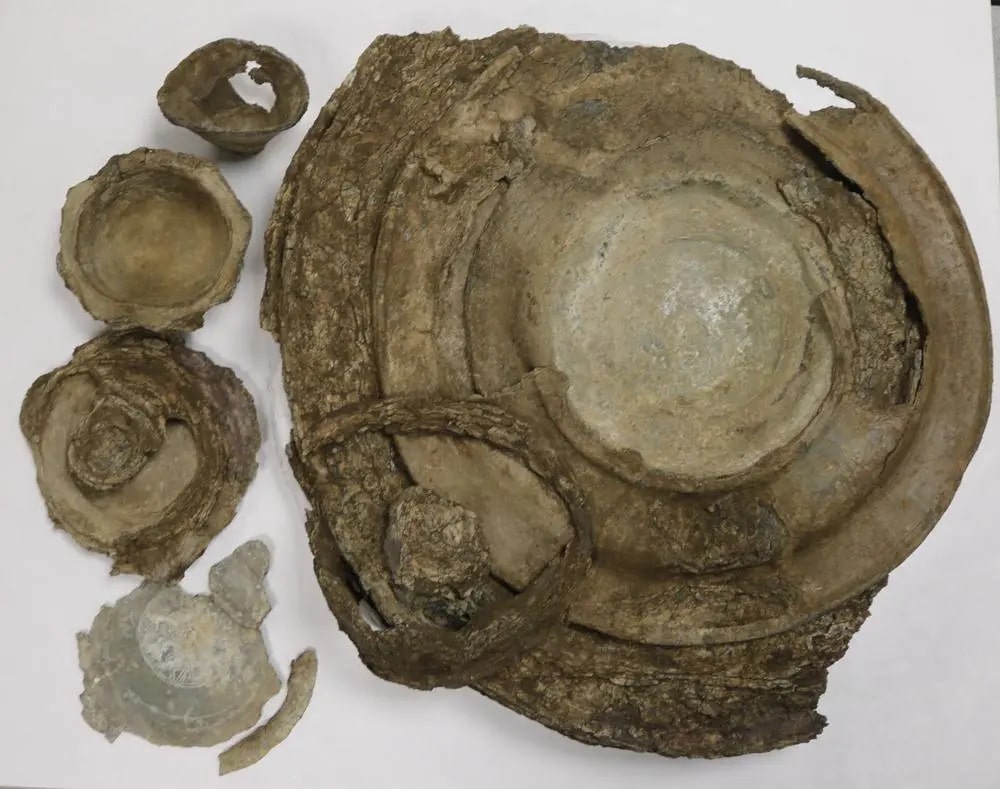
A rare hoard of Roman pewter has been discovered in Euston, western Suffolk, in eastern England. The rare discovery includes Roman pewter plates, platters, bowls, and a cup.

The vessels’ remains were carefully stacked in a pit, suggesting they were buried as a single group, possibly for safekeeping or as an offering.

The hoard was discovered in Autumn 2022 by local metal detector user, Martin White, whilst taking part in an East of England Rally – an organized detecting event. They are now on display at the West Stow Anglo-Saxon Village and Museum, near Bury St Edmunds, until January 2024.

Faye Minter, Suffolk County Council’s Archaeological Archives and Projects Manager, said: “This is a significant discovery. The larger plates and platters were used to allow food to be served communally and the octagonal bowls may have a Christian reference. Similar hoards are found across southern Britain, including from the nearby large Roman settlements at Icklingham and Hockwold.”

Suffolk County Council Archaeological Service facilitated the excavation of the hoard, which was carried out by Wardell Armstrong and Norfolk Museum Service conservators.


📣 Our WhatsApp channel is now LIVE! Stay up-to-date with the latest news and updates, just click here to follow us on WhatsApp and never miss a thing!!


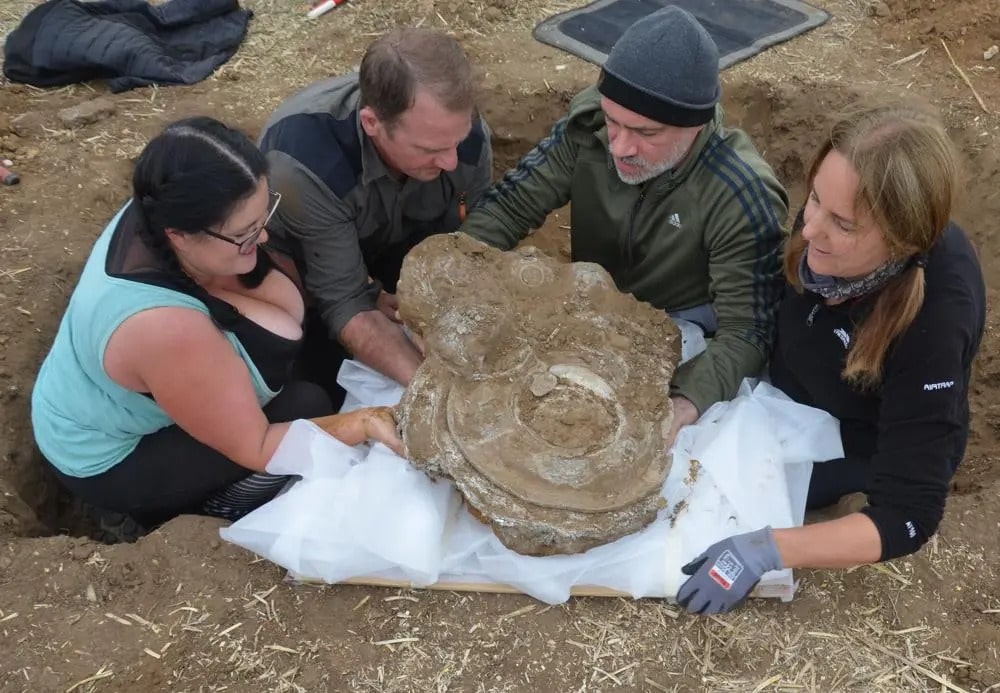
The Euston hoard is being lifted. Photo: SCC
The Euston hoard is being lifted. Photo: Suffolk County Council

There is evidence of heavy plow damage to the vessels, and advanced corrosion has fused several of them together. The main stack contained five plates and platters nested on top of each other.

All work was funded by the Euston Estate and East of England Rallies.

 However, pewter is not a precious metal, this treasure of inestimable archaeological value does not qualify as official treasure and therefore belongs to the property owner.

The hoard was discovered on the Euston Estate, making the Duke of Grafton the owner. He donated it to the West Stow Anglo-Saxon Village and Museum, which is located near Bury St Edmunds.

The Duke of Grafton from The Euston Estate, said: “We were happy to donate this hoard and make it available for the public to see. Everyone can then share in the joy of this historic Suffolk find.”

Suffolk County Council

Cover Photo: Suffolk County Council

Related Articles

Archaeologists have uncovered oldest Roman forum in Hispania, at the site of a named unknown city

3 September 2023

3 September 2023

Archaeologists have uncovered an ancient Roman forum from more than 2,000 years ago at the site of an unknown city...

The Discovery of a Unique Pre-Viking Helmet Fragment in Lejre, Denmark

23 January 2025

23 January 2025

In Lejre, the northwestern part of the island of Zealand in eastern Denmark, detectorists have uncovered an exceptionally rare fragment...

The Splendor of the Seven Descending Gods of Tulum Resurfaced

11 February 2024

11 February 2024

The National Institute of Anthropology and History (INAH) says the splendor of the seven Descending Gods of Tulum has resurfaced....

Underneath an Illegal Excavation House, a Subterranean City Is Revealed!

25 June 2021

25 June 2021

Upon the information that illegal excavations were carried out in a house in the İscehisar district of Afyonkarahisar in western...

Roman soldier’s 1,900-year-old payslip uncovered in Masada

16 February 2023

16 February 2023

During excavations at Masada, archaeologists from the Israel Antiquities (IAA) uncovered a papyrus payslip dated to 72 BC belonging to...

God Pan statue unearthed at Istanbul’s historical church of St. Polyeuctus

1 June 2023

1 June 2023

A Pan statue thought to belong to the Roman period was recovered during excavation works carried out by Istanbul Metropolitan...

Rock Ship of Masuda, Japan’s mysterious monolith

17 April 2023

17 April 2023

Located in the Takaichi District of Nara Prefecture, Japan, the village of Asuka is famous for its mysterious stones. The...

Around 400-year-old Bronze idols found during house construction in India

25 April 2024

25 April 2024

Three bronze idols, estimated to be about 400 years old, were unearthed during excavation for a house construction project in...

Archaeologists Find Severed Skull of Cantabrian Warrior in Palencia, Exhibited by Roman Troops as a War Trophy

22 November 2025

22 November 2025

When archaeologists began excavating the fortified Iron Age hilltop of La Loma in northern Spain, they expected to uncover weapons,...

2,700-year-old Children’s Cemetery unearthed in Turkey’s Tenedos

2 March 2024

2 March 2024

A 2700-year-old children’s cemetery was discovered during ongoing excavations in the ancient city of Tenedos in Bozcaada,  southeast of the...

Earliest Multiplication Formulas Discovered in a 2,300-Year-Old Chinese Tomb

27 December 2023

27 December 2023

Archaeologists excavating a tomb in the Qinjiazui archaeological site of Jingzhou City, Hubei Province, China, have found the earliest multiplication...

In Lowbury Hill Mystery of Anglo-Saxons buried 1,400 years ago may soon be solved

8 March 2023

8 March 2023

The mystery surrounding the remains of two Anglo-Saxons buried 1,400 years ago in south Oxfordshire, identified as a man and...

Birkleyn Caves is “the Place Where The World Ends”

18 January 2025

18 January 2025

The Birkleyn Caves were known as “the place where the world ends” and as “the place where the water of...

Archaeologists discovered a 2,000-year-old rock-carved face at Spain’s Tossal de La Cala castle

20 May 2023

20 May 2023

Archaeologists have discovered a rock-carved face at Toscal De La Cala, a Roman fort in Benidorm, on the east coast...

Lost sketches by Leonardo Da Vinci show that he understood gravity long before Newton

19 February 2023

19 February 2023

Leonardo da Vinci’s centuries-old sketches show that he may have understood key aspects of gravity long before Galileo, Newton, and...