
8 November 2025 The Future is the Product of the Past

Rare 1,400-Year-Old Stone Sculpture of a Woman Unearthed in Kyrgyzstan’s Chui Valley

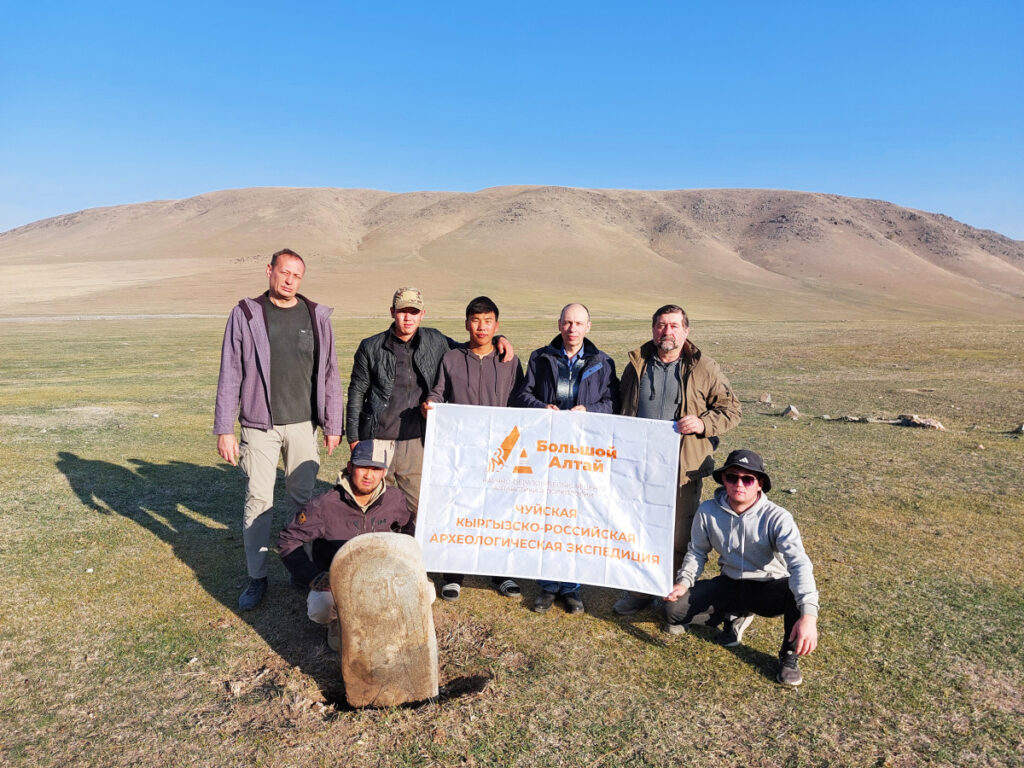
Archaeologists from the Greater Altai Research and Educational Center for Altaic and Turkic Studies at Altai State University, in collaboration with Jusup Balasagyn Kyrgyz National University, have unearthed a previously unknown stone sculpture depicting a woman’s face carved into a boulder in the Chui region of northern Kyrgyzstan.

The find, believed to date back to the early Turkic period (6th–8th centuries AD), sheds new light on the symbolic art and funerary traditions of ancient nomadic societies in Central Asia.

Discovery at the Borombay Archaeological Complex

The sculpture was discovered during the joint Kyrgyz–Russian archaeological expedition conducted at the Borombay archaeological complex near the village of Kyzyl-Oktyabr in Kemin District. The site, situated in the foothills of the Chui Valley, contains dozens of burial mounds and ritual structures spanning several eras.

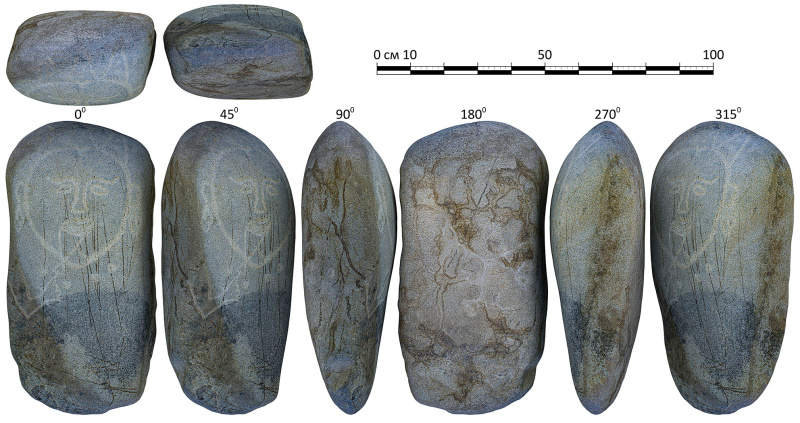
According to Professor Alexey Tishkin, who led the expedition, the team found the stone figure close to the Borombay-I burial group. The image, carved into a large boulder not native to the site, portrays a woman wearing a distinctive three-horned headdress — a feature characteristic of early Turkic iconography. The figure’s right hand holds a cup, a traditional symbol often associated with ritual offerings or ancestral veneration.

“The boulder’s composition differs from local stones, indicating that it was deliberately transported to the site for the creation of this image,” Tishkin explained. “It is a rare example of early Turkic anthropomorphic sculpture representing a female figure rather than a male warrior or ruler.”


📣 Our WhatsApp channel is now LIVE! Stay up-to-date with the latest news and updates, just click here to follow us on WhatsApp and never miss a thing!!


The image, carved into a large boulder not native to the site, portrays a woman wearing a distinctive three-horned headdress — a feature characteristic of early Turkic iconography. Credit: Greater Altai Research and Educational Center for Altaic and Turkic Studies

Digital Documentation and Early Turkic Context

The research team conducted detailed photogrammetry of the find and created a digital 3D model for future publication. The object’s surface shows signs of careful pecking and polishing, typical of stone-working methods of the early Turkic period. The discovery adds to a small but growing corpus of female anthropomorphic sculptures known from Inner Asia, expanding current understanding of the symbolic and social roles of women in early Turkic belief systems.

Archaeologists note that the three-horned headdress — sometimes interpreted as representing the heavens or divine protection — has parallels in other early Turkic and steppe art traditions. Similar motifs appear on petroglyphs and bronze artifacts from Mongolia and southern Siberia, suggesting shared cultural expressions across the greater Eurasian steppe.

Excavations at Borombay-I and Borombay-II

In addition to the sculpture, the expedition investigated two major burial sites: Borombay-I mound No. 39 and Borombay-II mound No. 8.

Mound No. 39 revealed a large catacomb burial with multiple stone layers. Though the tomb had been looted in antiquity, researchers recovered bone fragments and ceramic vessels that will undergo radiocarbon dating to determine the absolute chronology.

“This type of catacomb construction has not been observed on the Russian Altai,” said Tishkin. “It likely dates to a pre-Turkic phase, possibly connected with the Kenkol culture or even earlier traditions.”

At Borombay-II, mound No. 8 consisted of an oval ring of large stones without human remains. Archaeologists interpret it as a cenotaph—a symbolic grave marking the memory of an individual who died far from home. A fragment of pottery and a well-shaped stone pestle were recovered from the area, confirming its ritual character.

Overall, 41 archaeological features were documented across the Borombay-I site, including stone enclosures and ritual structures. Unfortunately, many of the mounds had been damaged by road construction and long-term agricultural use.
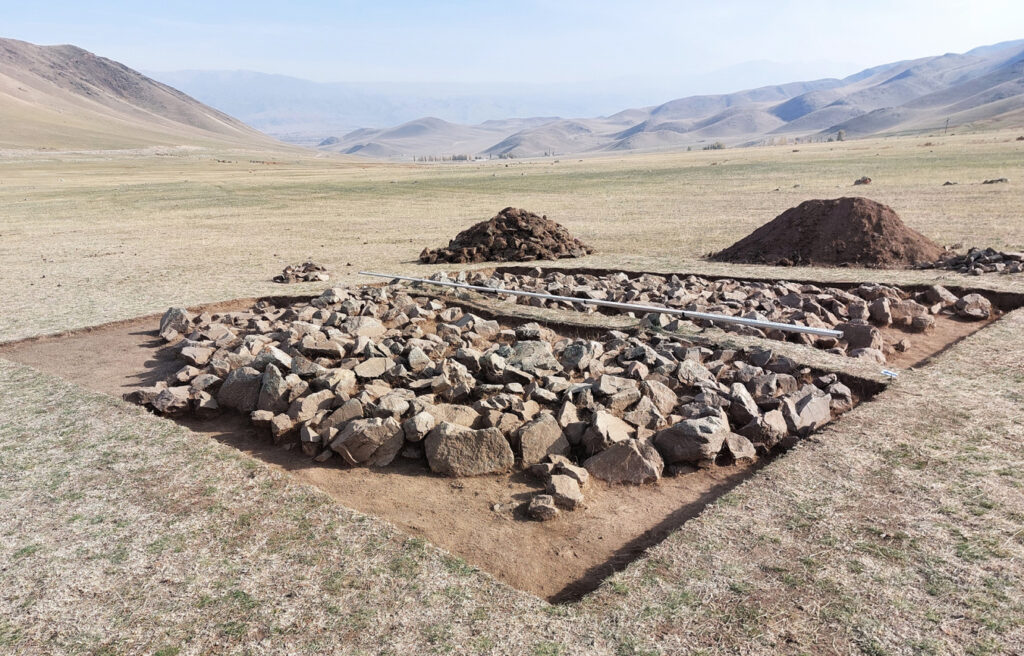
In addition to the sculpture, the expedition investigated two major burial sites: Borombay-I mound No. 39 and Borombay-II mound No. 8. Credit: Greater Altai Research and Educational Center for Altaic and Turkic Studies

Future Research and Preservation Efforts

Following the completion of excavations, all trenches were refilled and covered with turf to restore the natural landscape. The team emphasized that further research in the Chui Valley will require longer field seasons, additional funding, and wider use of digital recording technologies.

The collaboration between Altai State University and Kyrgyz National University marks the first systematic fieldwork by Altai archaeologists in Kyrgyzstan. Future expeditions aim to explore the cultural and chronological links between the ancient populations of the Altai and those of Central Asia.

“The discovery of the Borombay sculpture opens a new page in the study of early Turkic monumental art,” said Tishkin. “It provides direct archaeological evidence of the artistic and ritual worldviews shared among the nomadic peoples of the Greater Altai and Kyrgyz steppe.”

Greater Altai Research and Educational Center for Altaic and Turkic Studies

Cover Image Credit: Greater Altai Research and Educational Center for Altaic and Turkic Studies

Related Articles

Oman discovers fort dating back to the 5th century in North Al Batinah

12 March 2022

12 March 2022

A fort dating back to the 5th century has been discovered at Oman’s Al Fulaij archaeological site in North Al...

Roman Empire’s Emerald Mines May Have mined by Nomads as Early as the 4th Century

4 March 2022

4 March 2022

New research by archaeologists from the  Universitat Autònoma de Barcelona and the University of Warsaw suggests that Roman Empire emerald...

A Unique 2000-Year-Old Oil Lamp Found in Israel

5 May 2021

5 May 2021

Archaeologists have discovered a rare 2,000-year-old oil lamp in David, Jerusalem. Archaeologists have discovered a rare oil lamp, shaped like...

An Iron Age Necropolis was discovered in the Normandy, northwestern France

11 May 2022

11 May 2022

A modest Iron Age agricultural settlement excavated at Blainville-sur-Orne in Normandy, northwest France, led to the unexpected discovery of a...

Archaeologists revealed Urartian King Menua second temple in Van excavations

22 December 2022

22 December 2022

The second temple of King Menua as well as a chamber tomb were unearthed during the excavations carried out this...

The Mysterious Origins of the Cerne Abbas Giant Finally Revealed

3 January 2024

3 January 2024

There’s a huge chalk image of a man with a powerful erection and no clothes on his butt located in...

A 4000-Year-Old Seal Found in the prehistoric coastal site of Kalba on the Gulf of Oman

5 April 2024

5 April 2024

Archaeologists discovered a Gulf-type seal made of soft stone dating to the end of the third millennium BC at Kalba,...

The Discovery of nobleman Khuwy could rewrite Egypt history

25 October 2021

25 October 2021

The mummified corpse of an ancient Egyptian nobleman named Khuwy, discovered in 2019, showed the ancient Egyptians were carrying out...

Archaeologists Discovered the Largest Inscription Ever Found in Sri Lanka

10 February 2024

10 February 2024

Archaeologists discovered the largest inscription ever found in Sri Lanka. The largest inscription ever discovered in Sri Lanka was found...

La Tène-Era Woman’s Grave Filled with Opulent Bronze Jewelry Unearthed in the Czech Republic

3 September 2025

3 September 2025

Rescue excavations along the planned D7 highway, between the towns of Knovíz and Slaný, approximately 40 kilometers northwest of Prague,...

Iconic Double Arch collapsed after an ancient pyramid in America, Tribes Link Fall With ‘Bad Omen’

10 August 2024

10 August 2024

Two ancient North American structures collapsed within just nine days of one another. The iconic Double Arch, also known as...

Rare Arabic inscription discovered during Malta housing project works

3 May 2023

3 May 2023

A rare Arabic inscription, possibly dating back to medieval times, was discovered at the site of a social housing project...

Medieval Secrets Revealed: Archaeologists Discover Reading Stone Beneath World-Famous University

30 October 2025

30 October 2025

Archaeologists at Oxford uncover a perfectly preserved medieval reading stone alongside ancient halls, manuscripts, and artifacts that shed new light...

Kashmir’s Forgotten Temple? Shivlings and Ancient Idols Found Beneath Sacred Spring

4 August 2025

4 August 2025

A routine restoration of the Karkoot Nag spring in the Salia area of Aishmuqam, Anantnag district, Jammu & Kashmir, has...

Theater of Perinthos Ancient City to be unearthed

9 August 2021

9 August 2021

The theater area in the Ancient City of Perinthos, whose history dates back to 600 BC, will be unearthed during...

Comments
Leave a Reply

Your email address will not be published. Required fields are marked *