
12 June 2026 The Future is the Product of the Past

Oregon may be home to oldest human occupied site in North America

Where and when the first humans appeared in North America is a contentious issue that many disagree on, and this latest find will certainly fan the flames.

In 2021, the Meadowcroft Rockshelter in Pennsylvania was identified as the oldest human occupational site in North America, dating to at least 16,000 years old. In 2022, it was Cooper’s Ferry in Idaho, which was also dated to 16,000 years old. Now, Rimrock Draw Rockshelter, which is displaying occupation evidence dating back at least 18,000 years, may unseat that title!

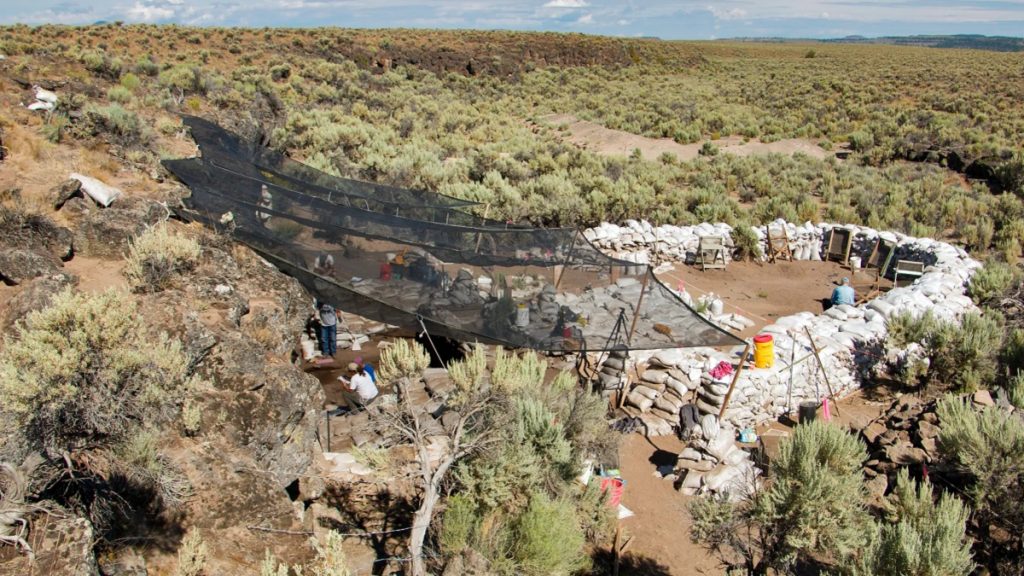
The Rimrock Draw Rockshelter outside of Riley in Central Oregon has been home to excavation efforts since 2011.

University of Oregon’s Museum of Natural and Cultural History Archaeological Field School, led by archaeologist Patrick O’Grady, has been excavating at the Rimrock Draw Rockshelter.

Archaeologists in Oregon discovered an animal tooth at a rock shelter that was over 18,000 years old. If their interpretation of the artifact and other relics at the site is on point, this could indicate the shallow cave is one of the oldest sites of human occupation in North America.


📣 Our WhatsApp channel is now LIVE! Stay up-to-date with the latest news and updates, just click here to follow us on WhatsApp and never miss a thing!!


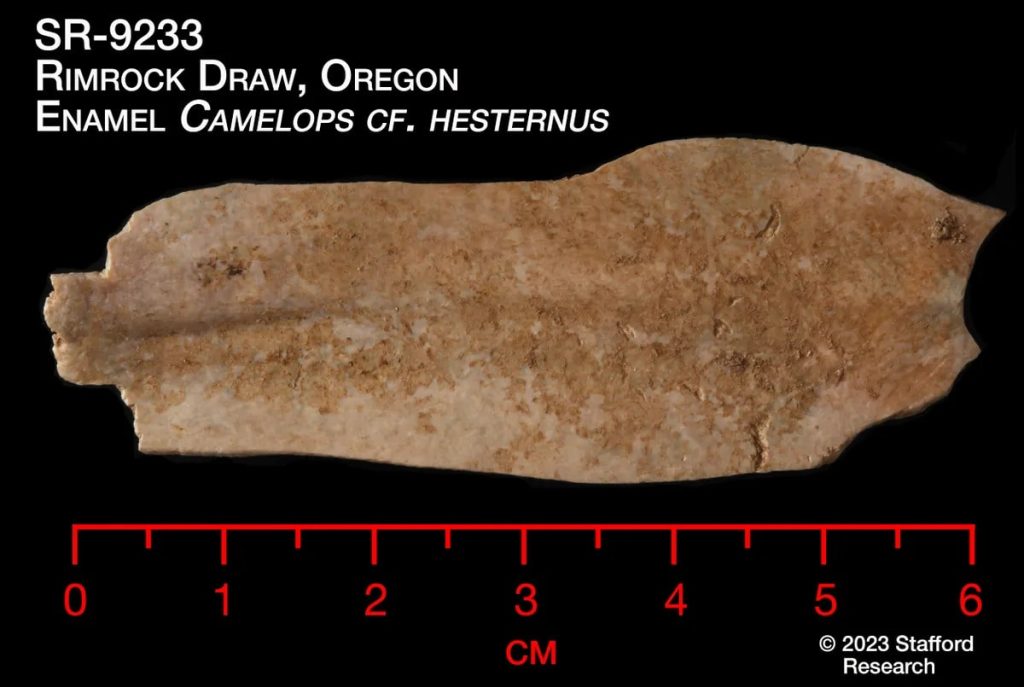
Part of the camel tooth recently dated to over 18,000 years old. Photo: Stafford Research

In 2012, the team identified camel teeth fragments under a layer of volcanic ash from an eruption of Mount St Helens that was dated over 15,000 years ago. They also found two finely crafted scrapers made from orange agate, one covered in preserved bison blood residue and another buried in volcanic ash.

Now, radiocarbon dating of the camel tooth enamel has revealed a more precise date: 18,250 years before the present.

“The identification of 15,000-years-old volcanic ash was a shock, then [the] 18,000-year old dates on the enamel, with stone tools and flakes below, were even more startling,” archaeologist Patrick O’Grady, who led the excavation, said in a statement.

Since the tools were discovered further down in the ash, the layering of the sediments indicates that they predate both the volcanic eruption and the camel teeth. This means Rimrock Draw Rockshelter could be one of the oldest human occupation sites in North America.
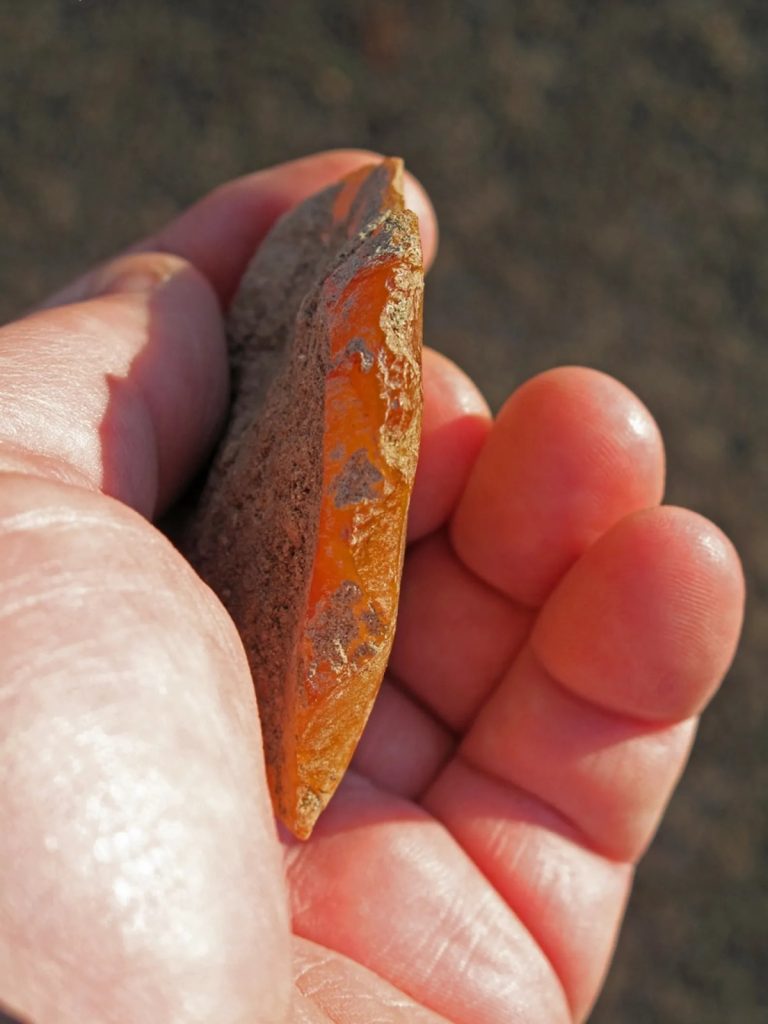
A team uncovered two finely crafted orange agate scrapers, one in 2012 with preserved bison blood residue and another in 2015 buried deeper in the ash, at Rimrock Draw Rockshelter. Photo: Bureau of Land Management Oregon and Washington
A team unA team uncovered two finely crafted orange agate scrapers, one in 2012 with preserved bison blood residue and another in 2015 buried deeper in the ash, at Rimrock Draw Rockshelter. Photo: Bureau of Land Management Oregon and Washington

The however important question is whether the animal tooth fragment from 18,000 years ago can categorically prove human occupation at the site. The presence of crafted stone tools suggests so, but the interpretation might not necessarily convince everyone.

“To me, it’s just a wonderful hunt,” Stafford said. “Now we’re down to real excavations that are very controlled and good chemistry and good radiocarbon data. We’re accumulating enough sites with good information that we can really say, ah, okay, it’s a little bit older. It’s a lot older.”

Radiocarbon is produced in the upper atmosphere. Anything that contains carbon, whether organic or inorganic, can be measured. From about 1950 to 1990, that process required grams of material. Now, scientists are able to use milligrams, which is about 1,000th less than what was needed before.

Which is where the enamel comes in. Two samples from about 2 inches of the enamel pieces returned the same age estimation.

Cover Photo: Bureau of Land Management Oregon and Washington

Bureau of Land Management Oregon

Related Articles

Archaeologists uncovered an Aztec altar with human ashes in Mexico City

1 December 2021

1 December 2021

Archaeologists in Mexico have discovered a 16th-century altar in Plaza Garibaldi, the center in Mexico City famous for its revelry...

China’s construction of the first archaeological museum which will house the famous Terracotta Warriors has been completed

19 April 2022

19 April 2022

Construction of the first archaeological museum in China’s northwestern province of Shaanxi, which will house the famous Terracotta Warriors, was...

The museum’s “Oscar” Awards had Received this Year by the Troy Museum and the Odunpazarı Modern Museum

11 May 2021

11 May 2021

At the European Museum of the Year Awards (EMYA) online ceremony on May 6, Turkey’s renowned Troy Museum and Odunpazar...

Needle-Carved Image of a Sasanian King Unearthed in Southern Iran’s Ancient City of Istakhr

13 November 2025

13 November 2025

Archaeologists have uncovered a rare needle-carved rock image believed to depict a Sasanian king, etched into the cliffs of the...

Archaeologists Uncover 1,300-Year-Old Maize God Effigy in Tlaxcala, Mexico

18 April 2026

18 April 2026

A remarkable archaeological discovery in central Mexico is offering fresh insight into ancient belief systems and cultural connections across Mesoamerica....

Maya Salt-Making Compound Found Preserved Underwater in Belize Reveals Secrets of “Invisible Sites”

19 October 2025

19 October 2025

The discovery of a Maya salt-making compound preserved beneath the mangrove peat of southern Belize is transforming our understanding of...

The researchers may have cracked the mystery of da Vinci’s DNA

7 July 2021

7 July 2021

A recent study of Leonardo da Vinci’s family tree indicates that the renowned Renaissance artist, inventor, and anatomist had 14...

Gold Roman Fidelity Ring: A 2,000-Year-Old Symbol of Love Discovered in Bulgaria

10 January 2026

10 January 2026

Archaeological excavations in Ancient Bononia, located in modern-day Vidin, Bulgaria, have revealed a remarkable discovery that sheds new light on...

Oldest Direct Evidence for Honey Collecting in Africa

18 April 2021

18 April 2021

Honey is an important food source that has been considered a very important healing source in the history of civilizations....

A rare Byzantine gold coin discovered in Norway, probably brought from Constantinople

9 December 2023

9 December 2023

A metal detectorist exploring the mountains in the municipality of Vestre Slidre in southern Norway discovered a rare histamenon nomisma...

Excavations in and around Yazıkaya, one of the monumental works of the Phrygians, start again after 71 years.

23 July 2022

23 July 2022

Archaeological excavations at Midas Castle in Yazılıkaya Midas Valley in the Han district of Eskişehir, located in northwest Turkey, will...

Well-Preserved A Dog, a Bone Dagger: Inside a 5,000-Year-Old Burial Beneath a Swedish Lake

16 December 2025

16 December 2025

By the edge of a vanished lake in southern Sweden, archaeologists have uncovered a burial so rare it reshapes what...

Assyrian Art at Getty Villa

22 June 2021

22 June 2021

The Getty Villa in Malibu, California’s arts complex is showcasing superbly-restored gypsum reliefs from the Assyrian Empire’s palaces for its...

The oldest Celtic Dice ever discovered in Poland

24 September 2023

24 September 2023

A dice, probably dating from the 3rd and early 2nd centuries BC, was discovered at the Celtic settlement of Samborowice...

4,500-Year-Old Harappan Settlement Unearthed in Rajasthan’s Thar Desert

31 July 2025

31 July 2025

Archaeologists uncover the first-ever Harappan site in Rajasthan’s Thar Desert near the Pakistan border, expanding the known geographical reach of...