
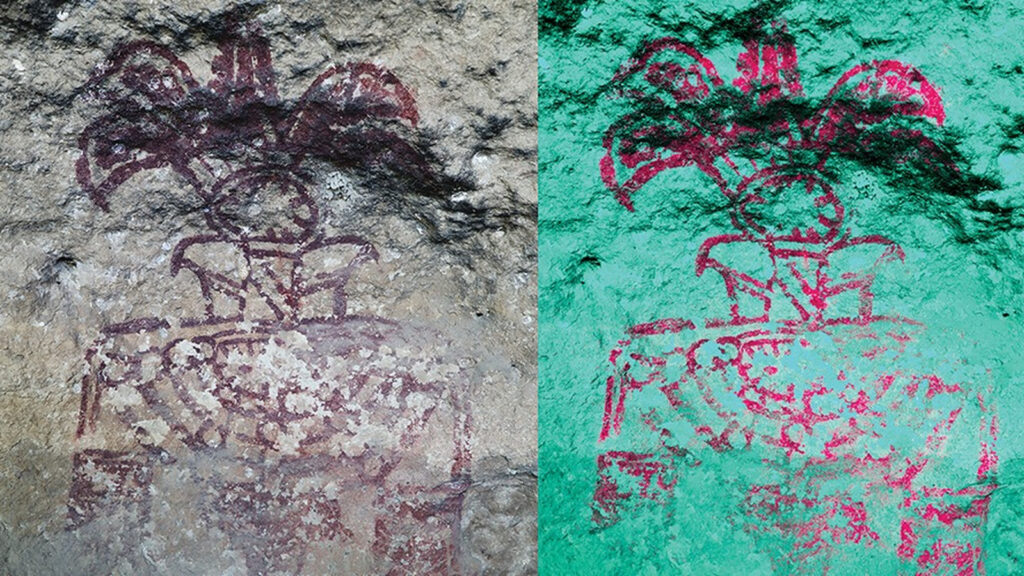
For decades, one of ancient Mesoamerica’s greatest cities appeared to have an unusual absence. Teotihuacan built monumental pyramids, covered walls with elaborate murals and projected its influence hundreds of kilometers across ancient Mexico, yet scholars debated whether its people ever developed a true writing system.
That picture is changing. A new study of three red-painted glyphic compounds inside a difficult-to-reach cave in central Mexico adds to a growing body of evidence that Teotihuacan possessed a genuine logo-phonetic script, with a known repertoire now approaching 120 signs.
The glyphs appear in Cave 19 at Chalcatzingo, an archaeological site about 90 kilometers southeast of Mexico City that is far older than Teotihuacan’s presence there. Chalcatzingo is famous for monumental Olmec-style rock art dating roughly between 900 and 500 BC, but the newly studied paintings belong to a much later chapter in the site’s history.
Researchers Christophe Helmke, Jesper Nielsen, Carolina Meza Rodríguez and Mario Córdova Tello argue that people connected with Teotihuacan used the cave for ritual activity between the fourth and sixth centuries AD. Their study, published in Antiquity, suggests the signs may preserve a place name, a military title and evidence of ceremonies connected with deceased warriors.
A City Once Thought to Have No True Writing
Teotihuacan presents archaeologists with a puzzle unlike those posed by several other major Mesoamerican civilizations. Glyphic signs appear on its murals, ceramics and carved monuments, but they rarely form the long texts familiar from Classic Maya monuments. Instead, Teotihuacan inscriptions tend to be remarkably brief, sometimes consisting of only a single glyphic compound.
That brevity shaped decades of scholarship. Researchers variously described the signs as a “notational system,” graphic conventions or emblematic glyphs, while questioning whether they could encode spoken language. Without lengthy historical inscriptions, it remained possible to interpret many of them as sophisticated visual symbols rather than writing in the strict sense.
Recent research has increasingly challenged that interpretation. Scholars have now identified elements representing calendar information, place names, personal names, titles, and even verbal predicates. Taken together, the evidence points toward a logo-phonetic system, in which signs could represent words or concepts while other elements carried phonetic information.
Researchers currently estimate the known sign inventory at almost 120 graphemes. The system remains far from completely deciphered, and scholars still debate which language—or prestige language—it recorded. But the authors of the new study argue that Teotihuacan writing can no longer be treated simply as a collection of decorative or emblematic symbols.
Cave 19 matters because its paintings expand that corpus beyond the metropolis itself and place Teotihuacan writing in an unusually specific ritual setting.
Three Red Glyphs Hidden on a Mountainside
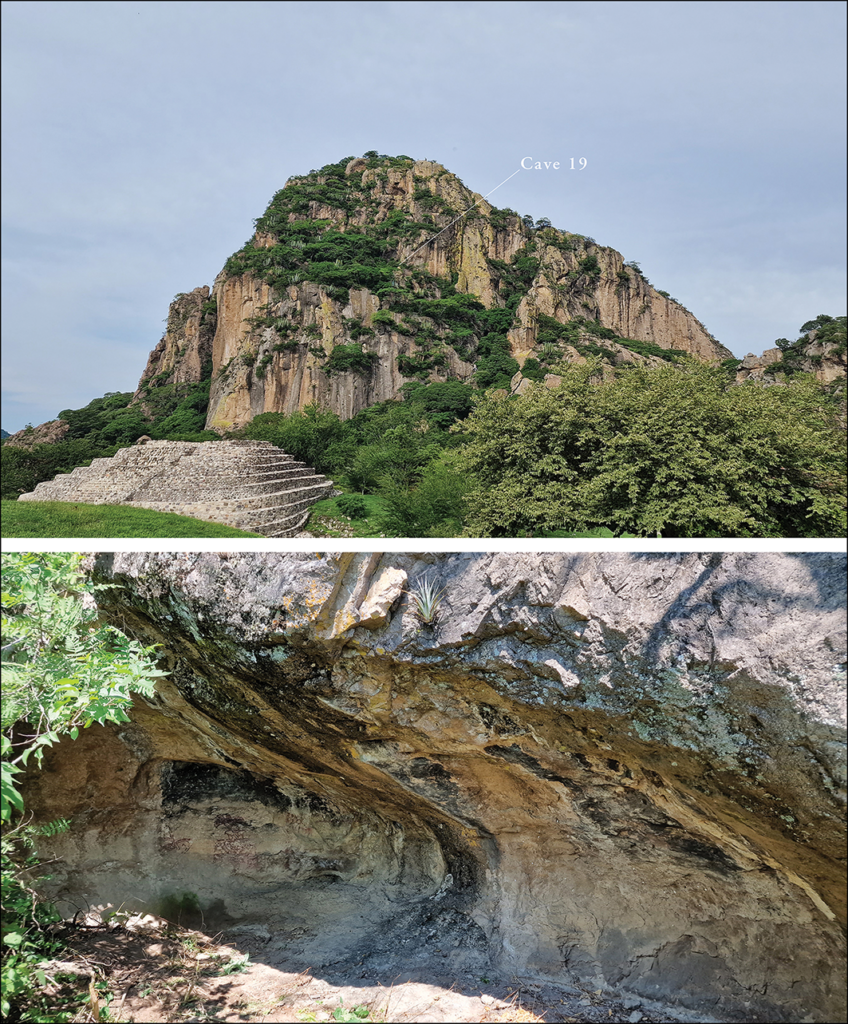
Cave 19 lies about 330 meters from the center of Chalcatzingo, partway up the steep western face of Cerro Delgado. Reaching it today requires climbing the hill from the east and then descending the western escarpment by rope. The researchers suggest ancient visitors may instead have approached from below using scaffold-like ladders; carved footholds and rough steps survive along parts of the route.
Calling it a cave almost exaggerates its size. The rock shelter covers only about 7.4 square meters, with a maximum depth of 2.24 meters. At the back sits a low natural rock shelf. Fire has blackened part of the wall and ceiling directly above it, providing evidence that burning once took place there.
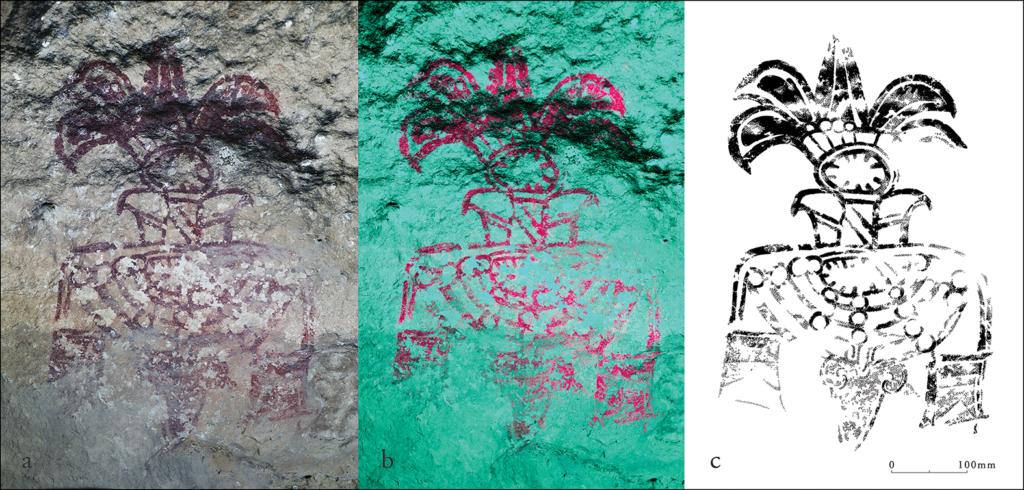
The paintings themselves were already known, but researchers returned to document Cave 19 in detail in August 2022. They photographed the dark-red pigment and used digital enhancement techniques including DStretch to reveal surviving portions that are difficult to distinguish with the naked eye. The team concluded that the three compositions differ sharply from most other painted rock art at Chalcatzingo and instead use signs belonging to the Teotihuacan writing tradition.
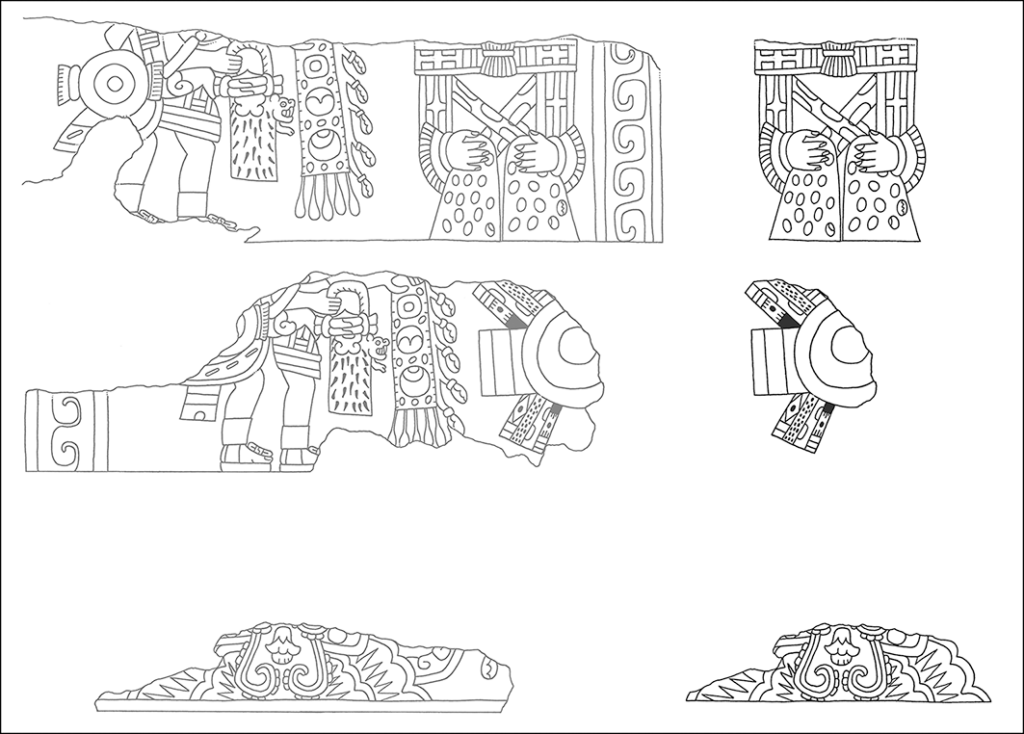
The first may be the most intriguing. Although part of it has weathered away, the surviving design includes stylized mountain signs accompanied by scrolls emerging from an open mouth. In Teotihuacan writing, such scrolls can signify speech or song. The researchers therefore interpret the compound as a place name meaning “Singing Mountain.”
That reading has an unexpected geographical connection. A nearby hill was historically known in Nahuatl as Cuicatepec, which also means “Singing Mountain.” The researchers suggest that the glyph could therefore name Cerro Delgado itself, potentially preserving a place name across many centuries.
There is another clue nearly 90 kilometers away. Murals at Teotihuacan show ritual participants carrying incense pouches and performing scattering ceremonies. Accompanying glyphs record information that researchers interpret as actions, personal names, and a place name. That place name, remarkably, has also been read as “Singing Mountain.”
If the two references identify the same place, the implications extend beyond deciphering one painted sign. The authors argue that Chalcatzingo may have served as an important pilgrimage destination visited by people from Teotihuacan for religious ceremonies.
A Warrior Title Beside a Fire-Blackened Altar
The second glyph takes the story in another direction. Its central elements include a large beaded necklace, a piece of cloth resembling a cloak or narrow garment, and an upright dart of the type launched with an atlatl, or spear-thrower.
All three belong to the visual language of Teotihuacan warriors. Similar combinations appear elsewhere in the Teotihuacan corpus, and the researchers propose that the Cave 19 compound records a martial title, perhaps associated with a particular warrior order. They stress that this remains an interpretation rather than a complete phonetic reading.
The third painting is different. It does not appear to encode linguistic information. Instead, a large rectangular frame decorated with five-pointed stars surrounds the rock shelf where burning took place.
Comparable star-decorated frames appear on elaborate Teotihuacan censers and in imagery associated with ceremonies commemorating deceased warriors. That correspondence becomes particularly suggestive because Teotihuacan ritual practice included both incense burning and the cremation of high-status warriors.
The researchers cannot determine what actually burned on the Cave 19 shelf. Exposure has erased any associated material. A censer could once have stood there, but the authors also raise the possibility that the shelf supported a funerary bundle during cremation. The evidence does not allow them to demonstrate that such a cremation occurred.
Together, however, the warrior glyph, starry frame and traces of fire make a ritual interpretation difficult to dismiss. The team proposes that Cave 19 served as a setting where writing, fire and the commemoration of warriors came together.
New Pieces of a Script Still Waiting to Be Read
The location adds another dimension to the discovery. Chalcatzingo had already been a sacred landscape for centuries before Teotihuacan reached the height of its power. More than 50 carved panels have been documented there, including some of the finest Olmec-style monumental imagery in Mesoamerica. Mountains and caves played prominent roles in Mesoamerican religious traditions, and Chalcatzingo’s earlier imagery repeatedly connected caves, rain, fertility, and the origins of maize.
Teotihuacan’s presence in the wider region was also substantial. Archaeologists have identified Classic-period settlements south of Chalcatzingo, including San Ignacio, only 13 kilometers away. Its rectilinear mound groups, ceramics, obsidian, and ritual objects point to a significant Teotihuacan enclave in eastern Morelos.
Yet Cave 19 suggests that people did not come to Chalcatzingo solely for resources, trade routes, or political expansion. Centuries after the site’s great Olmec-style monuments were created, its mountains apparently retained enough religious significance to attract new visitors with their own rituals and their own writing.
That makes the three faded red compositions more than isolated cave paintings. They add new signs and contexts to a script that archaeologists are only beginning to understand, while showing that Teotihuacan writing travelled beyond the walls of the great metropolis.
The larger mystery remains unresolved. Researchers can increasingly recognize how the system worked and identify place names, titles, personal names and actions, but they have not yet fully deciphered the language behind it. Every newly documented inscription therefore adds another fragment to a written record that, for much of modern archaeology, was not even accepted as writing at all.
Helmke, C., Nielsen, J., Meza Rodríguez, C., & Córdova Tello, M. (2026). Painted Teotihuacan glyphs of Cave 19, Chalcatzingo, Morelos, Mexico. Antiquity, 1–19. doi:10.15184/aqy.2026.10425
