
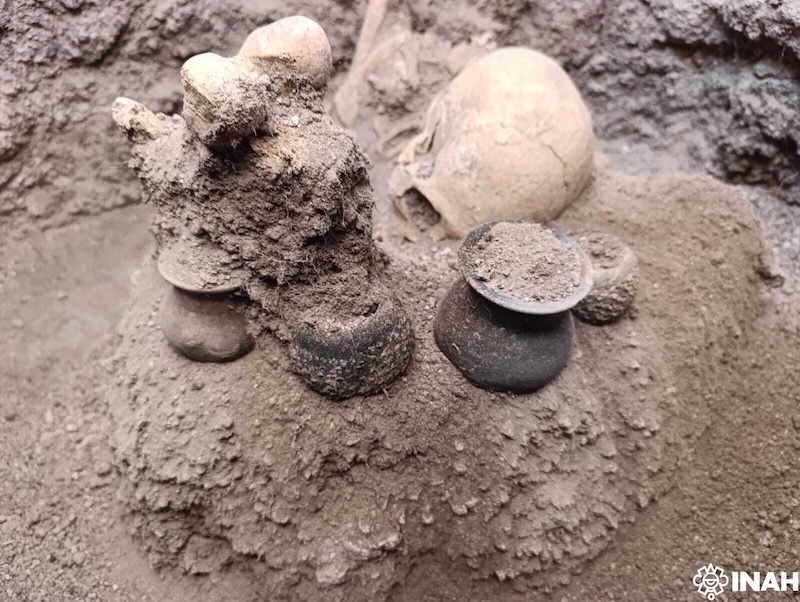
Archaeologists in central Mexico have uncovered a series of Teotihuacan-era burials near Tula, including shaft-tomb-like funerary chambers, cists, human remains, shell ornaments, and 47 miniature ceramic vessels placed as offerings inside one tomb.
The discovery was made at the Ignacio Zaragoza site, near the community of the same name in Tula de Allende, Hidalgo, during archaeological salvage work linked to the Mexico City–Querétaro passenger train project. According to Mexico’s National Institute of Anthropology and History, the settlement appears to have been occupied mainly between 225 and 550 or 600 CE, during the height of Teotihuacan’s influence, with later, smaller reoccupations in the Postclassic period.
A domestic settlement with graves beneath its rooms
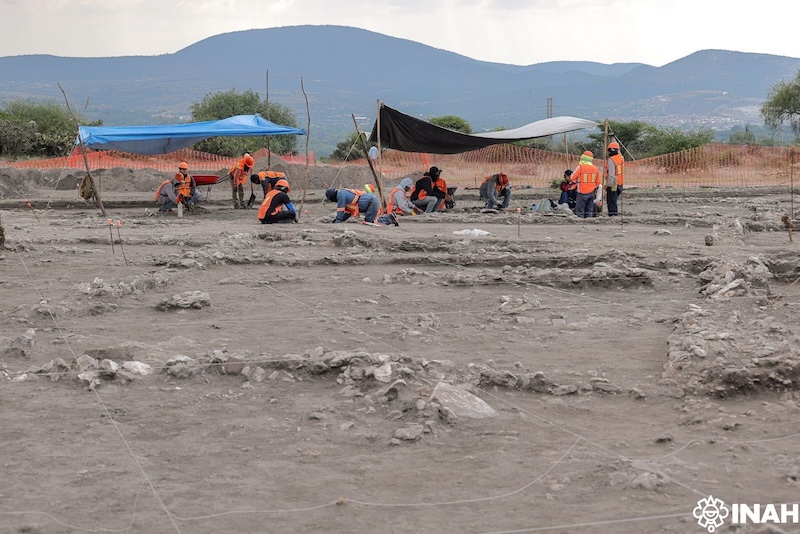
Since September 2025, an INAH salvage team coordinated by archaeologist Víctor Heredia Guillén has investigated an area of about 2,400 square meters along the projected railway route. What first appeared as scattered surface material soon led archaeologists to the foundations of pre-Hispanic walls and, beneath them, a small residential complex arranged around patios.
Field director Laura Magallón Sandoval said the team identified domestic structures aligned north-south and east-west, with access through central and lateral patios. Although centuries of agriculture had removed much of the old stonework, the lower wall foundations survived well enough to show that the site was once a planned residential space.
Inside and around these rooms, archaeologists found more than a dozen individual and collective burials. Some were placed in surface cists, while others were set into tombs cut directly into tepetate, a compact volcanic soil common in central Mexico.
The most striking discoveries are five tombs described by INAH as similar to shaft tombs. These are not necessarily the same as the famous shaft-tomb tradition of western Mexico, but their form is notable: vertical access shafts leading to small funerary chambers.
Eight people and 47 miniature vessels
One room contained two such tombs, one toward the north and another toward the south. Archaeologist Juana Mitzi Serrano Rivero explained that the northern tomb had two east-west chambers, while the southern tomb had a single chamber oriented eastward.
The northern tomb’s circular shaft measured about 80 centimeters in circumference and reached 1.69 meters deep. Its chambers averaged about 60 centimeters, with a total longitudinal cut of 2 meters. The southern tomb, also circular, measured about 80 centimeters across and 1.80 meters deep, with a chamber about 90 centimeters long.
Inside the northern tomb, archaeologists recovered the skeletal remains of eight individuals, mostly adults. Six had been placed in seated positions, with ceramic offerings arranged near their feet. Two others were found in disturbed contexts, suggesting that the tomb was reopened more than once. When a new body was deposited, earlier funerary bundles may have been moved aside.
The offering of 47 miniature vessels is especially important. Miniature ceramics in Mesoamerican funerary settings often point to ritual practice rather than daily use. Their placement near the bodies suggests that the tomb was not a simple burial space, but a carefully maintained mortuary context tied to memory, identity and household ritual.
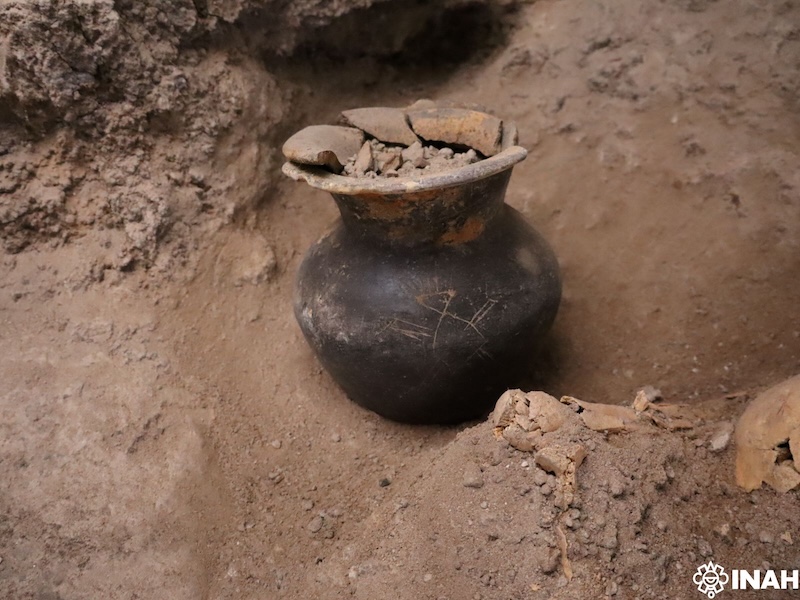
One individual was also buried with shell ornaments, including part of a small semicircular mother-of-pearl pendant and a small plate made from the same material. In another tomb, archaeologists found engraved vessels, which were removed with surrounding soil so they could be studied through micro-excavation.
A Teotihuacan-era site in Tula’s wider landscape
The Ignacio Zaragoza site belongs mainly to the Tlamimilolpa and Xolalpan phases, roughly 225 to 550 CE, when Teotihuacan was one of the most powerful cities in Mesoamerica. Located about 90 kilometers from Tula, Teotihuacan shaped trade, architecture, ritual practice, and political relationships across central Mexico.
Jonathan Velázquez Palacios, another archaeologist on the project, noted that the Tula region had been exploited since pre-Hispanic times as a source of raw material, especially lime. This resource would have been essential for the stucco used on Teotihuacan’s buildings.
That detail may prove important. The new burials were not found in Teotihuacan itself, but in a region connected to its economic and cultural sphere. INAH researchers argue that Ignacio Zaragoza should therefore be studied not as an isolated settlement, but as part of a wider regional network that included other Classic-period sites north of Tula, such as Chingú, El Tesoro, Acoculco, El Llano, and La Malinche.
Chingú is particularly relevant because it has long been considered a regional center linked to Teotihuacan expansion. The new funerary evidence from Ignacio Zaragoza could help clarify how smaller communities in this area adopted, adapted or resisted practices associated with the great metropolis.
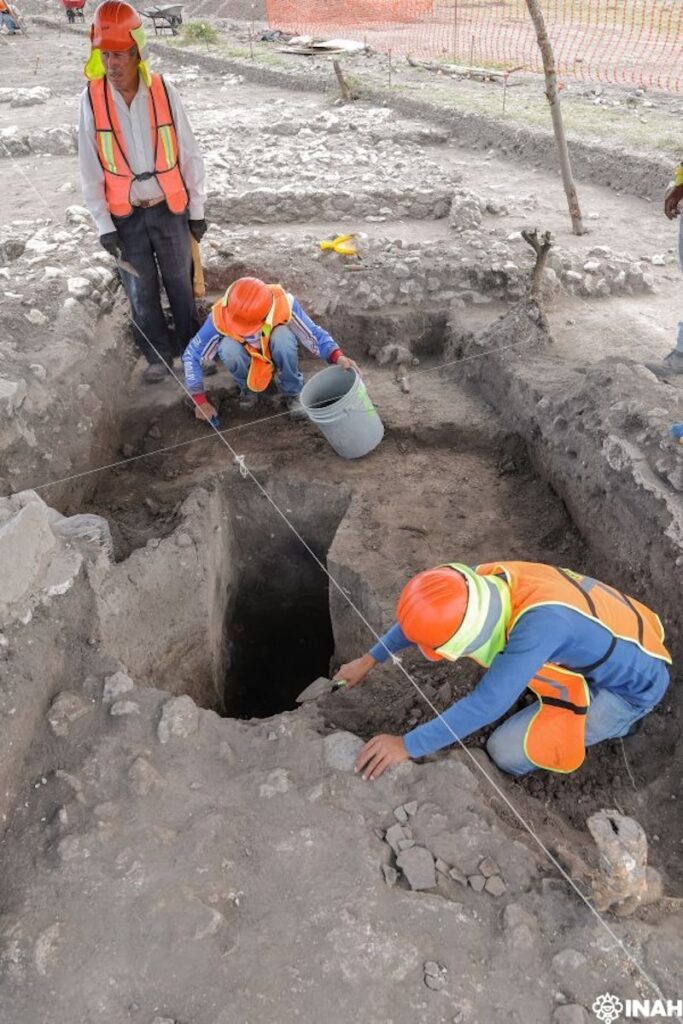
The archaeological salvage team working with the Mexico–Querétaro Train project has investigated cists and tombs resembling shaft tombs. Credit: INAH
Later traces from the Postclassic period
The site also preserves evidence of later reoccupation. Surface finds included Coyotlatelco and Mexica ceramics, indicating that the area remained meaningful long after its Teotihuacan-era occupation had ended. INAH dates these later materials broadly between 900 and 1521 CE in the release, although the main burials now under study belong to the earlier Classic-period phase.
This later activity matters because Tula itself became one of the great urban centers of Postclassic Mesoamerica. INAH describes Tula as a key city of the Central Highlands and the great Toltec capital from around the year 1000, with influence reaching into the Maya area, the Gulf Coast, Anahuac, and western regions.
Tula reached its major urban development after Teotihuacan’s decline. Tula grew rapidly between about 900 and 1200 before declining into a more provincial center in the Late Postclassic.
For that reason, the Ignacio Zaragoza discovery gives archaeologists a deeper time frame for the Tula region. Before the famous Toltec capital, before the monumental Atlantean warrior figures, and before Late Postclassic Mexica influence, there were smaller communities living, burying their dead, and maintaining ritual spaces during the age of Teotihuacan.
The burials, miniature vessels, and shell ornaments now under study may help reveal how these communities understood death, family, and social identity. They also show how modern infrastructure projects, when paired with archaeological salvage, can expose chapters of regional history that would otherwise remain hidden beneath cultivated land.
Cover Image Credit: Víctor Heredia -INAH
