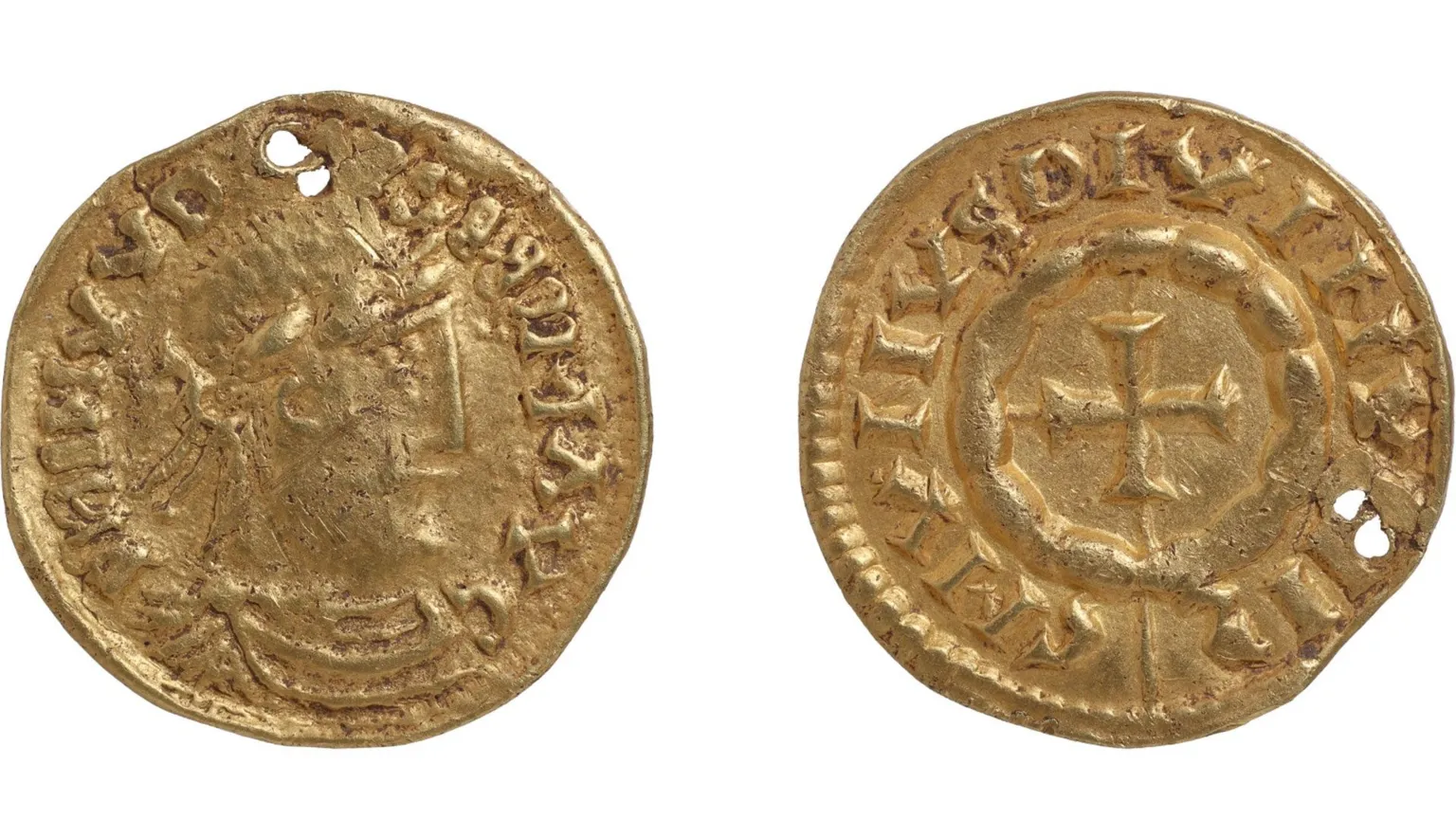
A rare gold coin pendant believed to have been worn by a Viking Great Army warrior during the 865 invasion has been discovered in Norfolk.
A remarkable gold coin pendant linked to the Viking Great Army has been unearthed in a field in Elsing, near Dereham, Norfolk—offering fresh insight into one of the most transformative invasions in early medieval English history. The rare find, discovered by a metal detectorist in September 2024, is an imitation of a gold solidus of Louis the Pious, the son of Charlemagne.
What makes this discovery extraordinary is not simply its age or its gold composition, but its powerful connection to the Viking incursions that reshaped England in the late ninth century. Experts believe the pendant was worn by a Scandinavian warrior who arrived with the so-called “Great Heathen Army” in AD 865. Its presence in Norfolk strengthens archaeological evidence charting the army’s movements across the country.
A Rare Carolingian Imitation in Viking Hands
The coin is based on an exceptionally rare original solidus minted around AD 816, shortly after Louis the Pious was crowned Holy Roman Emperor. These coins are widely considered among the finest of all Carolingian issues, with only a handful of confirmed originals known to exist.
The obverse of the original coin features a classical Roman-style portrait of Louis, complete with laurel wreath and imperial inscription, echoing earlier Roman emperors such as Constantine I. The reverse bears the inscription “MVNUS DIVINUM” (“Divine Gift”), framing a wreath enclosing a cross—an overtly Christian symbol of imperial legitimacy.
📣 Our WhatsApp channel is now LIVE! Stay up-to-date with the latest news and updates, just click here to follow us on WhatsApp and never miss a thing!!
Yet the Norfolk example is not one of these near-mythical originals. Instead, it is a later imitation produced in workshops in Frisia, now part of the modern Netherlands. These Frisian copies were likely made decades after the original issue, primarily during the mid-to-late ninth century. More than 100 such imitations have been found across western Europe, though only 22 have surfaced in Britain—each associated with the Viking Great Army’s advance.
According to reporting by the BBC and detailed numismatic analysis published by The History Blog, the Norfolk specimen stands out for its unusually high quality. While many later imitations are crude, with barely legible inscriptions and simplified portraits, this coin retains recognizable lettering and a carefully rendered bust. The inscription, though imperfect, closely mirrors the original Latin text. Even the portrait preserves key features such as the emperor’s elongated nose, moustache, and laurel crown.
A Portable Fortune for a Viking Raider
One particularly fascinating detail is the coin’s double piercing above the emperor’s head. The positioning indicates it was worn as a pendant, likely suspended from a cord or chain, with the imperial portrait facing outward. This transformation from currency into personal adornment reflects how Vikings adapted foreign objects into symbols of wealth, identity, and status.
Gold coins were not widely circulated in Scandinavia at the time. Instead, precious metal was valued by weight and often repurposed as jewelry. In this context, the imitation solidus would have served as portable wealth—compact, valuable, and easily displayed.
The discovery also reinforces what historians know about the Viking Great Army’s route. After landing in East Anglia in 865, the force—described in the Anglo-Saxon Chronicle as a “great heathen army”—moved strategically along river systems and former Roman roads. By 880, the Vikings had established dominance over East Anglia, Mercia, and Northumbria, dramatically altering the political map of England.
Metal-detected finds reported through the Portable Antiquities Scheme have increasingly allowed archaeologists to track this movement with greater precision. Each imitation solidus discovered in Britain effectively marks a waypoint in the army’s campaign. The Norfolk pendant, only the second of its type found in the county, strengthens evidence of Viking activity in the region.
What Sets This Gold Pendant Apart from Other Viking-Era Discoveries
What truly distinguishes this remarkable coin pendant is the rare combination of characteristics it brings together in a single object. First, its gold composition immediately elevates its importance, as gold artifacts from Viking contexts in England are far less common than silver finds.
Second, although discovered in Norfolk, the coin’s origins lie on the European continent, reflecting the far-reaching economic and cultural networks that connected the Carolingian world with Scandinavia during the ninth century.
Third, its discovery aligns closely with the documented movements of the Viking Great Army, reinforcing archaeological evidence that traces the army’s advance across England.
Finally, the craftsmanship of this particular example is notably refined compared to most surviving imitations. While many known copies are crudely executed with barely legible inscriptions, this specimen preserves clearer lettering and a more carefully rendered imperial portrait, making it an especially valuable and informative find for historians and numismatists alike.
The coin is currently undergoing the formal Treasure process in the UK, where a coroner will determine its legal status. Given its age, precious metal content, and historical significance, it is widely expected to be declared a treasure. Norwich Castle Museum has expressed hope of acquiring the pendant for public display.
A Window into a Turbulent Era
Beyond its monetary value, the pendant offers a vivid glimpse into a dynamic period when empires collided and cultures intertwined. It embodies the reach of Carolingian imperial imagery, the adaptability of Viking warriors, and the interconnected nature of early medieval Europe.
In a single object no larger than a modern coin, we see the convergence of Roman artistic legacy, Frankish imperial ambition, Frisian craftsmanship, and Scandinavian mobility. That convergence—captured in gold and lost in a Norfolk field for more than a millennium—is what makes this discovery truly extraordinary.
Cover Image Credit: Andrew Williams/Norfolk County Council