

A remarkable Ice Age discovery is reshaping our understanding of early human culture in Britain. Scientists from the Natural History Museum (NHM) have identified a rare prehistoric artifact—a seal tooth pendant dating back over 15,000 years—that provides compelling evidence of long-distance travel, artistic expression, and complex social behavior among ancient humans.
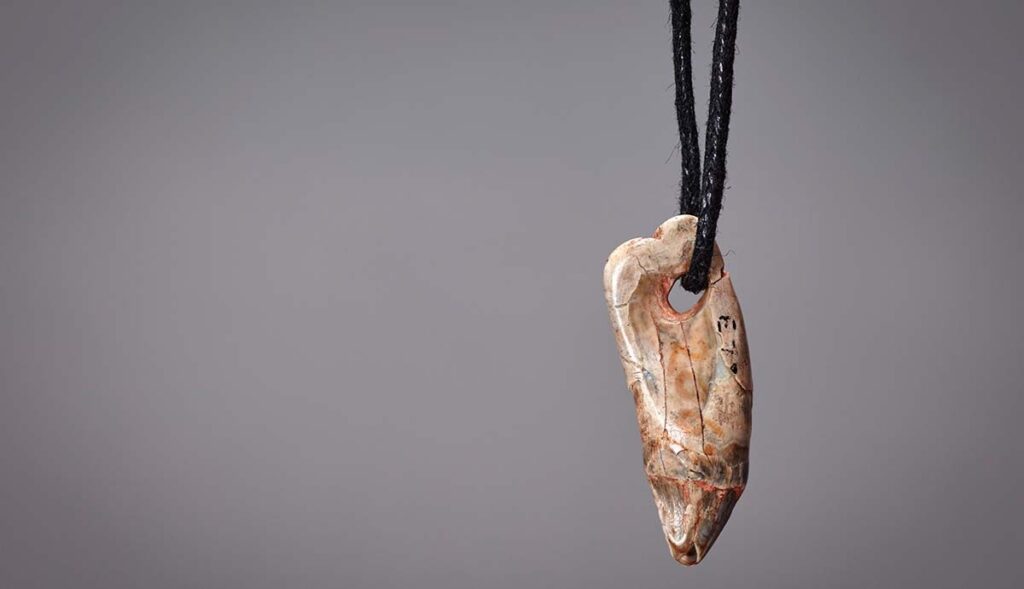
The object, originally unearthed during 19th-century excavations at Kents Cavern in Devon, had long puzzled researchers. First discovered in 1867 by pioneering archaeologist William Pengelly, the tooth was initially misidentified as belonging to terrestrial animals such as a badger or wolf. However, new research published in Quaternary Science Reviews confirms that the artifact is in fact a carefully crafted pendant made from the tooth of a grey seal.
A Rare Ice Age Ornament
According to the study, the pendant dates to the Late Upper Palaeolithic period, specifically the Magdalenian culture, a time known for a flourishing of art and symbolic behavior across Europe. The research team used advanced imaging techniques, including 3D surface analysis and micro-CT scanning, to reveal how the tooth was shaped, perforated, and worn.
The analysis shows that the tooth belonged to a male grey seal approximately 12 years old at the time of its death. After extraction—likely requiring the breaking of the animal’s jaw—the tooth was carefully modified. Its root was thinned and polished, and a hole was drilled using a flint tool to allow it to be worn as a pendant.
Wear patterns indicate that the ornament was used extensively, possibly for many years. The perforation, originally circular, became elongated over time due to friction from a cord, suggesting it was suspended freely, perhaps as part of a necklace or bracelet.
Evidence of Long-Distance Travel
One of the most striking aspects of this discovery is its location. During the Ice Age, Kents Cavern was situated more than 100 kilometers inland from the nearest coastline. This raises an important question: how did a marine animal tooth end up so far from the sea?
Researchers believe the pendant is evidence of long-distance movement by prehistoric humans, either through seasonal migration or early trade networks. Similar marine-based artifacts have been found at inland sites across Europe, suggesting that ancient communities were far more mobile and interconnected than previously thought.
The study highlights parallels with sites in Spain and France, where marine mammal remains and ornaments have also been discovered far from coastal regions. These findings point to the possibility of exchange networks spanning hundreds of kilometers during the Ice Age.
A Glimpse into Ancient Identity and Art
Experts say the pendant is not just a functional object, but a symbol of identity and creativity. Personal ornaments like this were rare in prehistoric Britain, making the find particularly significant.
Dr. Silvia Bello, a co-author of the study and specialist in human evolution at NHM, emphasized the cultural importance of the artifact. She explained that such objects likely carried social meaning, possibly indicating group affiliation, status, or connection to coastal environments.
“This pendant dates to a time when artistic expression was expanding across Europe,” Bello noted. “It suggests that humans were creating objects not only for practical use but also for symbolic and aesthetic purposes.”
The rarity of seal tooth pendants further enhances its significance. Only a handful of similar artifacts from this period have been identified across Europe, making the Kents Cavern example a unique addition to the archaeological record.
Rediscovering the Past Through Modern Science
The pendant’s true identity remained hidden for over a century, largely due to early misclassification and limited analytical tools. Thanks to modern scientific techniques and renewed interest in historic collections, researchers are now uncovering new insights from old discoveries.
The study demonstrates the enduring value of William Pengelly’s meticulous excavation methods. His detailed records of artifact locations and sediment layers allowed modern scientists to confidently place the pendant within its archaeological context.
Today, Natural History Museum researchers hope to conduct further analyses, including isotope and ancient DNA studies, to trace the geographical origin of the seal and better understand the movement patterns of Ice Age populations.
Unlocking Ice Age Connections
The discovery of the seal tooth pendant offers a fascinating glimpse into a world where humans traveled vast distances, exchanged materials, and expressed identity through personal adornment. It challenges the notion of isolated prehistoric communities and instead paints a picture of dynamic, interconnected societies.
As research continues, this small but powerful artifact may help unlock even deeper insights into the lives, movements, and creativity of our ancient ancestors—proving that even a single tooth can tell a story spanning thousands of years.
Parfitt, S. A., Crété, L., Dinnis, R., Lucas, C., Chandler, B., & Bello, S. M. (2026). Marine mammals and body ornaments in the Upper Palaeolithic: A rare example of a seal tooth pendant from Kents Cavern, Devon, U.K. Quaternary Science Reviews, 382, 109902. https://doi.org/10.1016/j.quascirev.2026.109902
Cover Image Credit: The Trustees of the Natural History Museum
