
11 November 2025 The Future is the Product of the Past

Fake Byzantine Coin Pendant Is First Evidence of 6th-Century Elite in Thaxted, Essex

Discovery of a rare 6th-century pseudo-Byzantine gold coin pendant near Thaxted sheds new light on elite presence in early medieval Essex.

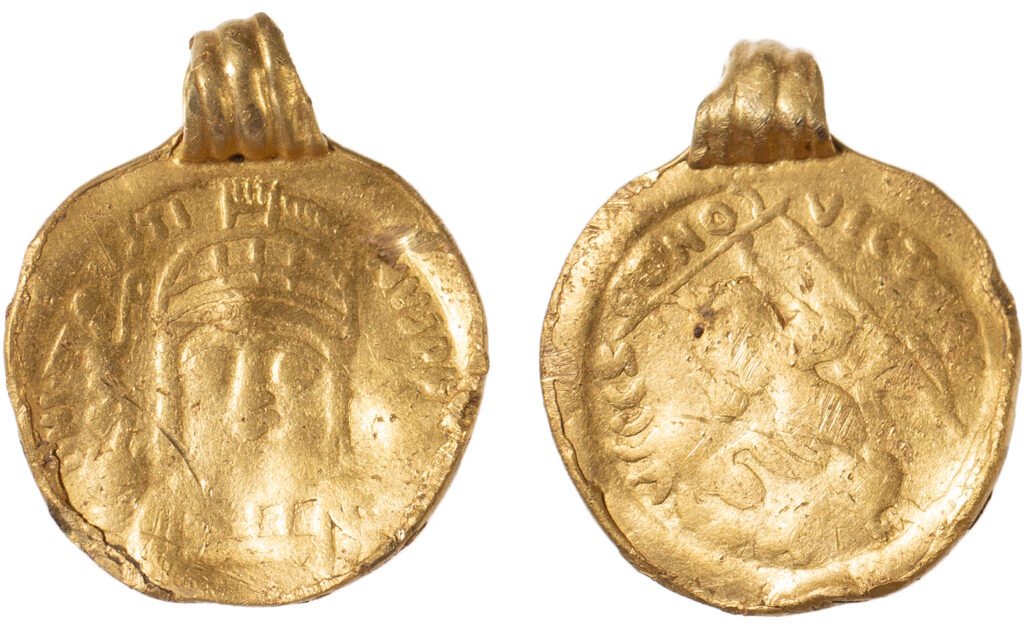
A finely crafted gold pendant — a 6th-century imitation of a Byzantine coin — has been unearthed near Thaxted, Essex, marking the first known archaeological evidence of elite groups living in the area during the early medieval period.

Measuring 19.6mm (0.7in) in diameter, the high-quality object was discovered by a metal detectorist and declared treasure by a coroner. Experts say the find sheds new light on the hidden aristocracy of post-Roman Britain.

Declared treasure by a coroner, the pendant has sparked major interest from historians and archaeologists. The Saffron Walden Museum hopes to acquire the artifact after it is assessed by the British Museum’s Treasure Valuation Committee.

The pendant is a finely crafted imitation of a gold solidus issued by Emperor Justin II (r. AD 565–578). On the obverse, the emperor is depicted helmeted and armored, holding a globe-topped Victory figure and shield, with the Latin inscription DN IVSTINVS PP AVG (“Our Lord Justin, Eternal Augustus”). The reverse shows the personification of Constantinople seated, bearing a scepter and cross-topped globe, with the inscription VICTORIA AVGGG and mintmark CONOB indicating the Constantinople mint.


📣 Our WhatsApp channel is now LIVE! Stay up-to-date with the latest news and updates, just click here to follow us on WhatsApp and never miss a thing!!


What makes this piece exceptional is not only its design but its transformation into jewellery. The suspension loop, featuring five longitudinal ribs typical of the late 6th to early 7th century, was deliberately placed above the emperor’s portrait — suggesting it was meant to be worn with the emperor’s image proudly displayed. The worn reverse indicates it rested against the wearer’s skin for a long time, reinforcing its personal and symbolic significance.
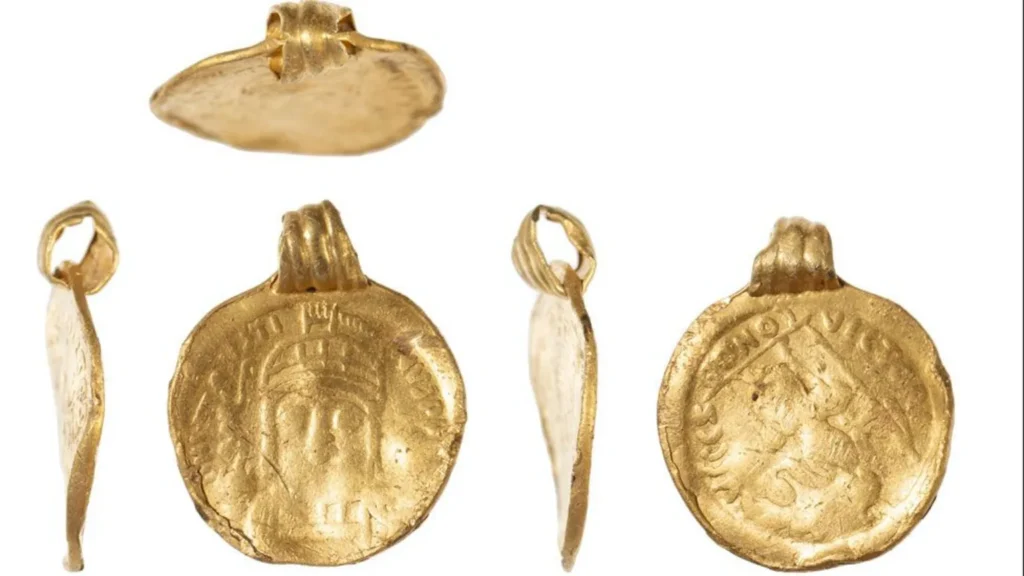
The 19.6mm (0.7in) diameter high quality gold coin pendant is the first evidence of "elite groups of people" in the Thaxted area in the 6th Century. Credit: Colchester and Ipswich Museum Services
The 19.6mm (0.7in) diameter high quality gold coin pendant is the first evidence of “elite groups of people” in the Thaxted area in the 6th Century. Credit: Colchester and Ipswich Museum Services

According to Essex County Finds Liaison Officer Lori Rogerson, “This find is flipping what we thought we knew about Essex at this time on its head. We have no written records from this period for the county, so this pendant literally shines a light on that dark age.”

While such pseudo-imperial solidi were minted by several post-Roman European kingdoms — including the Anglo-Saxons, Franks, Lombards, Visigoths, and others — they are more commonly found in regions like Kent, Suffolk, or Norfolk. This makes the Thaxted find a particularly rare example for Essex.

“These high-quality gold items are elite objects,” Rogerson explained. “They don’t appear in commercial archaeology digs, so without chance finds like this, we wouldn’t know these elite individuals even existed in Essex during this period.”

The discovery adds to a growing body of elite early medieval artifacts in the region. Previous notable finds include the lavish Prittlewell burial chamber (dubbed the “Prittlewell Prince”) unearthed near Southend-on-Sea in 2003, as well as high-status items from Colchester, Chelmsford, and a finger ring from Epping Forest.

“This pendant confirms that early medieval Essex had a more complex and wealthy elite society than we previously thought,” Rogerson added. “We’re now seeing evidence of high-status individuals from all corners of the county.”

As interest grows around the pendant, it not only contributes to our understanding of Essex’s forgotten past but also underscores the importance of metal detecting and community archaeology in uncovering the hidden layers of British history.

Cover Image Credit: Colchester and Ipswich Museum Services

Related Articles

76 Ancient Stone Traps Unearthed in Chile’s Andes Reveal Ingenious Prehistoric Hunting System

14 October 2025

14 October 2025

High in Chile’s northern Andes, where icy winds sweep across the desert ridges of the Camarones River Basin, archaeologist Dr....

In the backstage of Smyrna Ancient Theater Latrina found

3 November 2021

3 November 2021

Interesting finds unearthed during the excavations of the 2400-year-old Ancient City of Smyrna in the Aegean region of Turkey continue...

Archaeologists find evidence of how Iron Age Britons adapted to the Roman conquest in Winterborne Kingston

29 June 2024

29 June 2024

Archaeologists from Bournemouth University (BU) have discovered human remains and artifacts which give new insight into how early Britons adapted...

Jordan’s mysterious ancient wall “Khatt Shebib”

22 October 2022

22 October 2022

The accomplishments of ancient civilizations are typically woefully underappreciated because we stereotype them as primitives who only wore loincloths, and...

New Discoveries Made in World’s Oldest Ancient Shipyard

11 June 2024

11 June 2024

Associate Professor Hakan Öniz, who discovered the world’s largest and oldest shipyard dating back to the Bronze Age in 2015...

New Study Reveals Ancient Secrets of the 3,600-year-old Nebra Sky Disc

2 December 2024

2 December 2024

Discovered in 1999 in Germany, the Nebra Sky Disc is the oldest known depiction of the cosmos. A recent examination...

A 2900-year-old collection of fossilized shark teeth found in the City of David, one of Jerusalem’s oldest Parts

5 July 2021

5 July 2021

Scientists discovered an inexplicable collection of fossilized shark teeth at a 2900-year-old archaeological site in Jerusalem’s City of David, one...

Largest ever Roman silver hoard in Germany found in Augsburg

12 November 2021

12 November 2021

Archaeologists in Augsburg, Germany, revealed unearthed a historical hoard including 15 kg of silver coins from the Roman Empire’s era....

New AI Tool ‘Fragmentarium’ Brings Ancient Babylonian Texts Together

6 February 2023

6 February 2023

An artificial intelligence (AI) bot was developed by linguists at the Institute for Assyriology at Ludwig Maximilian University in Germany...

5,700-Year-old Ancient “Chewing Gum” Gives Information About People and Bacteria of the Past

4 April 2021

4 April 2021

Researchers at the University of Copenhagen have successfully extracted the complete human genome from “chewing gum” thousands of years ago....

Archaeologists found a noble woman buried beside her ‘husband’ 1,000 years ago with the top of her face hollowed out

4 November 2023

4 November 2023

Archaeologists unearthed the 1,000-year-old remains of a woman with her face and head hollowed out buried next to her husband...

12,000-Year-Old Rock Carvings Discovered Beneath Waters of Atatürk Dam in Türkiye

22 October 2025

22 October 2025

Archaeologists and museum officials in Adıyaman, southeastern Türkiye, have captured underwater images of rock carvings estimated to be 12,000 years...

Archaeologists discovered floor mosaics with early Christian designs in Roman town of Marcianopolis, in Bulgaria

16 January 2024

16 January 2024

Archaeologists discovered floor mosaics with early Christian designs and nearly 800 artifacts in the archaeological reserve of Marcianopolis in Devnya,...

Newly discovered inscribed brick may reveal Elamite water supply system in Western Iran

15 January 2024

15 January 2024

Archaeologists discovered a brick inscribed with Akkadian script, marking the Elamite water supply system, alongside some intricately patterned bricks in...

Archaeologists find 4 Umayyad epigraphs in the ancient city Knidos

24 May 2022

24 May 2022

Archaeological excavations in the ancient city of Knidos connected to Datça District of Muğla province in western Turkey have unearthed...