
A long-lost Roman mosaic—destroyed more than a century ago—has quietly rewritten the history of women in the arena. What was once dismissed as an ambiguous figure is now being recognized as something far more extraordinary: the only known visual depiction of a female beast hunter, or venatrix, in the Roman world.
The discovery, brought back into scholarly focus by researcher Alfonso Mañas of the University of California, Berkeley, challenges long-held assumptions about the role and lifespan of women in Roman spectacles. More strikingly, it suggests that female participation in arena hunts lasted far longer than previously believed.
A Mosaic Lost to War, Recovered Through Scholarship
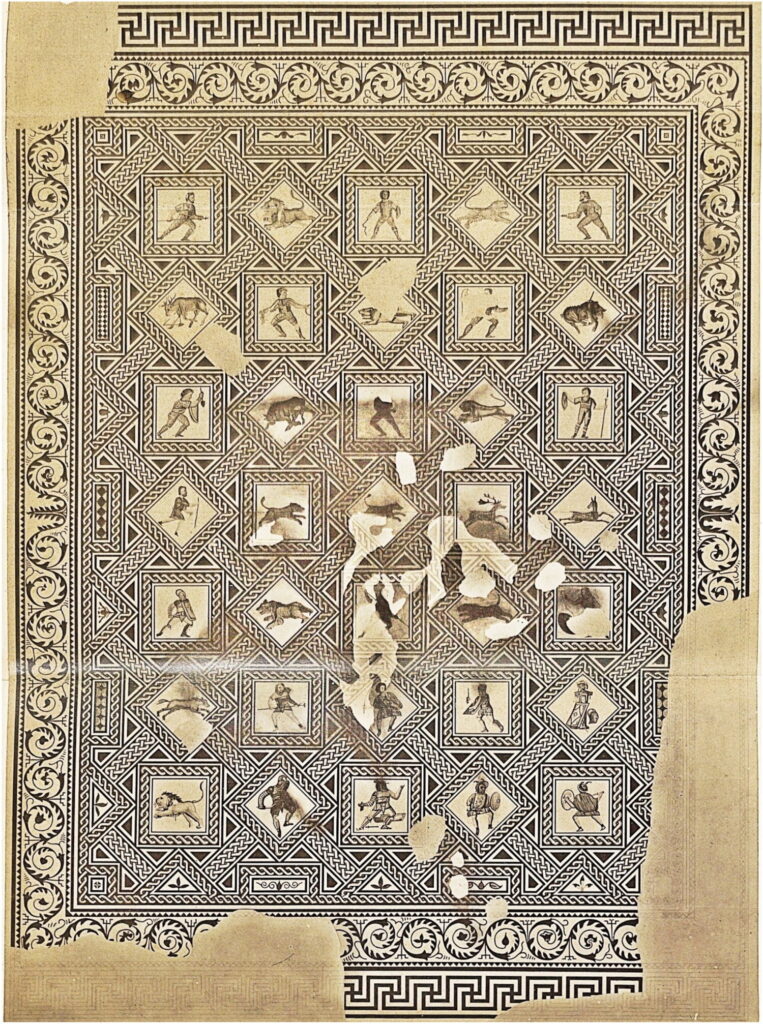
The mosaic was originally uncovered in 1860 in Reims, France, a major Roman city in antiquity. Measuring roughly 11 by 9 meters, it featured a complex arrangement of medallions depicting scenes from the amphitheater—gladiators, wild animals, and staged hunts.
But the artwork did not survive history.
It was destroyed during World War I bombing in 1917. What remains today are only 19th-century drawings made by archaeologist Jean-Charles Loriquet, which have proven remarkably accurate when compared to surviving fragments.
For decades, the mosaic faded into obscurity—rarely cited, rarely analyzed, and almost never illustrated in modern scholarship.
Until now.
The Figure No One Recognized
At the center of this reassessment is a single figure within one of the mosaic’s medallions.
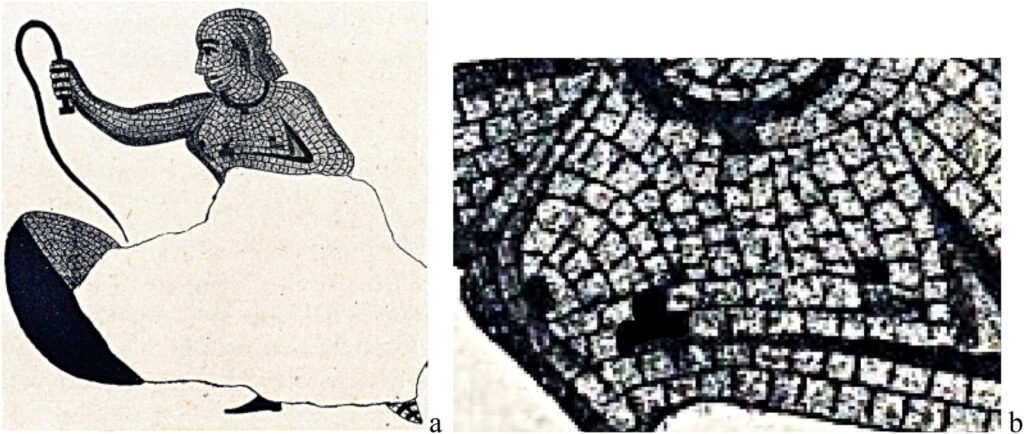
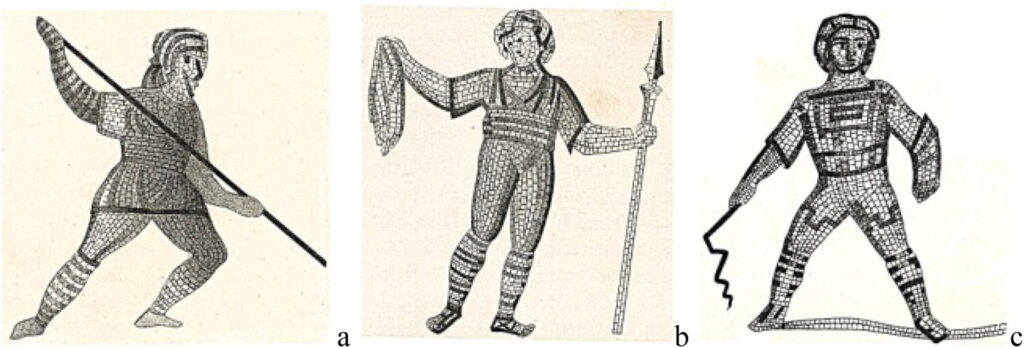
Earlier researchers noticed the figure but failed to identify it correctly. Loriquet cautiously suggested it might be a woman, while later scholars misidentified it as a male performer or even a comic gladiator.
The turning point lies in the details.
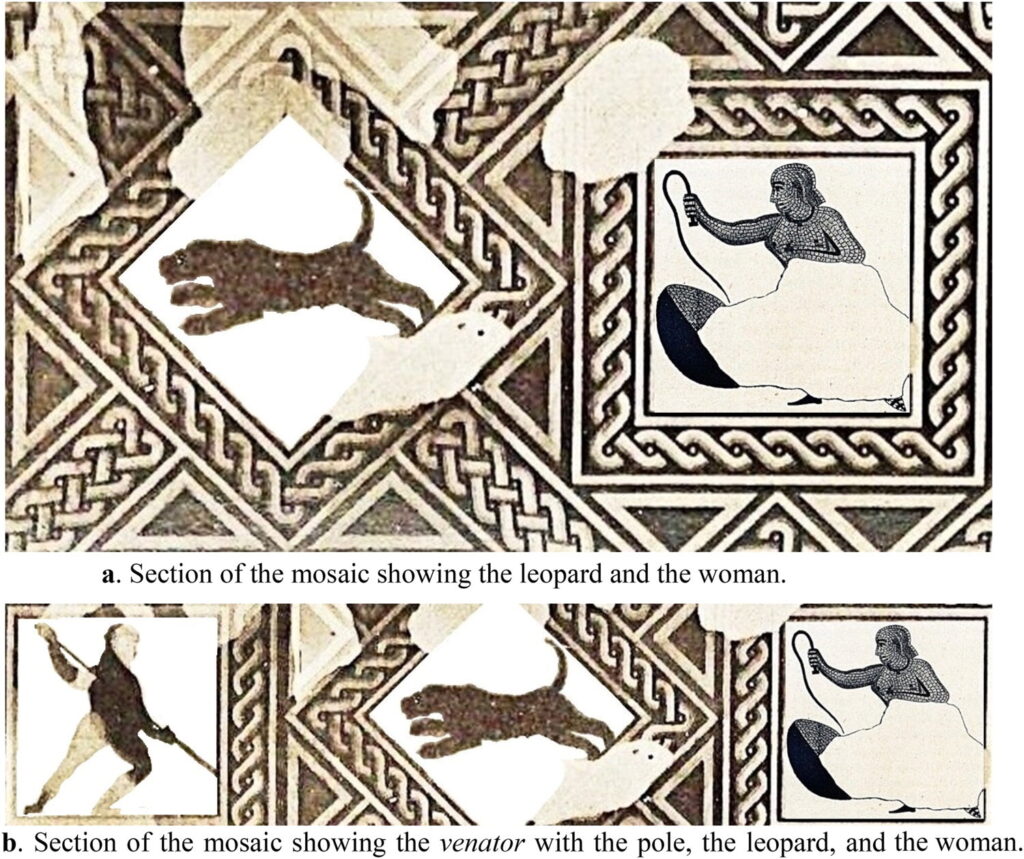
The figure is depicted holding a whip, positioned beside a leopard, and actively driving the animal toward another hunter. Crucially, the figure is also shown bare-chested, with clearly defined breasts—an intentional artistic choice not seen in any of the male figures in the same mosaic.
This is not a stylistic accident.
It is, in fact, the clearest visual signal available in Roman art to identify a female body.
Combined with facial features and context, the conclusion becomes difficult to avoid: This is a woman—and not just any woman, but a trained participant in the arena.
Not a Victim, but a Professional
In Roman spectacles, women associated with animals typically fell into two very different categories.
Some were condemned prisoners, executed in brutal public displays known as damnatio ad bestias. These individuals were unarmed and expected to die.
But the woman in the mosaic tells a different story.
She holds a whip. She engages actively with the animal. She participates in a coordinated hunt.
That single detail—the presence of a weapon—changes everything.
According to the study, this figure represents a venatrix, a female hunter trained to fight beasts in staged arena hunts known as venationes.
More specifically, she appears to be a succursora—an assistant who drove animals toward other hunters for the final strike.
This role required skill, timing, and training. It was not execution—it was performance.
Extending the Timeline of Women in the Arena
Before this identification, historians believed that female beast hunters existed only briefly, primarily between the reign of Nero in the 1st century CE and the early 2nd century.
Written sources—such as accounts by Cassius Dio, Martial, and Juvenal—mention women participating in hunts, but these references are rare and clustered within a narrow time frame.
Then, the record goes silent.
The Reims mosaic changes that.
Dating to the 3rd century CE, it provides concrete evidence that women were still appearing in arena hunts at least a century later than previously assumed.
This is not a minor adjustment—it fundamentally reshapes the historical timeline.
Why Female Hunters Survived Longer Than Gladiators
One of the most intriguing questions raised by the study is why female hunters outlasted female gladiators, who disappear from the historical record around 200 CE.
The answer lies in Roman cultural values.
Gladiatorial combat—human versus human—was often viewed as morally troubling, even by Roman standards. Female gladiators, in particular, were criticized harshly in literature.
But hunting animals was different.
Roman mythology provided respectable precedents. Figures like Diana and Atalanta embodied the image of the female hunter. Hunting could be framed not as transgression, but as tradition.
As a result, venationes were seen as more acceptable—and even prestigious—forms of spectacle.
There was also a practical distinction.
Killing animals did not carry the same stigma as killing humans. Even emperors who sought to reform the arena, such as Marcus Aurelius, targeted gladiatorial violence—not animal hunts.
Performance, Gender, and Spectacle
The mosaic also reveals another layer of Roman spectacle: the role of visual identity and audience perception.
The woman is shown topless—not necessarily as a reflection of her status, but as a deliberate artistic choice to make her gender unmistakable.
In a crowded arena, clarity mattered.
But the study also suggests another dimension: spectacle and attraction.
Ancient texts, including Juvenal’s description of a huntress named Mevia, indicate that female performers sometimes appeared with exposed bodies, adding an element of theatrical allure to their performances.
This was not incidental—it was part of the show.
A Singular Image in Roman History
Perhaps the most remarkable aspect of this discovery is its uniqueness.
Despite numerous written references to women in the arena, no other confirmed visual representation of a female beast hunter has ever been identified.
This makes the Reims mosaic—and the figure within it—exceptional.
It is not just another artifact.
It is the only surviving image of a woman actively participating in one of the Roman world’s most dramatic spectacles.
Rewriting a Forgotten Chapter
For more than a century, this mosaic existed only as a footnote—misunderstood, overlooked, and largely forgotten.
Now, it stands at the center of a significant historical revision.
The woman in the mosaic has no name. No inscription records her identity. No text tells her story.
And yet, through a combination of careful scholarship and long-neglected evidence, she has emerged as a powerful figure—one who expands our understanding of gender, performance, and spectacle in the Roman world.
Not a victim. Not an anomaly. But a professional—standing in the arena, whip in hand, facing the beast.
Manas, A. (2026). New Evidence of Women Fighting Beasts in the Roman Arena: The Woman in the Mosaic from Reims. The International Journal of the History of Sport, 1–29. https://doi.org/10.1080/09523367.2026.2632176
Cover Image Credit: A. Manas, 2026
