
23 January 2026 The Future is the Product of the Past

Britain’s First Discovery of Its Kind: A 2,000-Year-Old Carnyx and Boar Standard Unearthed in Norfolk

A groundbreaking archaeological discovery in Norfolk has revealed one of the most complete Iron Age war trumpets ever found in Europe, alongside a rare bronze boar standard. The remarkable hoard, uncovered during routine excavation work ahead of a housing development, is already being hailed as one of the most significant finds in British pre-Roman archaeology.

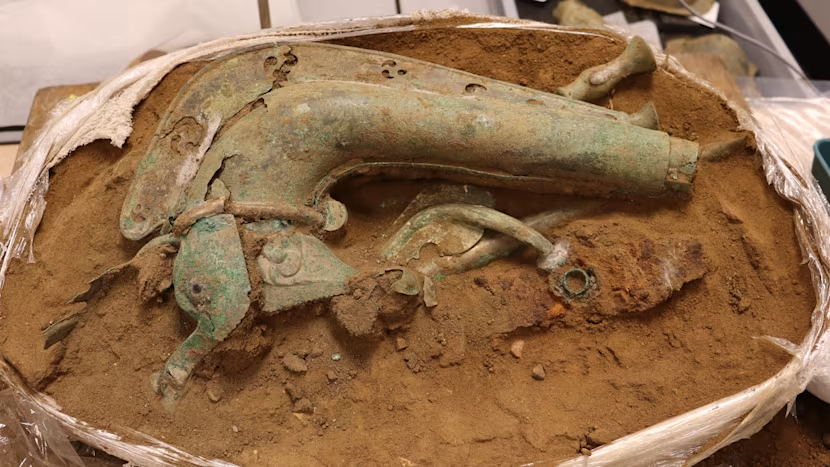
Archaeologists from Pre-Construct Archaeology made the discovery near Thetford in west Norfolk, where a carefully preserved soil block revealed a near-intact carnyx — the iconic Celtic battle trumpet — along with a sheet-bronze boar’s head standard, five shield bosses, and an iron object of unknown function. Experts believe the hoard dates from around 50 BC to AD 50, a turbulent period that saw growing tension between native tribes and Rome.

A Rare Glimpse Into Celtic Warfare

The carnyx, distinguished by its elongated vertical shape and animal-headed bell, was used by Celtic tribes across Europe to intimidate enemies and rally warriors during battle. Standing up to two meters tall, the instrument produced a loud, brassy, almost roaring sound designed to echo across battlefields.

Only three carnyces have ever been found in Britain, but this example is the most complete yet uncovered, retaining its mouthpiece, pipe, and decorative bell. Conservators described the instrument as being made from exceptionally thin metal sheets that survived over two millennia underground — a rarity given how fragile such objects are.

The discovery is particularly meaningful to East Anglia, once home to the Iceni tribe, famously led by Queen Boudica in her revolt against Roman rule in AD 60–61. While the hoard predates the uprising, it offers a powerful link to the martial traditions and symbolism of Iron Age Britain.


📣 Our WhatsApp channel is now LIVE! Stay up-to-date with the latest news and updates, just click here to follow us on WhatsApp and never miss a thing!!


Only three carnyces have ever been found in Britain, but this example is the most complete yet uncovered, retaining its mouthpiece, pipe, and decorative bell. Credit: Norfolk Museum Service

Symbolism of the Boar Standard

Equally significant is the bronze boar’s head standard found alongside the carnyx — the first of its kind ever discovered in Britain. Military standards served as battlefield rallying points, and the boar was a potent Celtic symbol representing strength, courage, and ferocity.

Boars were respected both as dangerous animals and as spiritual emblems associated with protection and warrior identity. The presence of both the carnyx and the boar standard suggests that the hoard may have belonged to a high-status warrior, chieftain, or ceremonial retinue.

Conservation and Research Underway

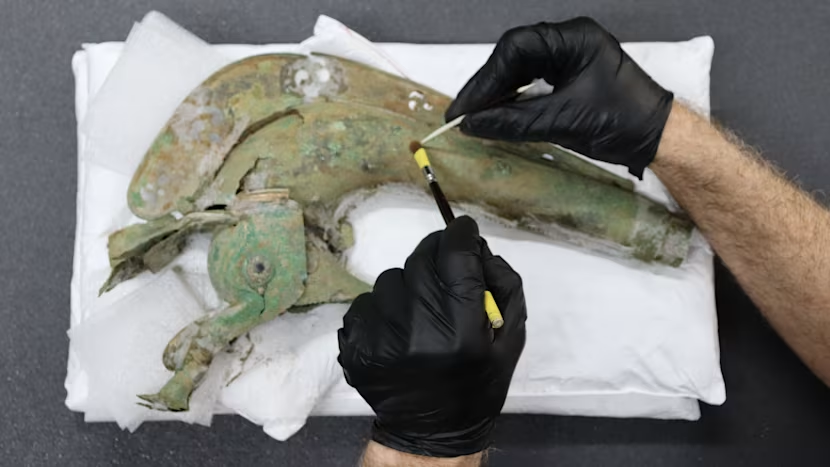
To preserve the delicate artefacts, specialists removed them inside a solid block of soil before scanning and conservation began. Historic England is now working closely with Norfolk Museums Service and the National Museum of Scotland — a leading authority on carnyx research — to study the objects in detail.

Scholars believe the find could transform our understanding of Iron Age soundscapes, ritual practice, and warfare. The trumpet’s unique completeness will allow researchers to examine how it was constructed and possibly even reconstruct the sounds that once echoed across Celtic battle lines.

Why the Carnyx Matters in European History

The carnyx was widely used across Celtic Europe between 300 BC and AD 200 and appears in Roman reliefs as a captured war trophy. Examples have previously been discovered in France, Switzerland, and Scotland, but intact finds remain extremely rare. The most famous reconstruction, the Deskford Carnyx from Scotland, has already demonstrated how powerful and haunting the instrument’s sound could be.

This new Norfolk discovery adds vital data to that growing picture, helping historians interpret how music, ritual, and warfare intertwined in ancient societies.
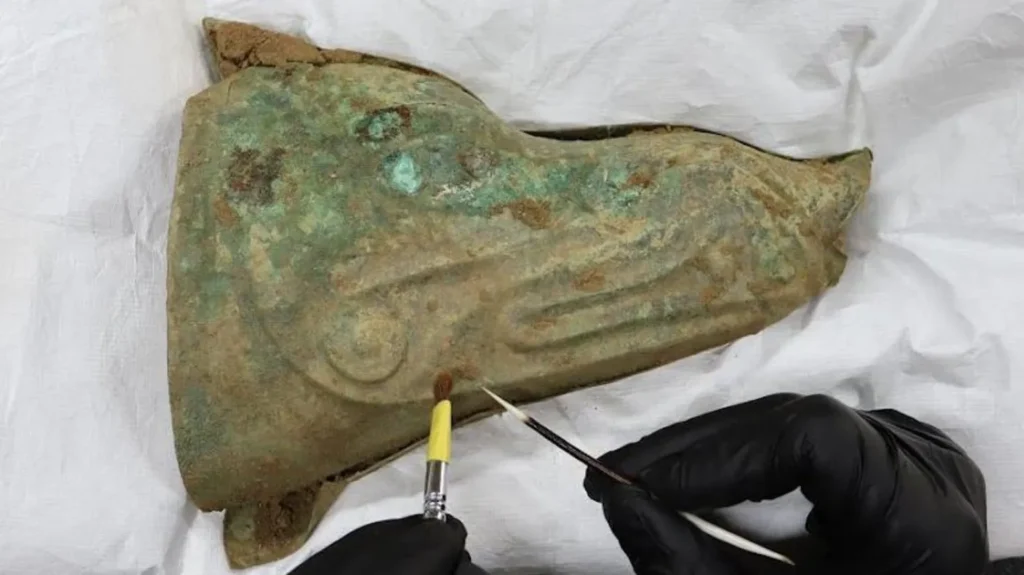

The boar’s head standard, crafted from exceptionally thin sheets of bronze, was discovered alongside the carnyx and is considered even rarer than the musical instrument itself. Likely carried aloft as a battlefield emblem and rallying symbol for Iron Age warriors, the piece survives in remarkable condition after more than 2,000 years underground. Credit: Norfolk Museums Service.

The boar’s head standard, crafted from exceptionally thin sheets of bronze, was discovered alongside the carnyx and is considered even rarer than the musical instrument itself. Likely carried aloft as a battlefield emblem and rallying symbol for Iron Age warriors, the piece survives in remarkable condition after more than 2,000 years underground. Credit: Norfolk Museums Service.

Next Steps for the Norfolk Carnyx Hoard

A coroner’s inquest will determine whether the hoard will legally be declared treasure, after which decisions will be made regarding its long-term home. Museums and researchers are hopeful the artefacts will eventually be displayed publicly so the community that once lived on the land can share its rediscovered story.

Experts agree that the Norfolk Carnyx Hoard is more than an isolated discovery — it is a vivid reminder of a culturally rich and militarily sophisticated Iron Age world that continues to shape Britain’s historical identity.

Pre-Construct Archaeology

Cover ımage credit: Norfolk Museums Service.

Related Articles

Ukrainian Soldiers Uncover 6th–5th Century BC Burial Site During Fortification Works

1 April 2025

1 April 2025

In a remarkable archaeological find, soldiers from the 123rd Territorial Defence Brigade have uncovered an ancient burial site dating back...

Alexander the Great’s Bathroom Discovered at Greece’s Aigai Palace

11 May 2024

11 May 2024

Archaeologists say to have unearthed Alexander the Great’s bathroom at the Aigai Palace in northern Greece. The vast Aigai palace,...

What Lies Beneath Bor Ovoo? Turkish and Mongolian Researchers Set to Unearth Ancient Nomadic Traditions

20 July 2025

20 July 2025

Renowned historian Prof. Dr. Kürşad Yıldırım, a leading expert in Central Asian nomadic cultures from Istanbul University, is spearheading a...

Archaeologists Unearth 78,000-Year Oldest Human Burial

5 May 2021

5 May 2021

A 78,000-year-old group of bones discovered at the mouth of a Kenyan coastal cave constitutes the oldest recorded formal human...

Egypt unearths 2,300-year-old remains of Greco-Roman town in Alexandria

28 August 2021

28 August 2021

An Egyptian archeological team discovered the ruins of a Greco-Roman residential and commercial town in the north coast city of...

Gold glass ‘Roma’ unearthed in the excavations of the Rome subway

7 February 2023

7 February 2023

A very rare and refined piece of gold glass representing ‘Roma’, the woman symbol of the Eternal City, has been...

Archaeologists discovered the first evidence of early administrative management in eastern Iran

21 June 2022

21 June 2022

Iranian archaeologists believe they have discovered the first evidence of early administrative management in an eastern Iranian province, which they...

Unique Lion-Headed Handles Unveiled from a Roman-Period Cist Tomb Near Khirbat Ibreika

30 April 2025

30 April 2025

Beneath the ancient dust of Khirbat Ibreika in southern Israel, archaeologists have unearthed an unexpected enigma: four bronze discs, each...

Archaeologists Discover Hidden Roman Hoard in Romania’s Oldest City

18 September 2025

18 September 2025

The National Museum of Romanian History (MNIR) has announced groundbreaking archaeological findings at the ancient site of Histria, one of...

“Ladies of Anavlochos”: Crete’s Puzzle in Pieces

9 May 2025

9 May 2025

Perched high on the rugged slopes of Mount Anavlochos, overlooking the azure expanse of the Mediterranean Sea, lie the silent...

Stone reliefs describing the Persian-Greek wars were found in the ancient city of Daskyleion in northwestern Turkey

16 August 2021

16 August 2021

A relief depicting a fifth-century BC battle between the Greeks and Persians was discovered in the ancient city of Dascylium...

The 3,000-Year-Old Ancient City is Under Danger

8 February 2021

8 February 2021

For the port planned to be built in Izmir’s Aliağa district, a part of the 3,000-year-old ancient city is in...

Bone tools for bleeding cows discovered in a 7,000-year-old cemetery in Sudan

24 March 2023

24 March 2023

During excavations in the Letti basin in northern Sudan, archaeologists have unearthed 7,000-year-old bone tools used to bleed cows. Explorers...

After 150 years, Schliemann’s destruction in Troy was repaired

8 August 2021

8 August 2021

Heinrich Schliemann, a German businessman, excavated the ancient city of Troy in northwest Canakkale province 150 years ago. Archaeologists are...

Medieval Rye: From Humble Weed to Powerful Staple – New Study Reveals Surprising Farming Secrets

27 May 2025

27 May 2025

Discover how medieval rye cultivation was far more advanced than previously believed. New research reveals intensive farming and fertilizing techniques...