
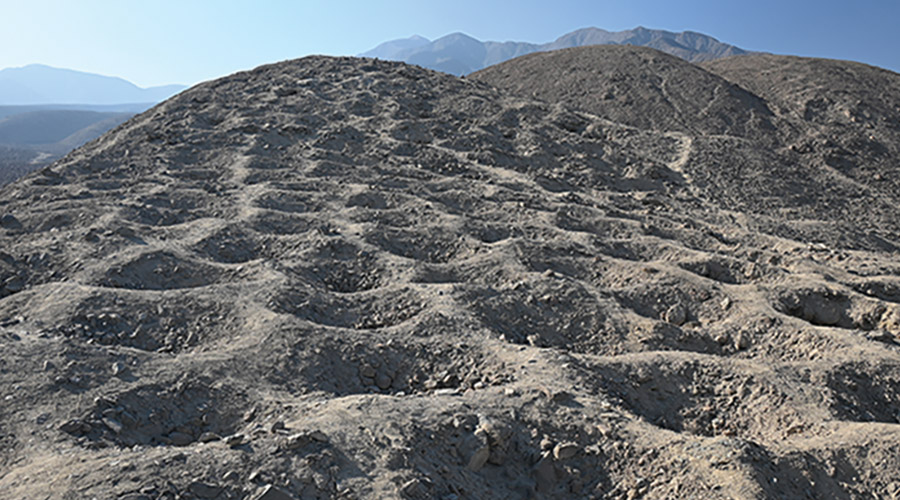
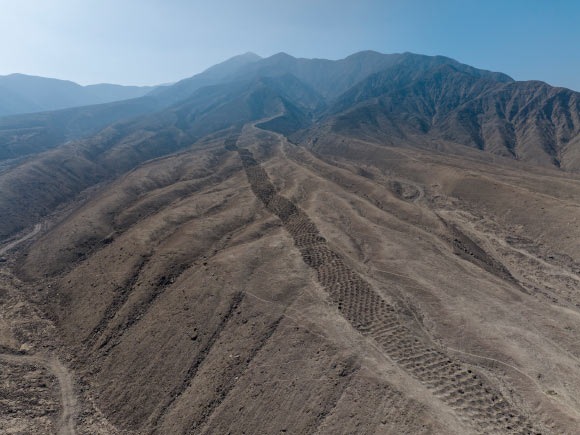
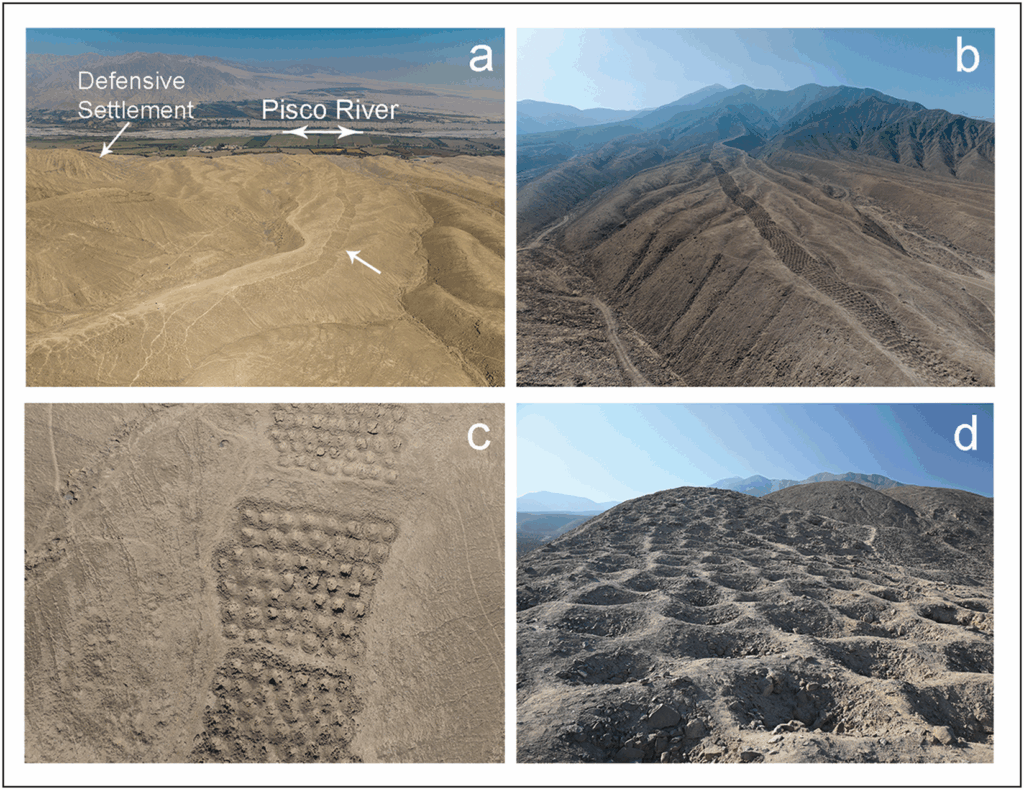
High in the arid foothills of southern Peru, thousands of mysterious holes carved into a rocky ridge have puzzled archaeologists for nearly a century. Known locally as Monte Sierpe (Serpent Mountain) or the Band of Holes, this ancient monument—spanning 1.5 kilometers and containing around 5,200 perfectly aligned cavities—may have finally revealed its secret.
A groundbreaking study led by Dr. Jacob Bongers from the University of Sydney, published in Antiquity in November 2025, proposes that Monte Sierpe once functioned as a prehistoric barter marketplace and later as an Inca accounting system. Using drone mapping and microbotanical analysis, researchers have uncovered evidence that connects the enigmatic site to ancient trade, social gathering, and sophisticated record-keeping practices.
Thousands of Holes, One Great Mystery
Monte Sierpe first captured global attention in 1933, when National Geographic published aerial photographs by explorer Robert Shippee. The images revealed a massive band of evenly spaced holes stretching across the Pisco Valley, about 35 kilometers from Peru’s Pacific coast. For decades, scholars debated their purpose—were they ancient graves, food storage pits, or part of a defensive system?
Dr. Bongers and his international team, however, found something more intricate. Their drone surveys revealed mathematical patterns in the arrangement of the holes—rows and clusters with repeating numerical structures. Even more surprisingly, these patterns closely resemble the layout of Inca khipus—knotted-string devices used for recording data, census numbers, and trade inventories.
“The regularity of the holes mirrors the logic of a khipu,” said Dr. Bongers. “It suggests a standardized form of counting or accounting that predates or coincides with Inca administration.”
Ancient Pollens Reveal a Bustling Trade Hub
To understand what the holes were used for, the researchers collected 21 soil samples from across the site. Under the microscope, they discovered ancient pollens and phytoliths—tiny silica structures from plants—of maize (corn), reeds, and other cultivated species. The presence of these agricultural traces indicates that the holes once held plant materials, baskets, or bundles of goods, possibly for trade.
Some samples also contained pollen from willow and bulrush, plants long used by Andean peoples for weaving baskets and mats. This detail reinforces the idea that goods were transported and stored in woven containers, suggesting an organized system of exchange.
“Finding maize and basket-making plants in these holes was a revelation,” explained Bongers. “It implies that people were bringing goods here, depositing them, and possibly trading them—just like in a pre-Inca marketplace.”
A Marketplace Before Money
The study proposes that Monte Sierpe served as a barter marketplace during the Late Intermediate Period (CE 1000–1400), when the Chincha Kingdom dominated southern coastal Peru. With an estimated population of over 100,000 people, the Chincha were renowned traders who managed vast networks connecting coastal, highland, and Amazonian regions through llama caravans and seafaring merchants.
Unlike modern markets that rely on currency, barter markets depended on direct exchange of goods—corn for cotton, fish for tools, or pottery for textiles. The thousands of holes, each large enough to hold a basket or bundle, could have represented individual trading units, allowing participants to display and compare goods in a fair and standardized way.
“Monte Sierpe may have been the Andean version of a flea market,” Bongers suggested. “A place where farmers, fishermen, and artisans came together to trade, negotiate, and socialize.”
From Barter to Bureaucracy: The Inca Connection
When the Inca Empire absorbed the Chincha Kingdom in the 15th century, Monte Sierpe’s function may have evolved. The Incas were master administrators who imposed a labor and tribute system known as mit’a and relied heavily on khipus for accounting.
The team discovered striking similarities between Monte Sierpe’s layout and a Pisco Valley khipu now housed in Berlin’s Ethnological Museum. Both display segment-based structures with repeating numerical sequences—potential evidence that the site transitioned from a marketplace into an Inca tribute center for collecting and recording goods such as maize or textiles.
Each section of holes might have represented a community or kin group, responsible for depositing their tribute in a specific area—essentially transforming Monte Sierpe into a landscape-sized ledger.
Rewriting the Story of Andean Innovation
Beyond solving one of Peru’s longest-standing archaeological mysteries, the study of Monte Sierpe redefines our understanding of Indigenous innovation and social organization. The site reveals how ancient peoples developed their own systems of accounting and commerce long before European contact, integrating mathematical logic, environmental design, and community cooperation.
“Monte Sierpe was more than just holes in the ground—it was a social technology,” said Bongers. “It brought people together and structured their economic and political relationships.”
Fighting Pseudoarchaeology and Preserving Heritage
Monte Sierpe has long been the target of speculative and pseudo-archaeological claims, often linked to “ancient astronaut” theories. Bongers’ team hopes their scientific findings will replace sensational myths with verifiable data.
“By combining drone mapping, radiocarbon dating, and botanical science,” Bongers emphasized, “we can tell the real story—one that celebrates Indigenous ingenuity rather than erasing it.”
A Monument to Human Collaboration
Today, Monte Sierpe stands as a silent testament to a vibrant network of ancient Andean traders, administrators, and craftspeople. Whether as a bustling marketplace or an imperial ledger, its 5,200 holes embody a timeless truth: trade, cooperation, and communication have always shaped civilization.
Bongers, J. L., Kiahtipes, C. A., Beresford-Jones, D., Osborn, J., Medrano, M., Dumitru, I. A., … Stanish, C. (2025). Indigenous accounting and exchange at Monte Sierpe (‘Band of Holes’) in the Pisco Valley, Peru. Antiquity, 1–19. doi:10.15184/aqy.2025.10237
Cover Image Credit: Bongers et al. (2025), Antiquity
