
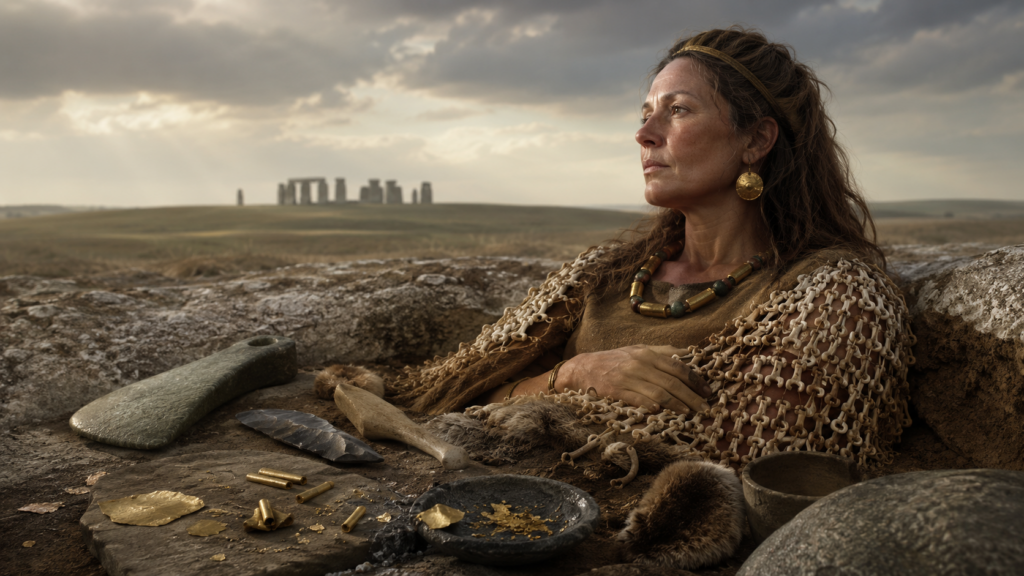
For more than two centuries, the person buried beneath a Bronze Age barrow near Stonehenge was described as a man. The size of the bones, the presence of battle axes and the unusual objects placed in the grave all seemed to support that assumption.
Ancient DNA has now rewritten the story.
The individual long known as the “Upton Lovell Shaman” was a woman. She lived around 4,000 years ago, was probably older than 45 when she died, and appears to have spent much of her life working with gold.
Her burial, discovered on Salisbury Plain less than 10 miles from Stonehenge, contained one of the most remarkable collections of craft tools known from Early Bronze Age Britain.
A conclusion made more than 200 years ago
The burial was first excavated in 1803 by William Cunnington, an early pioneer of British archaeology. Looking at what he considered unusually large bones, Cunnington concluded that the dead person “appeared to be a stout man.”
The identification remained largely unchallenged for generations.
The objects recovered from the grave seemed to reinforce the image. They included a battle axe, stone implements, animal remains and more than 40 perforated bone pieces that may once have decorated an elaborate cloak.
Because the assemblage was so unusual, the individual eventually became known as the “Upton Lovell Shaman.” The name was never a confirmed description of her role, but it reflected the mystery that surrounded the burial.
The grave did not resemble the resting place of an ordinary member of Bronze Age society. Whoever had been buried there had owned specialised objects, unusual clothing and tools connected with highly skilled work.
DNA overturns the old identification
Scientists at the Francis Crick Institute’s Ancient Genomics Laboratory analysed DNA taken from the woman’s skull, tooth and toe bone.
The results revealed XX chromosomes, typically associated with female biological sex.
Examination of the skeleton also suggested that she was over 45 years old when she died. Arthritis in her right wrist may be consistent with years of repeated manual work, including the use of tools, although skeletal damage alone cannot prove a particular occupation.
In this case, however, the objects buried beside her provide unusually strong supporting evidence.
The findings form part of ongoing ancient DNA research at the Francis Crick Institute and are featured in We Go Way Back, an exhibition examining how genetic science is changing what researchers know about people who lived in ancient Britain.
The full DNA study is expected to be published in a scientific journal.
Tools covered with microscopic traces of gold
The grave had suffered extensive damage from centuries of ploughing when archaeologist Colin Shell and Wiltshire researcher Gill Swanton returned to the site in 2000.
During the renewed investigation, Shell recovered additional human remains and noticed traces of gold on some of the stone objects associated with the burial.
Those traces transformed the interpretation of the grave.
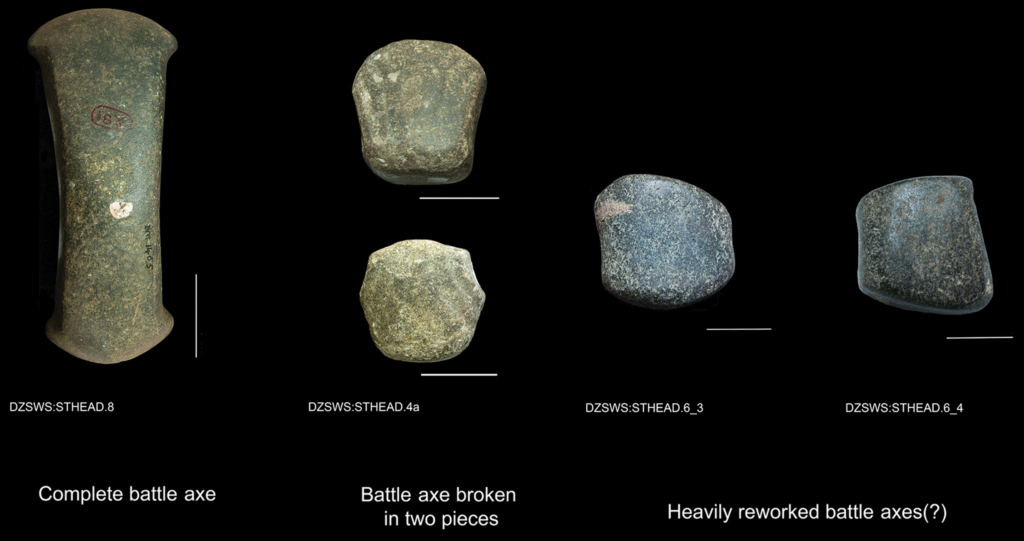
A later study by Oliver Harris, Rachel Crellin and Christina Tsoraki of the University of Leicester examined the objects in detail. Their research showed that many of the pieces had practical roles in gold production.
Some stone tools had been used to hammer, smooth and polish gold. Broken battle axes appear to have been reused as working surfaces or hammers. Small cups made from fossil sponges may have held adhesives used to attach thin sheets of gold to other objects.
What once appeared to be a strange collection of ritual items began to look like a carefully assembled goldworking toolkit.
The woman buried at Upton Lovell was not simply placed beside valuable objects. She was buried with the equipment and materials connected to a specialised craft that demanded experience, precision and technical knowledge.
A different picture of Bronze Age women
Goldworking in Early Bronze Age Britain was closely connected with status. Craftspeople produced ornaments and decorated objects for powerful individuals whose burials have been found across the Stonehenge landscape.
The Upton Lovell woman may have been one of the skilled people responsible for creating those objects.
Her identification challenges an assumption that shaped the interpretation of the burial for more than 200 years: that a person buried with axes, tools and specialist equipment was probably male.
It does not prove that women dominated gold production or that craft roles were divided in the same way across every Bronze Age community. It does show that an older woman could possess specialist knowledge and occupy an important place within the social world of prehistoric Britain.
Lisa Brown, curator at the Wiltshire Museum, said the research had created an entirely new understanding of the burial and placed women at the centre of the story of Early Bronze Age society.
The grave goods from the Upton Lovell burial remain on display at the Wiltshire Museum in Devizes. The new DNA findings are being presented at the Francis Crick Institute, where the woman once called a “shaman” is finally being seen not through a 19th-century assumption, but through the evidence left in her bones and tools.
Crellin RJ, Tsoraki C, Standish CD, et al. Materials in movement: gold and stone in process in the Upton Lovell G2a burial. Antiquity. 2023;97(391):86-103. doi:10.15184/aqy.2022.162
