
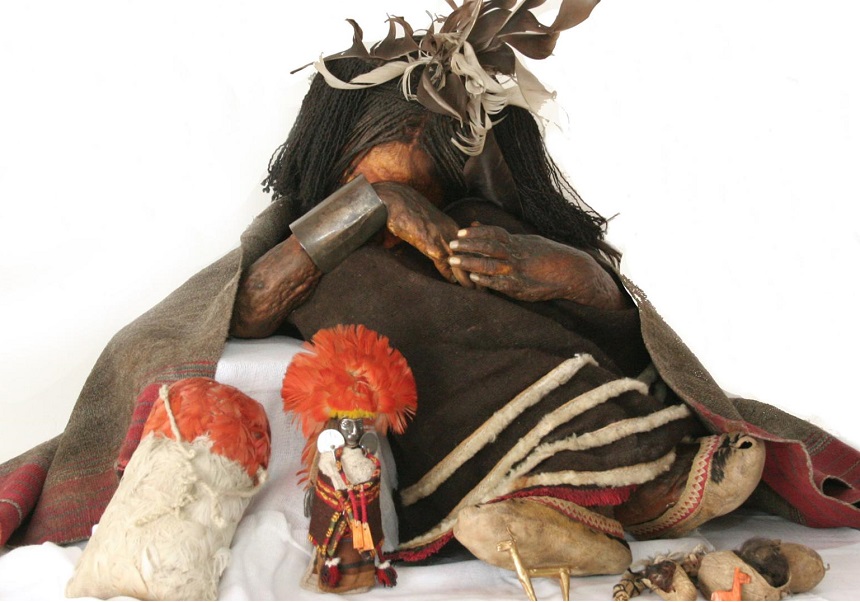
New forensic evidence overturns the decades-old theory that the eight-year-old child died from hypothermia during an Inca ceremony high in the Andes.
For more than 70 years, the death of the Inca child known as the Boy of Cerro El Plomo was largely attributed to freezing temperatures and extreme altitude. A new multidisciplinary investigation now concludes that the child most likely died after receiving a deliberate blow to the head during a Capacocha ritual sacrifice.
The naturally preserved body was discovered in 1954 at approximately 5,400 metres above sea level on Cerro El Plomo, a mountain overlooking central Chile. Researchers estimate that the boy was eight or nine years old when he died during the 15th century.
The study, led by researchers from the University of Valencia and published in Science Advances, combined CT scanning, forensic anthropology, dermatology, histology, biomechanical modelling, stable isotope analysis and radiocarbon dating. It also re-examined two young women recovered from Cerro Esmeralda in northern Chile, another site associated with the Inca Capacocha ceremony.
A Head Injury Hidden Beneath the Skin
The hypothermia explanation originated partly from apparent damage to the boy’s fingers, which was interpreted as cold-induced tissue death. Earlier examinations had also failed to identify clear signs of violence.
The new analysis found no microscopic or visible evidence of tissue damage caused while the child was alive by freezing temperatures. The skin on his hands and feet remained exceptionally well preserved, while histological examinations showed no inflammation or degeneration consistent with severe cold injury.
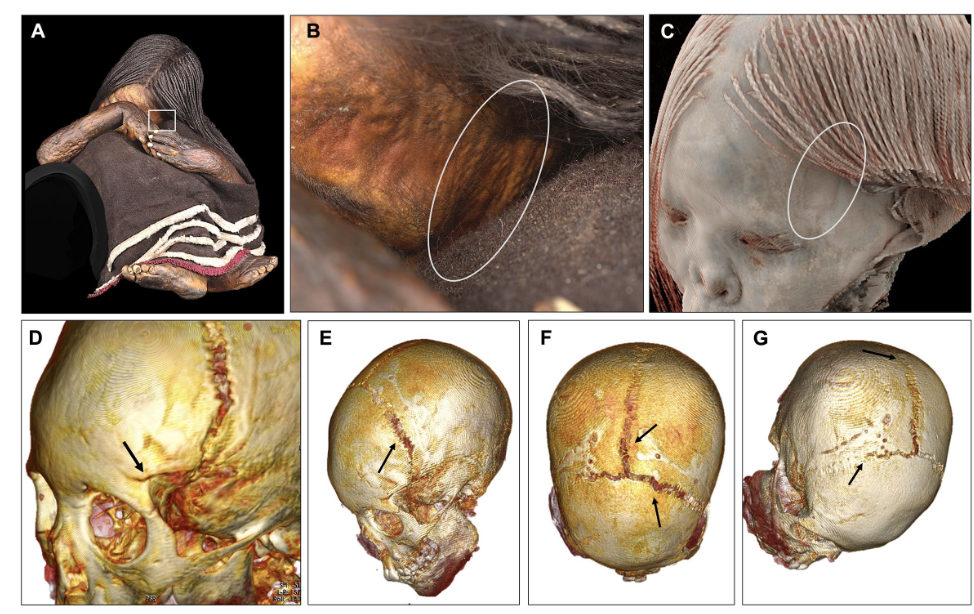
CT scans instead revealed an oval lesion on the left side of the forehead. Directly beneath it was a fracture in the frontal bone, accompanied by extensive separation along the coronal and sagittal sutures of the skull.
The alignment of the external lesion and internal fracture indicates a single, high-energy impact. Because there was no evidence of bone healing, researchers concluded that the injury occurred at or very close to the time of death.
According to the study, the position and direction of the trauma are more consistent with a targeted blow than an accidental fall.
Was an Inca Mace Used?
The team created a three-dimensional model of the child’s skull and used finite element analysis to test how different levels of force would affect the bone.
The simulations showed that an impact of approximately 2,800 newtons could have produced the fracture and displacement seen in the CT images. Among the possible objects examined, a blunt-lobed, star-shaped stone mace head produced the closest match to the shape of the injury.
The researchers stress that the modelling cannot identify the weapon with absolute certainty. However, the results demonstrate that a compact blunt implement of this type could have caused the fatal trauma.
The child may have been facing the person who struck him, with his head lowered. The blow appears to have crossed the left frontal region at an oblique angle, transferring force through the still-developing sutures of the juvenile skull.
Evidence of a Final Ceremonial Meal
CT imaging also revealed that the boy’s stomach contained food and that his oesophagus was dilated. Food residues were found on his clothing.
Researchers interpret this evidence as indicating that he ate shortly before death and vomited around the time of the fatal injury, possibly because of the rapid physiological effects of the cranial trauma.
After death, the body was carefully arranged in a seated position resembling sleep. The injured side of the forehead was placed against the left knee, concealing the damaged area.
Freezing temperatures at the summit then preserved the body, but the cold was probably responsible for its survival rather than its death.
Months of Pilgrimage Before the Sacrifice
The study also reconstructed the final months of the boy’s life by analysing stable isotopes preserved along strands of his hair.
Variations in oxygen, hydrogen, nitrogen, carbon and sulfur isotopes indicated sustained movement through several ecological regions. The pattern supports a long southward journey, possibly beginning in or passing through the northern Andes before reaching the Maipo-Mapocho region of central Chile.
The soles of the child’s feet provided additional evidence. Thickened skin and dark pigmentation indicated prolonged friction and repeated mechanical pressure, consistent with walking considerable distances.
These findings suggest that the ascent of Cerro El Plomo was only the final stage of a pilgrimage that may have lasted many months.
Capacocha, also written Qhapaq Hucha, was one of the most important state ceremonies of Tawantinsuyu, the Inca Empire. Children and young women were selected and taken through imperial territories before being offered at mountains regarded as sacred beings, ancestors, and powerful deities known as apus.
The journeys linked distant communities with the political and ceremonial centre of the empire. Local populations may have hosted the travelling groups and participated in communal meals, turning food and movement into instruments of imperial integration.
Cerro Esmeralda Strangulation Theory Rejected
The investigation also re-examined the remains of two females discovered at Cerro Esmeralda in the Atacama Desert in 1976. One was approximately nine or ten years old, while the other was around 18 or 19.
Marks around their necks had previously been interpreted as evidence of strangulation. The new CT scans found that their hyoid bones remained intact and correctly positioned, with no fractures or displacement.
The superficial neck impressions were more consistent with pressure from clothing or textiles than with ligatures.
Researchers could not determine an alternative cause of death because the bodies were damaged during their uncontrolled recovery, previous autopsies, and later handling. The study therefore does not rule out every form of neck compression, but it finds no convincing evidence supporting the longstanding strangulation theory.
Sacrifice as an Instrument of Inca Expansion
Radiocarbon dating places the Cerro El Plomo child and the two Cerro Esmeralda individuals broadly within the mid-15th century, when Inca authority was expanding across the southern Andes.
The results show that Capacocha did not follow a single method of killing. Death could involve blunt-force trauma, suffocation, exposure or other mechanisms depending on the ceremony and location.
What remained consistent was the carefully organised preparation: prolonged travel, ritual feeding, elaborate clothing, sacred landscapes and the formal placement of the body.
The Boy of Cerro El Plomo was therefore not simply a child who succumbed to the cold on a mountain. The new evidence presents his death as the final act of a state-directed pilgrimage in which sacrifice, political power and the sacred geography of the Andes were inseparably connected.
Verónica Silva-Pinto et al., Pilgrimage to sacrifice: Mechanisms, causes, and time of death of the Western Andean Capacocha of the Southern Tawantinsuyu.Sci. Adv.12,eadz9055(2026).DOI:10.1126/sciadv.adz9055
