
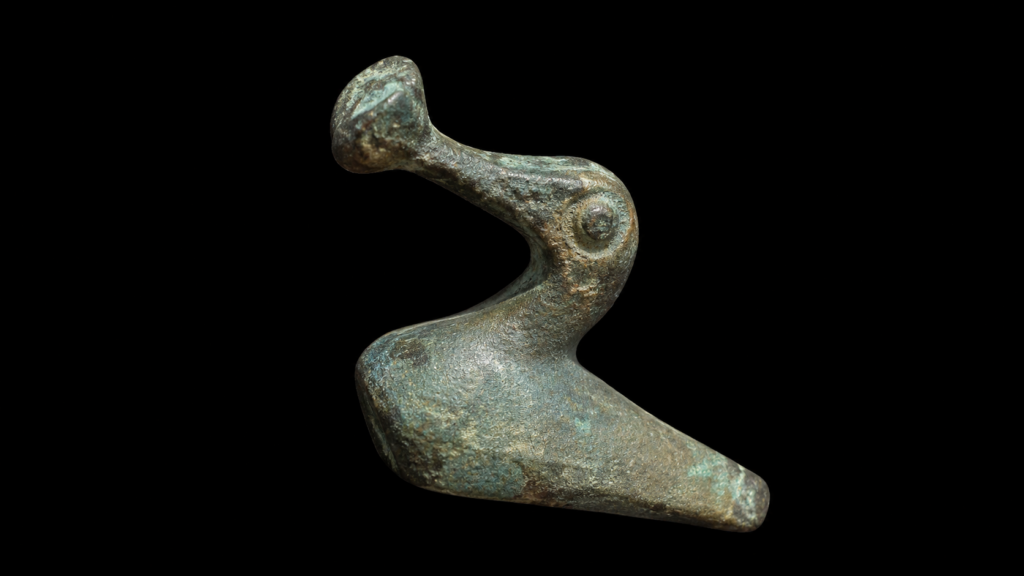
A tiny Celtic bronze duck dating back more than 2,000 years has been discovered on the surface of a field near Tučín in the Czech Republic. According to Czech Radio’s iROZHLAS, the remarkably well-preserved figurine measures only 23 millimetres in length and weighs less than 10 grams.
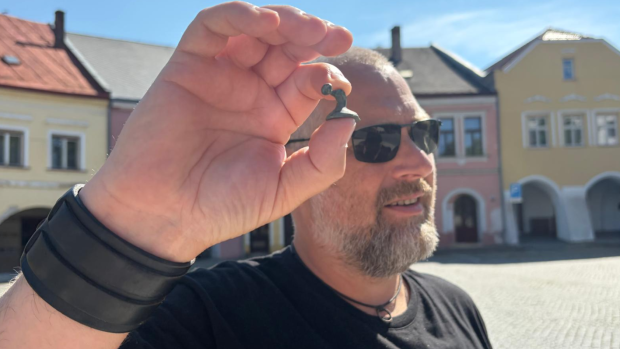
The object was found by Miroslav Komínek, an amateur archaeologist who works with the Comenius Museum in Přerov. Although Komínek usually relies on a metal detector during field surveys, no equipment was needed on this occasion. The bronze bird was lying exposed on the soil and could be seen with the naked eye.
Despite its small size, the figurine preserves several carefully modelled details. It has prominent rounded eyes, an elongated bill that widens at the tip, and a teardrop-shaped body. A series of transverse grooves at the rear appears to represent the duck’s tail feathers.
Archaeologist Zdeněk Schenk described it as one of the finest examples of a Celtic bronze animal figurine yet found in the Moravian Gate area around Přerov.
A Toy, Symbol or Decorative Fitting?
The original purpose of the Celtic bronze duck remains uncertain.
One possibility is that it functioned as a small toy or gaming piece. It may also have carried symbolic meaning connected with water birds. However, archaeologists consider it more likely that the figurine was originally attached to a larger object as a decorative fitting.
Without the object to which it may once have belonged, its precise function cannot be determined. Its intact condition nevertheless makes it an unusual discovery, particularly because agricultural activity often damages or displaces small metal artefacts found close to the surface.
The figurine has been broadly dated to the Celtic Iron Age, making it more than two millennia old. The La Tène cultural tradition associated with Celtic communities spread across much of Central and Western Europe from around the fifth century BCE until the Roman expansion. Metalwork from this period frequently incorporated stylised human, plant and animal forms.
Found Along the Ancient Amber Road
Tučín lies near the Moravian Gate, a natural corridor between the Carpathian and Sudeten mountain systems. For thousands of years, the low-lying passage provided an accessible route for migration and long-distance trade.
One branch of the Amber Road passed through this region, carrying Baltic amber south toward the Danube and Mediterranean world. Salt, metal objects and other goods travelled in the opposite direction.
According to Schenk, similar bronze animal figures have been found near important Celtic trading centres stretching from Poland through central Moravia to Lower Austria. The examples include miniature wild boars as well as water birds, suggesting that the Tučín duck belonged to a wider artistic and cultural tradition connected by the Amber Road.
Animal imagery appeared frequently in Iron Age Celtic metalwork. Surviving bronze objects depict boars, ducks, geese, swans, ravens, stags and rams. Some were independent figurines, while others decorated vessels, weapons, ceremonial equipment or personal accessories. Their meanings probably varied, ranging from ornament and social identity to ritual or protective symbolism.
The bronze duck is not the only ancient object recovered near Tučín. Finds from the surrounding landscape also include a Roman silver denarius. Both artefacts are expected to feature on a new educational trail being prepared by the municipality, which plans to present the archaeological history of the area to the public.
Cover Image Credit: Český rozhlas
