
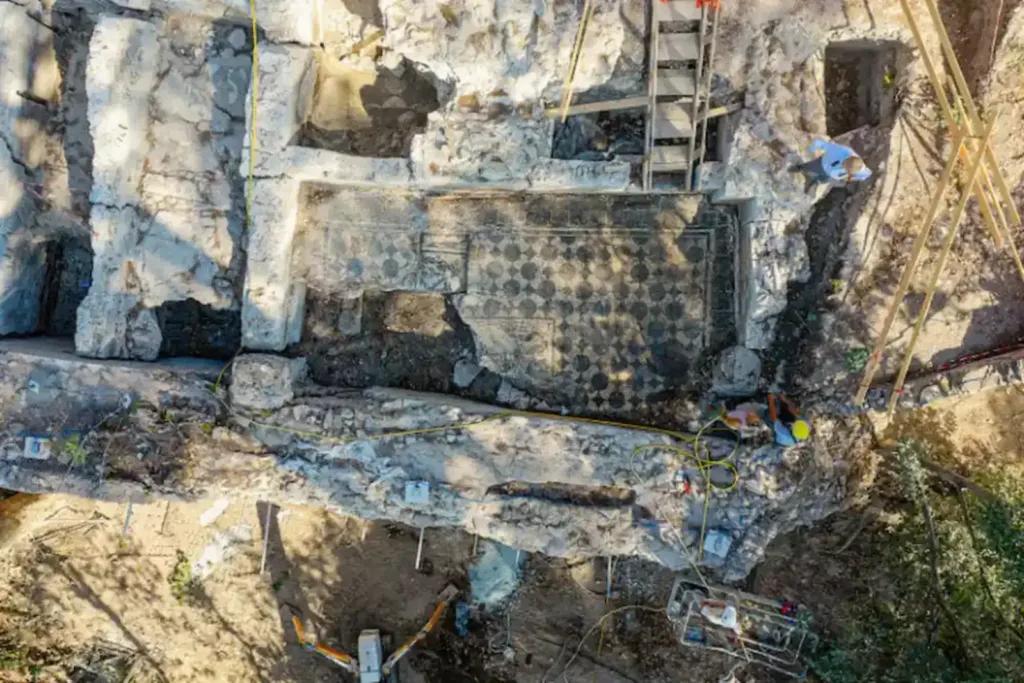
Archaeologists in Rome uncover a 2nd-century imperial complex beneath Villa Celimontana, with rare mosaics and frescoes hinting at a noble residence or ancient firefighters’ barracks.
A routine restoration job in one of Rome’s most beloved parks has turned into one of the most exciting archaeological finds of the year.
What began as a project to shore up a crumbling retaining wall inside Villa Celimontana has instead uncovered an elaborate Roman building from the 2nd century AD, complete with intricate mosaic floors, painted ceilings, and marble-clad walls that have survived remarkably intact beneath centuries of soil.
From Retaining Wall to Research Site
The discovery happened almost by accident. Engineers and archaeologists from Italy’s Ministry of Culture were carrying out consolidation work on the historic wall of Villa Celimontana — also known as Villa Mattei al Celio- when traces of ancient masonry began to emerge. As is so often the case in the Italian capital, a simple engineering job quickly evolved into a full archaeological excavation.
Daniela Porro, the Special Superintendent of Rome, described how a project meant purely to stabilize an old Roman support wall transformed into a research dig the moment excavators recognized the significance of what lay beneath. The excavation, funded through Italy’s PNRR recovery plan and part of the broader “Caput Mundi” program of 152 heritage interventions across the city, took several months and cost around two million euros to complete.
Eight Rooms, Five Fully Exposed
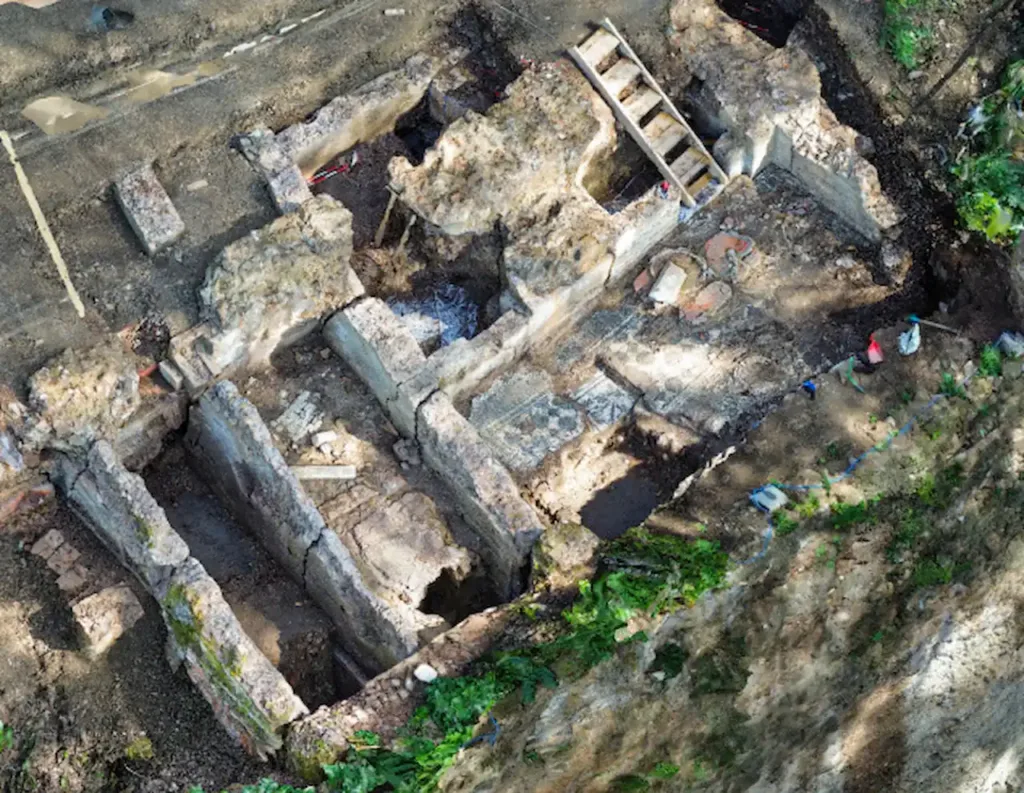
So far, archaeologists have brought to light eight rooms belonging to the imperial-era structure. Five have been completely excavated, while three remain partially buried. The building was originally constructed in the 2nd century AD and later remodeled during the 3rd century, suggesting it remained in active use — and likely in high esteem — for generations before it was ultimately abandoned sometime between the 5th and 6th centuries.
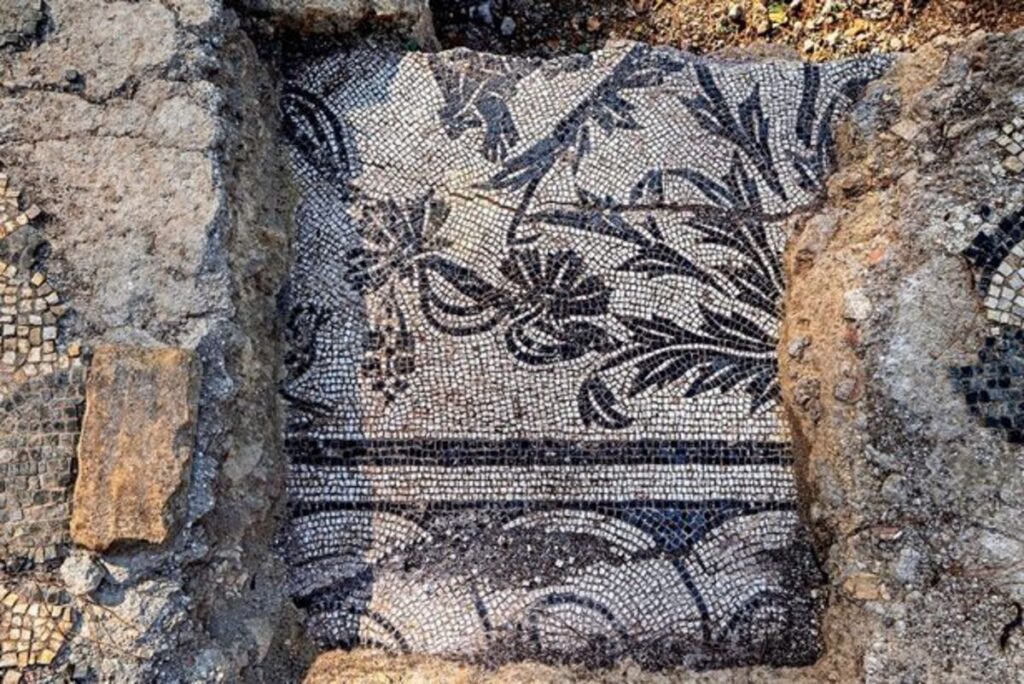
The standout find is a large mosaic floor featuring a dolphin, a fish, a lobster, and a crab, all arranged around a krater — the wide-mouthed vessel ancient Romans used to mix wine with water at banquets.
Beneath and around this later floor, excavators also found fragments of an even older mosaic dating to the Antonine period, along with extensive sections of painted ceiling and numerous pieces of luxurious marble paneling known as opus sectile. Taken together, the decorative program points to a building of considerable wealth and status.
A Noble Villa or a Firefighters’ Barracks?
What makes the find especially intriguing is that archaeologists aren’t yet sure exactly what the building was used for. One theory holds that the richly decorated rooms once belonged to a private residence owned by a member of Rome’s aristocracy: a fitting use for a site perched on a scenic hillside terrace near the Aqua Claudia aqueduct.
But a second, arguably more compelling theory has emerged as well. The building sits close to where historians have long placed the barracks of the Fifth Cohort of the Vigiles: the organization Emperor Augustus founded to protect Rome from fire and handle nighttime security across a city of over a million residents. Simona Morretta, the excavation’s scientific director, noted that inscribed and dated stone bases confirm a Vigiles barracks stood in the area as early as 111 AD, during the reign of Trajan. The Vigiles didn’t just fight fires; they also patrolled the streets after dark and could bring nighttime offenders to trial.
Supporting this theory, earlier excavations in the surrounding area had already turned up statue bases inscribed with the names of cohort members, along with the remains of small, modular living quarters that resemble soldiers’ barracks. Even the krater motif on the newly discovered mosaic has a direct parallel: similar imagery decorates communal rooms in the well-documented Vigiles barracks at Ostia, Rome’s ancient port city.
Should the barracks theory be confirmed, the discovery could reshape historians’ understanding of the full extent of one of Imperial Rome’s most important military and civic complexes — one dedicated not to conquest, but to keeping the capital safe.
What Happens Next
For now, the true function of the building remains an open question. Researchers plan to carry out further analysis of the structures, building materials, and surrounding archaeological context to determine which hypothesis holds up. Valentina Gemignani, speaking on behalf of Culture Minister Alessandro Giuli, praised the project as proof that heritage protection, scientific research, and public engagement can move forward hand in hand, even when a project starts out as basic infrastructure repair.
Once the scientific study is complete, officials say the site will be opened to the public — offering visitors a rare chance to walk through a slice of Imperial Rome that spent more than 1,500 years buried beneath one of the city’s most tranquil green spaces.
