
25 December 2025 The Future is the Product of the Past

Hunting tools Dating Back 1900 Years Found inside a Cave in Querétaro, Mexico

Archaeologists from the National Institute of Anthropology and History (INAH) found hunting weapons dating back approximately 1,900 years in a cave in the central state of Querétaro.

The Federal Ministry of Culture, in collaboration with the National Institute of Anthropology and History (INAH), recovered one of the few sets of pre-Hispanic hunting tools discovered in Mexico to date in a small gallery of the Cave of Treasure in Cadereyta de Montes, Querétaro. It consists of an atlatl (spear) and two wooden darts from the first century of our era.

According to a press announcement by INAH, the discovery was reported by members of the Association of Cavers of Querétaro.

The cave is situated 200 meters above the ravine floor, and once at its entrance, researchers ventured 200 meters through a narrow passage to reach the gallery.
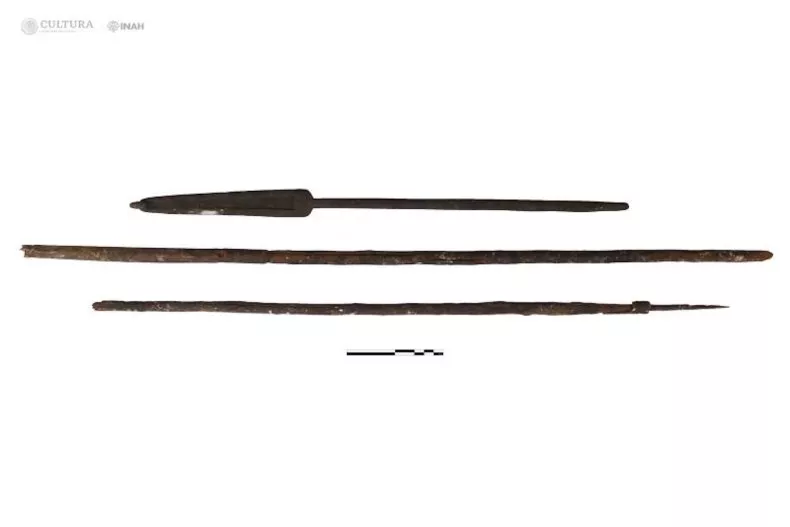
Photo: JESÚS E. MEDINA V. INAH

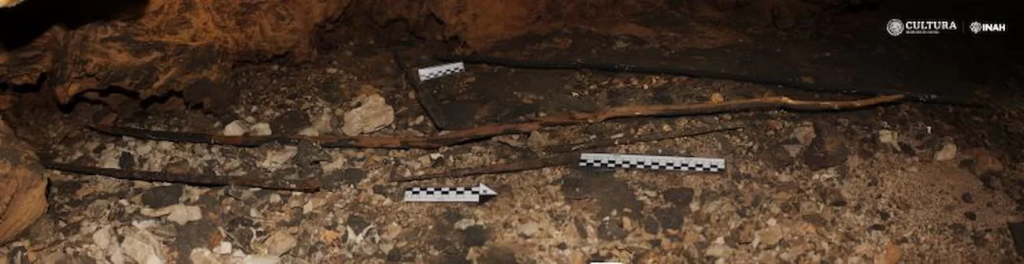
Within this underground branch, with an average height of 80 centimeters, specialists observed an atlatl (51.5 centimeters long), two fragmented darts (66 and 79 centimeters), and a pair of culturally modified wooden sticks (135 and 172 centimeters), likely used as digging sticks and multifunctional tools. The atlatl is a spear-throwing lever that significantly increases the range and velocity of thrown projectiles, making it possible to target prey at a greater distance than with bare-handed throwing.


📣 Our WhatsApp channel is now LIVE! Stay up-to-date with the latest news and updates, just click here to follow us on WhatsApp and never miss a thing!!


The dryness of the environment in the Treasure Cave allowed for the preservation of the hunting instruments, the age of which was determined using radiocarbon dating techniques. This gave a possible age range of A.D. 7-132.

During the exploration, the INAH team did not find other pre-Hispanic archaeological elements in the cave to provide an interpretation of why they were present in that remote location. However, the results of a sample analysis will be announced by the team on the 27th of January 2024.

The INAH archaeologists said the mystery of the latest discoveries will persist until new investigations are carried out in the areas surrounding the cave. This may enable experts to determine how and why these instruments were left there.

Cover Photo: General view of the In Situ instruments inside the gallery. Photo Jesús E. Medina V., INAH

Related Articles

Habib-i Neccar Mosque, one of the first mosques in Anatolia, was destroyed in the earthquake

12 February 2023

12 February 2023

Antakya Habib-i Neccar Mosque, one of the first mosques built in Anatolia, was destroyed in the earthquake that killed tens...

Roman-era marble sundial found for the first time in Turkey’s second Ephesus

26 September 2022

26 September 2022

Archaeologists have unearthed a Roman-era marble sundial in the ancient city of Aizanoi in the Çavdarhisar district of Kütahya province...

İnteresting Relief on the Roman Millstone

20 February 2021

20 February 2021

During the Cambridgeshire A14 road improvement work, workers found an interesting millstone. A large penis was engraved in the Roman-era...

A hungry Badger uncovers the largest collection of such coins ever discovered in northern Spain

11 January 2022

11 January 2022

Archaeologists have uncovered a rich trove of 209 Roman-era coins in northwestern Spain, due to the apparent efforts of a...

Paleontologists have discovered a new species of giant rhino

18 June 2021

18 June 2021

Paleontologists studying in China have found a new species of gigantic rhinoceros, the world’s biggest land animal. According to a...

Seven metal detectorists found 2,584 silver coins in a southwest England field “the most expensive treasure ever found in the United Kingdom”

27 October 2024

27 October 2024

In early 2019, seven metal detectorists found a cache of 2,584 silver coins dating to the Norman Conquest that had...

Hidden Treasure from WWII: 500,000 Phantom Ceramic Coins Found

8 November 2024

8 November 2024

About 500,000 Maboroshi (phantom) ceramic coins manufactured due to metal shortages during World War II were discovered in a warehouse...

New insights into Scotland’s ‘bodies in the bog’

31 March 2022

31 March 2022

Fourteen bodies were found at Cramond near Edinburgh in 1975. New research suggests that two of the remains of these...

500-year-old curse tablet found in Germany

15 December 2023

15 December 2023

In the city of Rostock on Germany’s northern coast, archaeologists found a lead curse tablet invoking Satan and two other...

148 Ancient Tombs Spanning 2,100 Years Unearthed in the Construction Area of the Zoo

18 August 2024

18 August 2024

An ancient burial site with 148 tombs,  spanning over 2,100 years, has been discovered on the construction site of the...

Who really fought in the Battle of Himera? Researchers found the answer to the question

14 May 2021

14 May 2021

According to the Ancient Greek Historians, victory over the Carthaginians in the Battle of Himera was won by the alliance...

5,700-Year-old Ancient “Chewing Gum” Gives Information About People and Bacteria of the Past

4 April 2021

4 April 2021

Researchers at the University of Copenhagen have successfully extracted the complete human genome from “chewing gum” thousands of years ago....

19 funerary tombs from Roman times were discovered in Tartus, Syria

27 May 2022

27 May 2022

During search and excavation operations in the archaeological area of Amrit in Tartus, Syria, a joint excavation team from the...

A 2,200-Year-Old Monumental Pyramidal Structure Discovered in the Judean Desert

26 March 2025

26 March 2025

In a remarkable archaeological breakthrough, Israeli archaeologists have uncovered a monumental pyramidal structure in the Judean Desert, dating back 2,200...

Ancient Hittite Archives Unearthed at Kayalıpınar: 56 Cuneiform Tablets and 22 Seal Impressions Found

18 September 2025

18 September 2025

Archaeologists excavating the ancient Hittite city of Kayalıpınar (ancient Šamuḫa) in Sivas province have uncovered a remarkable collection of 56...