10 January 2026 The Future is the Product of the Past

Bronze Age Treasure Found in Swedish Forests

A man who studied the forest to make a map for the orienteering club in western Sweden made an incredible discovery.

Cartographer Thomas Karlsson first learned that the treasure he thought was a fake was 2500 years old and belonged to the bronze age.

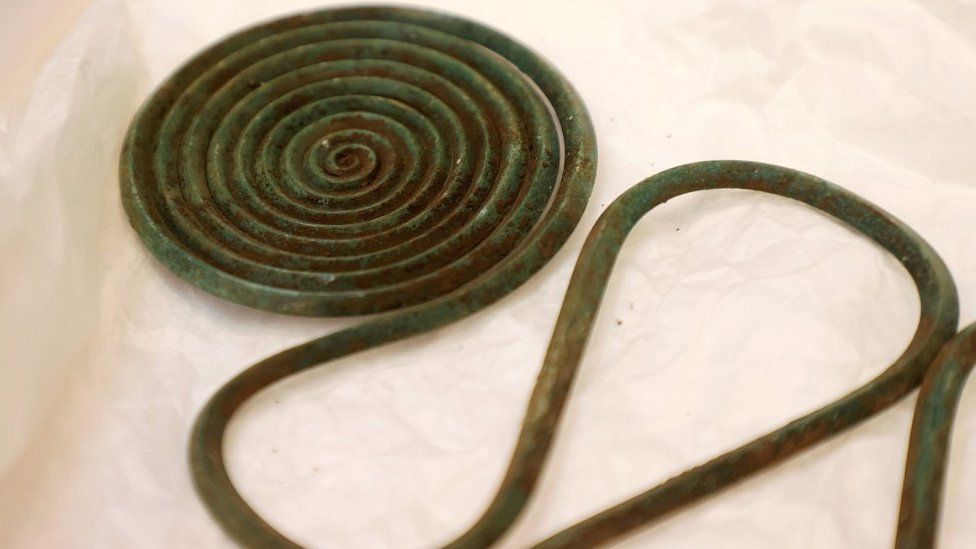
Found treasure, It includes about 50 items, such as necklaces, bracelets and clothing pins.

The cartographer, Thomas Karlsson, said “I first thought it might be a lamp, but when I looked closer I saw that it was old jewelry”.

According to Swedish archaeologists, it is very rare to find such a hoard in a forest. Such gifts were typically left in rivers or wetlands by ancient tribes. The hoard was on the forest floor, next to rocks.


📣 Our WhatsApp channel is now LIVE! Stay up-to-date with the latest news and updates, just click here to follow us on WhatsApp and never miss a thing!!


They have been dated between 750 and 500 BC.
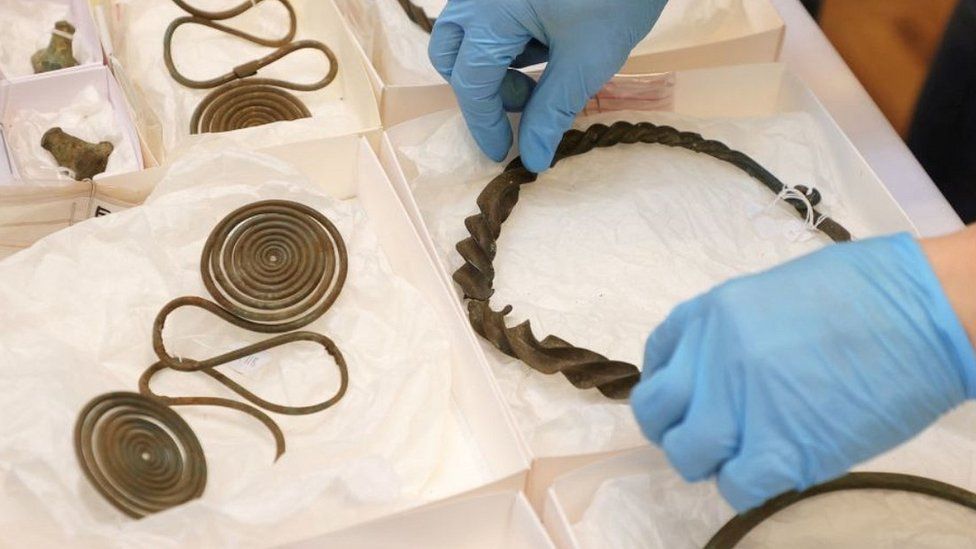
It is one of Sweden's most spectacular Bronze Age finds
It is one of Sweden’s most spectacular Bronze Age finds.AFP

When staring down at a map he was working on, Mr. Karlsson noticed the metallic glint. Since the ornaments were in such fine repair, he first assumed they were copies. Then, while drinking coffee in the park, he emailed a local archaeologist, according to the regional newspaper Goteborgs-Posten.

The forest is located near the town of Alingsas, about 48 kilometers (30 miles) northeast of Gothenburg.

Archaeologists refer to it as a “depot” discovery, which means it was intentionally left as a sacrifice to a deity or gods, or to invest in life after death.

The jewelry “is extremely well preserved”, said Prof Johan Ling, lecturer in archaeology at Gothenburg University.

“Most of the items can be linked to a woman, or women, of high status,” he said, quoted by Goteborgs-Posten.
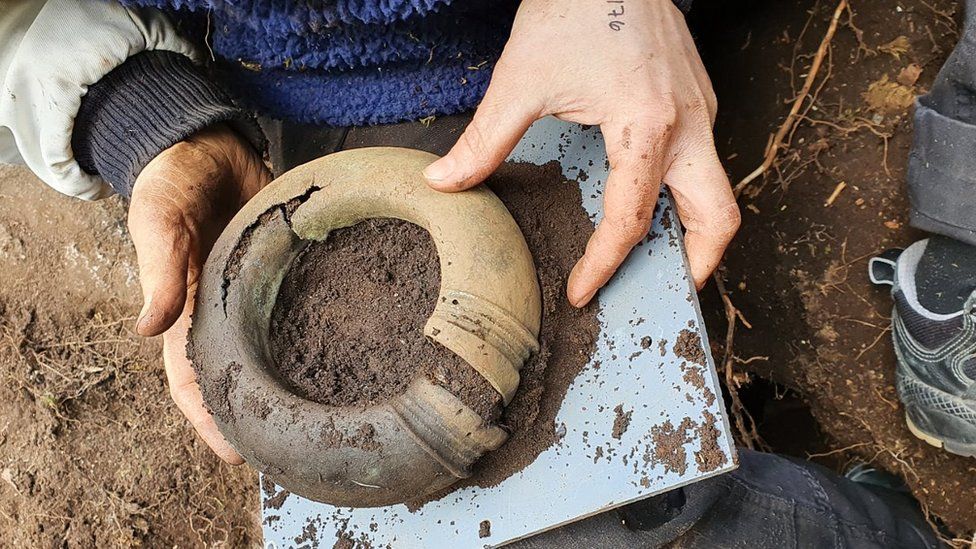
Celtic torcs
This is believed to be an ankle ring, similar to Celtic torcs. Photo: MATS HELLGREN/VGREGION

The treasure includes a type of rod used to spur on horses, previously found in neighbouring Denmark, but not in Sweden.

Since such antiquities are considered state property in Sweden, anyone who discovers them is required by statute to contact the police or municipal authority. The Swedish National Heritage Board then agrees on a monetary award, if any, for the finder.

Mr. Karlsson said a reward “would be a nice bonus, but it’s not very important to me.

“It’s fun to be a part of exploring history. We know so little about that era because there are no written sources.”

The Bronze Age lasted in Scandinavia from about 1700BC to 500BC, until it gave way to the Iron Age. The Iron Age lasted until about the year 800 when the Viking Age began.

Pernilla Morner, an antiquities expert for the Vastra Gotaland region, said that “not since the bronze shields from Froslunda were excavated from a field in Skaraborg in the mid-1980s has such an exciting find from the Bronze Age been made in Sweden”.

VGRfokus, a news site for Vastra Gotaland, says a team of Gothenburg archaeologists is now investigating the site in detail.

Source: BBC

Related Articles

Archaeologists deciphered the Sabaean inscription on a clay jar finds link between King Solomon and the Queen of Sheba

3 April 2023

3 April 2023

Archaeologists deciphered a partially preserved inscription that was found on the neck of a large jar dated back to the...

HS2 archaeologists discover Romanization of Iron Age village in Britain

12 January 2022

12 January 2022

Archaeologists have uncovered a vast Roman trading town on Britain’s HS2 high-speed rail route. Evidence found during a dig of...

Manot Cave yielded evidence for ritualistic gathering 35,000 years ago, the earliest on the Asian continent

13 January 2025

13 January 2025

Archaeological research at the Manot Cave in what is now the Galilee in northern Israel has uncovered evidence of ritualistic...

Neanderthal Fingerprint on 50,000-Year-Old Pebble Could Be Europe’s Oldest Portable Artwork

29 May 2025

29 May 2025

New analysis reveals that a pebble marked with ochre and a fingerprint could be the earliest known example of transportable...

Archaeologists find evidence of how Iron Age Britons adapted to the Roman conquest in Winterborne Kingston

29 June 2024

29 June 2024

Archaeologists from Bournemouth University (BU) have discovered human remains and artifacts which give new insight into how early Britons adapted...

Ancient Eco-Tech Uncovered in Lebanon: Phoenicians Used Recycled Pottery for Hydraulic Lime Plaster 2,700 Years Ago

23 July 2025

23 July 2025

Excavations at Tell el-Burak Reveal Technological Innovation and Early Sustainable Construction in Iron Age Lebanon In a major archaeological breakthrough,...

The altar of Zeus Temple discovered in western Turkey

1 September 2023

1 September 2023

Archaeological excavations in the ancient city of Magnesia, located in the western province of Aydın’s Germencik district, have uncovered the...

Rare Medieval Amethyst Jewel Discovered in Castle Kolno’s Moat

24 July 2025

24 July 2025

A stunning medieval amethyst jewel, believed to date back over 600 years, has been discovered in the moat of the...

Archaeologists Uncover Rare Trojan War-Era Armor from 1200 BCE in Czechia

22 July 2025

22 July 2025

A remarkable archaeological discovery in South Moravia has brought new insights into Bronze Age Europe and its warrior elites. The...

Archaeologists identify a sunken Nabataean temple dedicated to the God Dusares at Pozzuoli

12 April 2023

12 April 2023

Off the coast of Pozzuoli on the Phlegrean Peninsula in Campania, Italy, underwater archaeologists have identified a sunken Nabataeans temple...

Ancient Thracian Royal Palace Uncovered in Vratsa, Bulgaria: Possible Seat of the Powerful Triballi Ruler

14 July 2025

14 July 2025

Archaeologists have unearthed what may be one of the most significant Thracian discoveries of the 21st century: the remains of...

First Trilobite Fossil Amulet from Roman Early Empire (1st–3rd Century CE) Found in Spain

22 July 2025

22 July 2025

In a discovery that may reshape our understanding of how ancient Romans perceived the natural world, archaeologists have uncovered a...

Oldest found human traces on Roof of the World, Is it art?

21 October 2021

21 October 2021

Dr. David Zhang and his team’s investigations of Quesang on the Tibetan Plateau in 2018 and 2020 sparked controversy, along...

Underneath an Illegal Excavation House, a Subterranean City Is Revealed!

25 June 2021

25 June 2021

Upon the information that illegal excavations were carried out in a house in the İscehisar district of Afyonkarahisar in western...

In French Necropolis 21 Roman “curse tablets” discovered including one written in the extinct Celtic language of Gaulish

18 January 2025

18 January 2025

During the excavation of an eighteenth-century hospital in north-western France by researchers from the Orléans Archaeological Service, a 2,000-year-old necropolis...