
11 February 2026 The Future is the Product of the Past

Riddle of Former Crater Lakes in the Highest Mountains of the Sahara Solved

An interdisciplinary research team, led by scientists from the Free University of Berlin and the Max Planck Institute for Meteorology, was able to show how deep lakes could form in the craters of the Tibesti Mountains around 9,500 years ago and persist for over 5,000 years.

In a study published in Nature Communications, researchers have unveiled surprising insights into the climate history of the Central Sahara. During the mid-Holocene, around 7,000 years ago, the Tibesti Mountains — the highest range in the Sahara — experienced extreme rainfall levels, driven not by the well-known West African monsoon, but by moisture-laden winds from the Mediterranean Sea.

This study not only provides insights into the paleohydrological changes between the Tibesti, located in present-day Chad, and the Saharan plains during the North African Humid Period, but also demonstrates the importance of spatially high-resolution paleoclimate simulations.

Deep Lakes in a Desert Heart

Sedimentary records from the craters Trou au Natron and Era Kohor show that these once barren landscapes once hosted deep, freshwater lakes. Trou au Natron reached depths of over 330 meters, while Era Kohor filled to around 130 meters. Such massive bodies of water in the middle of today’s arid Sahara were made possible by a climate system far different from what scientists had previously imagined.

A Mediterranean Connection

For decades, experts assumed the African Humid Period — also known as the Green Sahara — was primarily driven by intensified monsoon rains from the south. But high-resolution climate models reveal a different story: strong orographic uplift in the Tibesti Mountains allowed moisture-rich north-easterly winds from the Mediterranean to release enormous rainfall over the region. This process created precipitation levels at least ten times higher than in the surrounding plains.


📣 Our WhatsApp channel is now LIVE! Stay up-to-date with the latest news and updates, just click here to follow us on WhatsApp and never miss a thing!!


Lead author Philipp Hoelzmann from Freie Universität Berlin emphasizes the significance: “Our study demonstrates that the Mediterranean, not just the African monsoon, played a crucial role in sustaining high-altitude lakes in the Sahara.”

Why the Lakes Differed

Interestingly, the two crater lakes did not behave in the same way. Trou au Natron, located in the northwestern Tibesti, was sustained by heavy Mediterranean-fed rainfall. Era Kohor, in the southeastern Tibesti, received much less precipitation due to its leeward position. This explains the dramatic differences in water volumes between the two lakes.
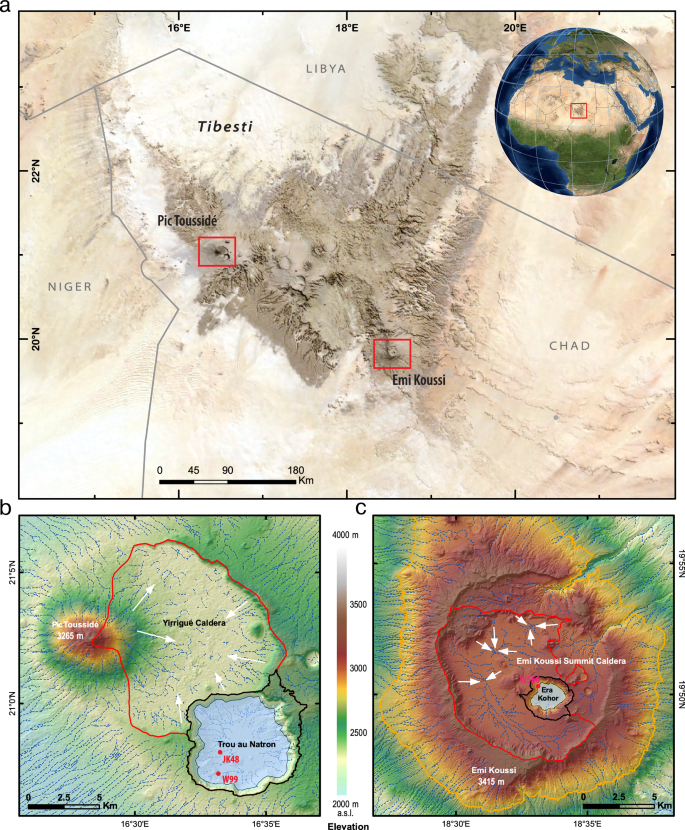
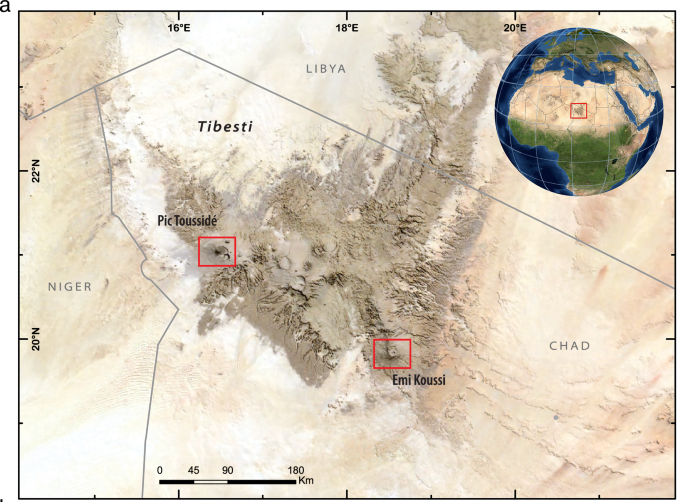
Satellite image of the Tibesti Mountains and close-up maps of the Trou au Natron and Era Kohor craters. Credit: Hoelzmann, P., Claussen, M., Dallmeyer, A. et al.

Rethinking Climate Models

The research team combined sediment analysis, satellite-based terrain studies, and advanced 5-kilometer resolution climate simulations to reconstruct the hydrological balance of these ancient lakes. Their results highlight a major shortcoming in current Earth System Models: they smooth out mountainous terrain, underestimating orographic rainfall. As a result, past simulations have failed to capture localized wet zones within the Sahara.

“By resolving the fine-scale topography, we discovered that precipitation in Tibesti was far greater than previously thought,” explains co-author Martin Claussen of the Max Planck Institute for Meteorology. “This has huge implications for both past and future climate scenarios.”

Lessons for the Future

The findings not only reshape our understanding of Sahara’s climate history but also carry warnings for the future. As global warming intensifies, climate models project wetter conditions in the Sahel and southern Sahara. However, without accounting for mountainous orography, these models may miss crucial details about where extreme rainfall — and potentially devastating floods — could occur.

The Sahara’s past is a reminder that deserts are not eternally dry wastelands. Under the right conditions, even the world’s largest hot desert can bloom with lakes and life. As scientists refine climate predictions, the Tibesti Mountains stand as both a historical archive and a warning system for future environmental shifts.

Hoelzmann, P., Claussen, M., Dallmeyer, A. et al. Mid-Holocene extreme precipitation in the Tibesti, Central Sahara. Nat Commun 16, 7426 (2025). https://doi.org/10.1038/s41467-025-62769-9

Cover Image Credit: Hoelzmann, P., Claussen, M., Dallmeyer, A. et al.

Related Articles

Uncovering the ritual past of ancient mustatils: Cult, herding, and ‘pilgrimage’ in the Late Neolithic of north-west Arabia

16 March 2023

16 March 2023

Mustatils—stone monuments from the Late Neolithic period thought to have been used for ritual purposes—have been the subject of new...

7,000-year-old Ritual Complex Found In Jordan Desert

23 February 2022

23 February 2022

The team of French and Jordanian archaeologists has discovered a 7,000-year-old ritualistic complex near what is thought to be the...

A princely tomb discovered in the infrastructure project of the A7 Ploieşti-Buzău highway in Romania

20 December 2022

20 December 2022

An impressive archaeological discovery took place on the Ploiești-Buzău section of the Moldova Highway. The excavations uncovered a princely tomb,...

A Rock-Cut Temple and Inscriptions from the Neolithic period discovered in Saudi Arabia

6 August 2022

6 August 2022

In a project led by the Saudi Heritage Commission, a multinational team of archaeologists has discovered an 8,000-year-old archaeological site...

A 3,300-year-old tablet found at Büklükale from Hittite Empire describes catastrophic invasion of four cities

11 March 2024

11 March 2024

Archaeologists have unearthed a 3,300-year-old clay tablet depicting a catastrophic foreign invasion of the Hittite Empire in Büklükale, about 100...

1,600-Year-Old Tomb of First Maya King Discovered in Caracol, Belize

11 July 2025

11 July 2025

Archaeologists have unearthed the 1,600-Year-Old Tomb of First Maya King at Caracol, Belize, marking one of the most significant Maya...

Derinkuyu: A Subterranean Marvel of Ancient Engineering with 18 Levels and Capacity for 20,000 Inhabitants

2 May 2025

2 May 2025

Beneath the sun-drenched plains of Cappadocia, where otherworldly “fairy chimney” rock formations pierce the sky, lies a secret world carved...

Electoral inscriptions just discovered in Pompeii reveal clientelism in ancient Rome

29 September 2023

29 September 2023

Several electoral inscriptions, the ancient equivalent of today’s electoral posters and pamphlets, have appeared on the walls of the room...

3 Bronze Shields and Helmet of 2700 Years Old Belonging to Urartians Found in Ayanis Castle

8 September 2024

8 September 2024

Three bronze shields and a bronze helmet dedicated to Haldi, the chief god of the Urartians, were discovered during excavations...

One of the oldest known mosques in the world uncovered in Israel

23 June 2022

23 June 2022

A team of Israeli archaeologists has discovered what is one of the oldest known mosques in the world. Israeli archaeologists...

After 85 years of adventure, Globetrotting Mycenaean gold ring returns home

3 June 2022

3 June 2022

The 3,000-year-old gold Mycenaean ring, stolen from the Rhodes Archaeological Museum during World War II and later bought by a...

New Archaeological Discovery Extends Human Settlement of Kodiak Island by 7,800 Years

26 August 2025

26 August 2025

Archaeologists at the Alagnaruartuliq site (KAR-00064) on Kodiak Island’s Karluk Lake have uncovered evidence of one of the oldest known...

The Latest Surprises Revealed by Investigations Inside the Tomb of Cerberus in Giugliano

24 July 2024

24 July 2024

The latest surprise revealed by investigations at the Tomb of Cerberus in Giugliano: The remains of a corpse covered with...

Iran wants UNESCO recognition for 56 of its historic caravansaries

10 October 2021

10 October 2021

Iran wants 56 Caravanserais from various periods, from the Sassanids (224 CE-651) to the Qajar period (1789-1925), to be included...

Archaeologists discover Ice Age human footprints in the Utah desert —may be more than 12,000 years old.

26 July 2022

26 July 2022

Daron Duke and Thomas Urban, a Research Scientist with Cornell University, discovered 88 preserved human footprints on alkaline plains at...