
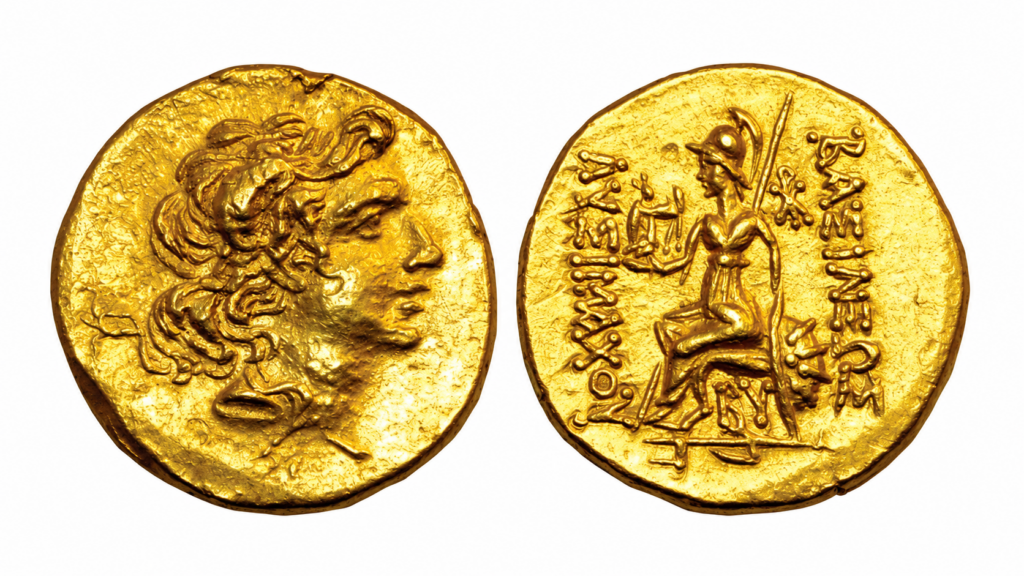
More than two millennia ago, a young mounted warrior was buried inside a sacred circle at the heart of a Maeotian cemetery, a setting that marked his grave as anything but ordinary. His horse lay beside him, weapons identified him as a fighter, and animal offerings accompanied him into death. Among the objects placed with him, two stand out: a gold stater beneath his jaw and a drinking vessel scratched with a pentagram associated with protective magic.
A new study of the Vinogradny 1 necropolis in Russia’s Krasnodar region shows that the burial belonged to a much larger ritual landscape. Archaeologists identified 155 graves at the site, but the warrior occupied a privileged place near a deep ritual shaft containing a second gold stater and another complex with sacrificed animals and human remains.
The researchers date the complex to the opening decades of the 1st century BC. Taken together, the sacred setting, the horse, weapons, gold, and protective symbol suggest that the burial expressed far more than wealth: it tied military status to ritual practice and beliefs surrounding death and the afterlife.
A warrior inside a sacred circle
Vinogradny 1 lies near the modern city of Krymsk, close to the northern foothills of the Western Caucasus and not far from the eastern frontier of the ancient Bosporan Kingdom. The settlement itself belonged to an earlier phase, flourishing between the 5th and 3rd centuries BC, while the cemetery that later occupied the area dates mainly from the second half of the 2nd century to the first half of the 1st century BC.
At the heart of the necropolis, archaeologists identified a circular sacred space about six meters across. Ash covered parts of the area, while a narrow rectangular shaft descended roughly two meters into the natural clay. Nine steps led downward toward the groundwater level, and one gold Lysimachus-type stater appeared inside the shaft. The authors interpret that coin as a votive offering, suggesting that people used the center of the cemetery for ritual activity as well as burial.
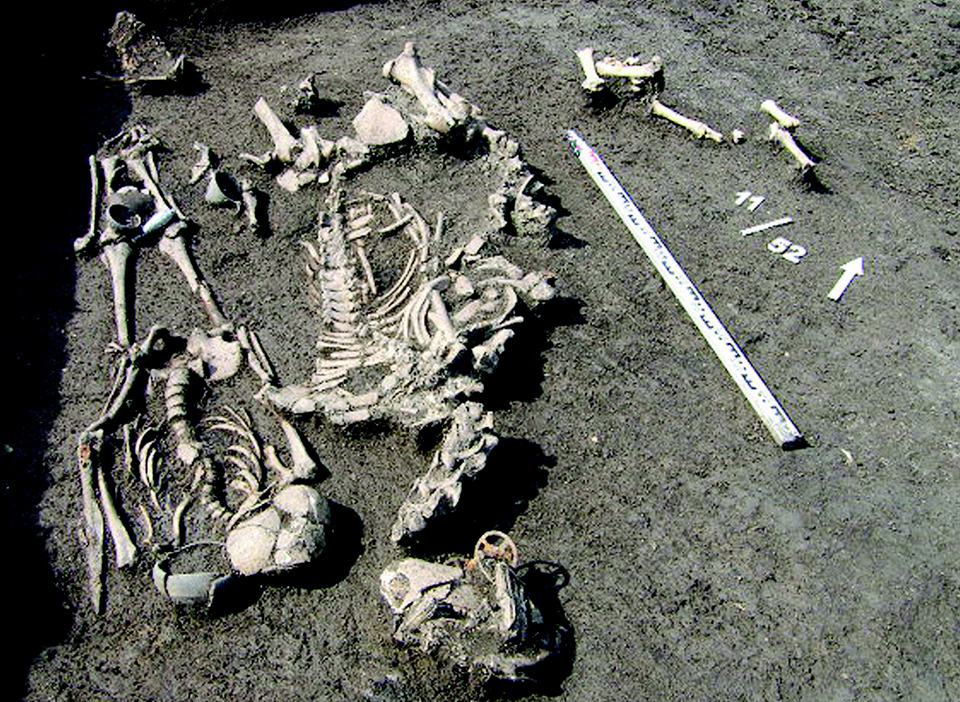
Only two major complexes occupied this inner zone. One of them, Burial 97, contained the complete skeletons of three horses and a young bull, along with remains from a cow, dog, and pig.
Archaeologists also recovered part of an adult human pelvis. The study interprets the assemblage as a commemorative and sacrificial complex in which both animal offerings and a human element played a role.
The second complex, Burial 52, belonged to the young warrior-horseman. Anthropological analysis placed his age between 25 and 30. An adult horse accompanied him in the grave, complete with iron bits and wheel-shaped cheekpieces, while a girth buckle survived near one of the animal’s forelegs. His location inside the sacred circle itself appears to have reinforced his elevated status within the community.
Weapons, offerings and a protective symbol
The grave goods built a clear image of a mounted fighter. Archaeologists recovered an iron spearhead, a javelin head, an arrowhead and a knife, while the remains of a sheep and pig point to food offerings or funerary provisions. These objects did more than mark the man’s profession; they also formed part of a carefully arranged burial package that mixed status, ritual and practical symbolism.
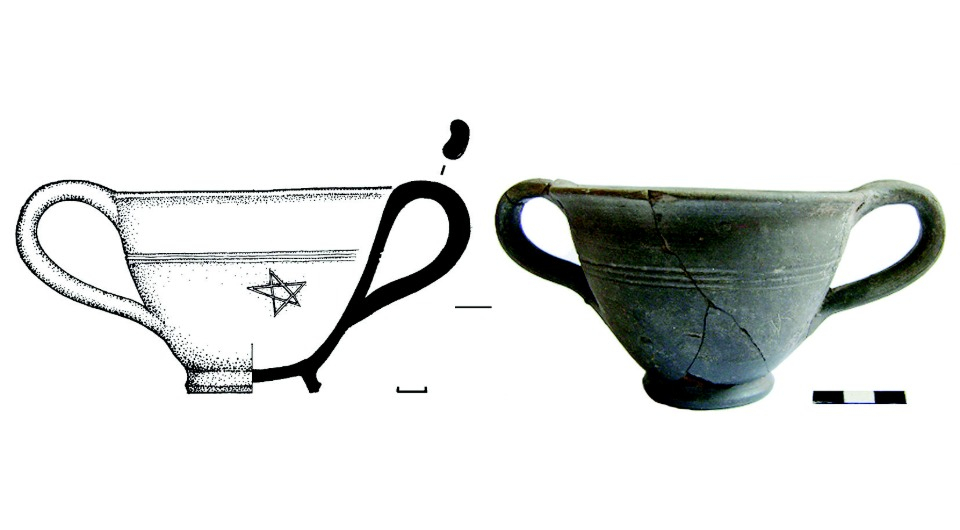
Other finds add a more intimate dimension. The grave contained a gray-clay bowl, a handmade vessel, a glass alabastron and a small two-handled kantharos. On the body of that drinking vessel, someone had scratched a pentagram.
The authors describe the pentagram as a widespread symbol of apotropaic magic, intended to ward off harm. In antiquity, people also associated the sign with astral beliefs, healing and health, and similar symbols appear on ceramics and amulets from the Greek and eastern Mediterranean worlds. The Bosporan region provides several comparable examples, including objects connected with military settings.
That context gives the pentagram particular weight in this burial. It did not appear in an abstract ritual deposit far from the dead. Instead, it accompanied a warrior whose grave already emphasized identity and rank through weapons, horse equipment, and privileged placement. The symbol may therefore have carried a protective meaning that extended beyond life itself.
A gold coin beneath the jaw
The gold stater beneath the warrior’s lower jaw adds another layer to that interpretation. The coin weighed 8.16 grams and belonged to the Lysimachus type. Its obverse showed the deified Alexander the Great with the horn of Ammon, while the reverse carried Athena seated with Nike in her hand.
The researchers interpret its position as evidence that it may have served as a form of “Charon’s obol,” the funerary payment traditionally associated with the dead person’s passage into the afterlife. The placement of the coin beneath the jaw makes that interpretation especially compelling within the burial context.
The second gold stater from the ritual shaft creates a striking parallel. One coin belonged to a collective sacred setting, while the other accompanied an individual warrior. The study therefore sees two distinct ritual uses for rare gold Lysimachus-type staters within the same cemetery.
The coins themselves are unusual in the region. The authors note that such staters rarely occur in the Bosporan area and describe their appearance in a Maeotian context as unique. They also connect the late issues to the age of Mithridates Eupator, placing the cemetery within the wider political and economic world of the northern Black Sea during a period of intense change.
More than a rich grave
The imported glass alabastron strengthens that wider connection. The vessel belongs to an eastern Mediterranean tradition, and comparable examples appear across areas including Cyprus, Syria, Italy and the northern Black Sea. Finds of this particular type were previously unknown in the Kuban region, making its presence in the warrior’s grave another indication of long-distance exchange and elite access to imported objects.
The researchers date both the warrior’s grave and the ritual complex to the first third of the 1st century BC using several lines of evidence: the two gold staters, the wheel-shaped cheekpieces, the gray-clay kantharos and the imported glass vessel. Each object adds chronological weight, but together they also reveal something more human.
This was not simply the burial of a wealthy fighter. The horse, weapons, and food offerings preserved his social identity, while the pentagram and gold coin introduced ideas of protection, transition, and the afterlife. By placing him at the heart of sacred ground, his community turned the grave into something larger than a resting place: a carefully constructed passage between status in life and meaning in death.
Abramzon, M. G., de Callataÿ, F., Treister, M. Y., & Shevchenko, N. F. (2026). First-century BC complexes with gold Lysimachus type staters from the Maeotian necropolis of Vinogradny 1. Russian Archaeology, 3, 206–220. https://doi.org/10.7868/S3034577426030152
