
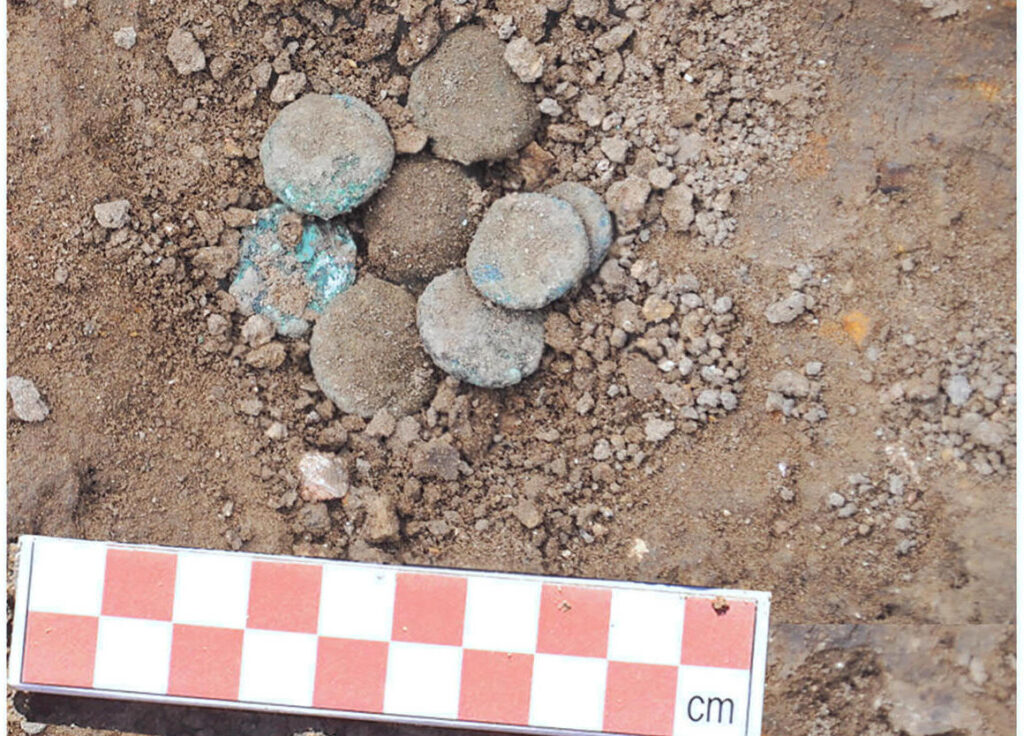
A dramatic discovery from southern Russia is shedding new light on everyday life in Late Antiquity. Archaeologists working at Phanagoria have uncovered several small clusters of coins, the remains of wallets dropped during a catastrophic fire in the mid-6th century AD. Among them were not only long-circulating ancient coins but also counterfeit, or “fake,” pieces. The finds offer a rare, almost intimate glimpse into the final moments of a community caught in sudden destruction.
The discoveries were made during excavations between 2023 and 2024 in the city’s “Lower Town,” an area already known for its dense urban layout and religious structures. According to research published in the journal of the Institute of Archaeology of the Russian Academy of Sciences by archaeologists Mikhail Abramzon and Sergey Ostapenko, the coin clusters represent the contents of at least four wallets lost amid chaos as residents fled a devastating blaze.
A City at the Crossroads of Ancient Worlds
Phanagoria was no ordinary settlement. Founded in the 6th century BC by Greek colonists, it quickly grew into a major hub on the Taman Peninsula, strategically positioned between the Black Sea and the Sea of Azov. By the 5th century BC, it became part of the powerful Bosporan Kingdom, serving as the administrative center of its Asian territories.
For centuries, the city thrived as a cultural and commercial crossroads linking the Greek world with steppe populations and eastern trade routes. Classical authors even regarded the nearby Kerch Strait as the symbolic boundary between Europe and Asia. This geopolitical importance ensured Phanagoria’s survival well into the early medieval period, long after many ancient cities declined.
Fire, Siege, and Sudden Loss
The layer in which the wallets were found corresponds to a violent destruction event dated between 545 and 554 AD. Archaeological and textual evidence align closely. A coin minted under Justinian I (r. 527–565 AD) provides a terminus post quem, while the historian Procopius of Caesarea describes the destruction of Phanagoria and nearby cities in his work Wars.
Excavations in the Lower Town revealed the remains of a synagogue complex, surrounding utility buildings, and a Jewish quarter—all destroyed in the same fire. Nearby, archaeologists found numerous stone projectiles, likely used in siege engines. These details suggest that the fire was not accidental but part of a broader military assault. Residents may have sought refuge within the synagogue walls as the city came under attack.
Amid this chaos, people dropped what they carried. The wallets, likely made of leather or fabric, did not survive the fire or the centuries that followed. What remained were tight clusters of coins, preserved in the destruction layer exactly where they fell.
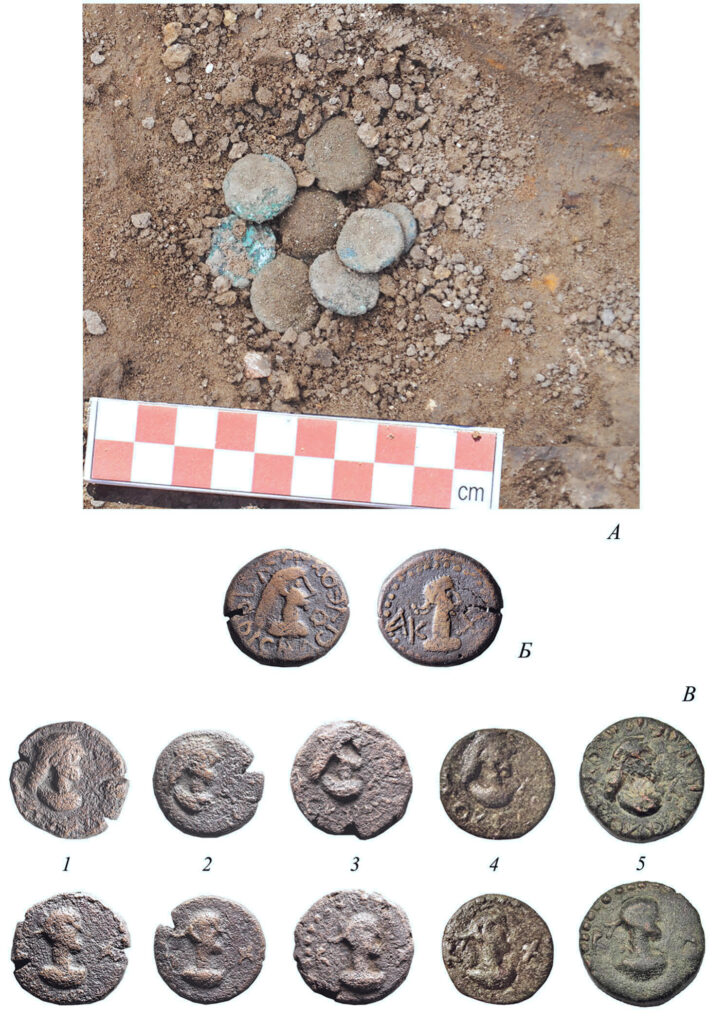
Photo credits: A, B, C (1 and 2) – M.G. Abramzon, S.N. Ostapenko / Brief Communications of the Institute of Archaeology (KSIA). Brief Communications of the Institute of Archaeology (KSIA), 281; C (4) – V.N. Yushkov, Bosporan Coins from Cotys III to Rhescuporis V. Krasnodar, 2010; C (5) – Bosporan Coins Catalog-Archive.
Modest Wealth, Remarkable Insight
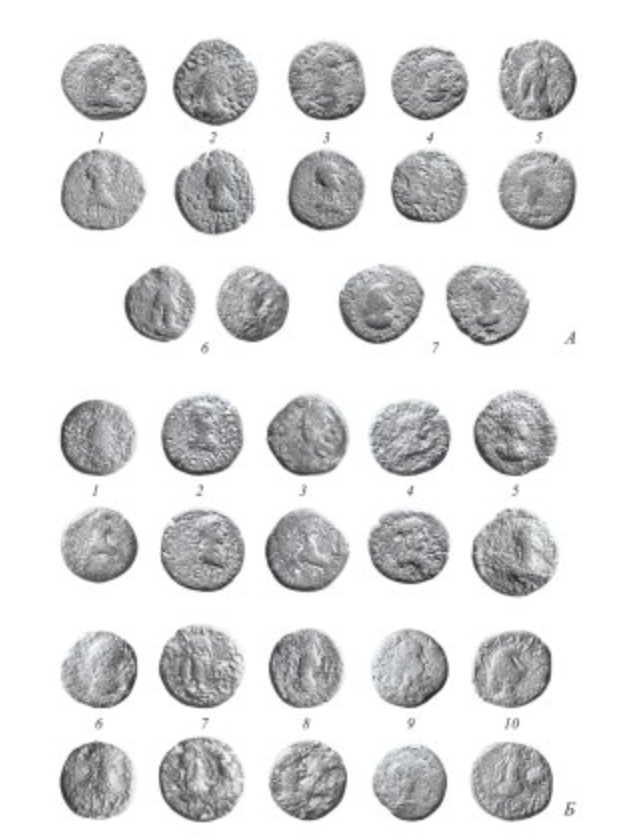
Each wallet contained between three and ten bronze staters, coins originally minted by rulers of the Bosporan Kingdom. In purely economic terms, these were modest sums, suggesting that their owners were ordinary townspeople rather than elites. Yet their historical significance is considerable.
What makes the discovery particularly striking is the age of the coins. The Bosporan Kingdom had ceased minting these bronze staters more than 200 years before the fire, around 341–342 AD. Despite this, coins issued under rulers such as Rhadamsades, Thothorses, and Rhescuporis VI were still circulating in the 6th century.
This prolonged use suggests a resilient local monetary system, possibly driven by limited access to new coinage or a continued trust in familiar currency. In a frontier economy like Phanagoria, older coins may have remained practical long after their official minting ceased.
Counterfeit Coins and a Local Economy Under Pressure
One of the wallets revealed an even more intriguing detail: counterfeit coins. These imitations closely resemble the staters of Rhescuporis VI but feature crude portraits and misspelled inscriptions. Even more telling, all the fake coins appear to have been produced using the same die.
This consistency indicates localized production, likely shortly before the city’s destruction. Rather than relics of an earlier period, these counterfeits may reflect economic stress in Phanagoria during its final decades. The presence of forged currency suggests a breakdown in centralized control or a shortage of official coinage, prompting local solutions.
Such evidence challenges earlier assumptions that similar imitations dated back to the mid-4th century. Instead, the Phanagoria finds push their production forward into the 6th century, offering a revised timeline for monetary practices in the region.
Aftermath and Abandonment
The destruction marked a turning point. Following the mid-6th-century catastrophe, Phanagoria was largely abandoned for approximately 130 years. When the site was reoccupied, it was by the Khazar Khaganate, a powerful polity that controlled vast territories across the Eurasian steppe.
Interestingly, Judaism held an official status within the Khazar elite, and a new settlement emerged over the ruins of the earlier Jewish quarter. This continuity, layered over destruction, adds another dimension to Phanagoria’s complex cultural history.
The city ultimately ceased to exist in the early 10th century, around the time when the Kievan Rus’ prince Oleg of Novgorod campaigned against the Khazars. By then, Phanagoria had already faded from prominence, its ruins slowly merging with the landscape.
A Moment Frozen in Time
The wallets of Phanagoria are small finds, easily overlooked beside monumental architecture or rich tombs. Yet they carry a rare emotional weight. They represent individuals caught in a moment of crisis, their personal belongings lost in the confusion of fire and conflict.
More broadly, the discovery highlights how material culture can illuminate the lived experiences of ordinary people. Coins, often studied in isolation, here tell a more human story—of continuity, adaptation, and sudden loss.
In the end, these scattered coins do more than document an economy. They preserve a fleeting moment when a thriving city, shaped by centuries of history, was abruptly brought to a halt.
Краткие сообщения Института археологии (КСИА)
Cover Image Credit: A – Wallet 4 at the moment of discovery. B – Stater with an engraver’s error in the king’s name. C – Imitations of staters: 1, 2 – from the destruction layer in Phanagoria; 3 – from the “Upper Town” excavation in Phanagoria; 4, 5 – comparative examples from published catalogs.
Photo credits: A, B, C (1 and 2) – M.G. Abramzon, S.N. Ostapenko / Brief Communications of the Institute of Archaeology (KSIA). Brief Communications of the Institute of Archaeology (KSIA), 281; C (4) – V.N. Yushkov, Bosporan Coins from Cotys III to Rhescuporis V. Krasnodar, 2010; C (5) – Bosporan Coins Catalog-Archive.
