
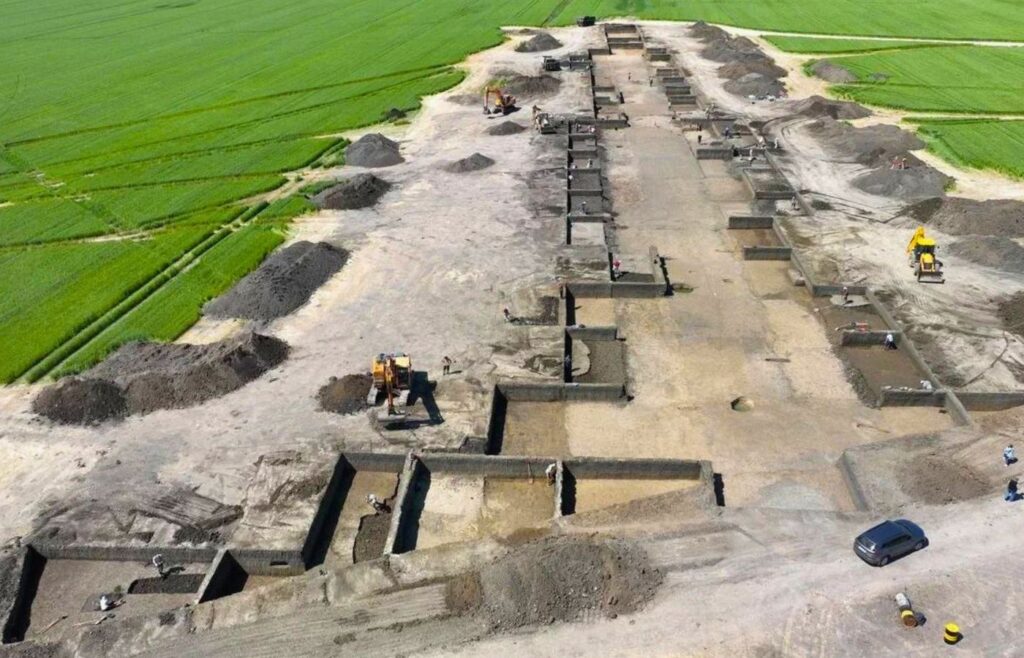
Archaeologists working on the Taman Peninsula in Russia’s Krasnodar Region have uncovered a remarkable example of ancient ingenuity: bone skates crafted from horse bones, believed to have been used for crossing frozen waterways during winter. The discovery sheds new light on how local communities adapted to the region’s seasonal climate thousands of years ago and provides rare insight into daily life, trade, and mobility in the ancient Black Sea world.
A Discovery Unearthed During Rescue Archaeology
The finds were made by researchers from the Laboratory of Archaeological Technology at the Institute for the History of Material Culture of the Russian Academy of Sciences (IIMK RAS). The team conducted large-scale rescue excavations in 2024 along the route of a new fuel pipeline in the Temryuk District, an area rich in archaeological heritage dating from antiquity through the medieval period.
The investigated sites — including Sady-1 and 2, Armature Plant-1, Mingrelskoye, Khabl-Mingrelskoye, Sheptalskoye-Levoberezhnoye, and Yastrebovskoye-Berezhnoe — form a unique cultural landscape once located within the territory of the Bosporan Kingdom. Studying such a wide complex of monuments has allowed scientists not only to document individual artifacts but also to reconstruct broader patterns of life, economy, and environmental adaptation among the region’s ancient inhabitants.
Bone Skates Interpreted Through Wear Marks and Context
Among the most intriguing finds were carefully processed horse bones discovered at the Yastrebovskoye-Berezhnoe site. Detailed examination revealed distinctive traces of concentrated wear, indicating purposeful and repeated use. Based on their shape, surface polish, and archaeological context, researchers interpreted the artifacts as bone runners or skates — devices designed to facilitate movement across ice.
According to the research team, the bones were selected from large animals such as horses or cattle, whose strong and dense skeletal structure could support the weight of a human. The discovery demonstrates not only technical skill, but also a sophisticated understanding of available materials and environmental conditions.
Crossing the Frozen Kerch Strait
The geographical setting of the finds strongly supports their functional interpretation. In antiquity, sea levels in the Black Sea were higher than they are today, and many settlements stood closer to the coast of the Kerch Strait — a natural water corridor separating the Taman Peninsula from the Crimean Peninsula. During especially cold winters, the strait could freeze, creating natural ice passages.
The bone skates would have allowed residents to travel efficiently across frozen surfaces, likely for purposes related to trade, communication, seasonal movement, or economic activity. This practical innovation reflects how communities responded creatively to the challenges and opportunities of their environment.
As archaeologist Elizaveta Kondrashova of IIMK RAS noted, the team analyzes artifacts not as isolated objects, but within their broader “archaeological context.” By combining zoological, anthropological, and radiocarbon data, researchers can reconstruct detailed stories about how people lived — what they owned, produced, consumed, and how they interacted with their surroundings.
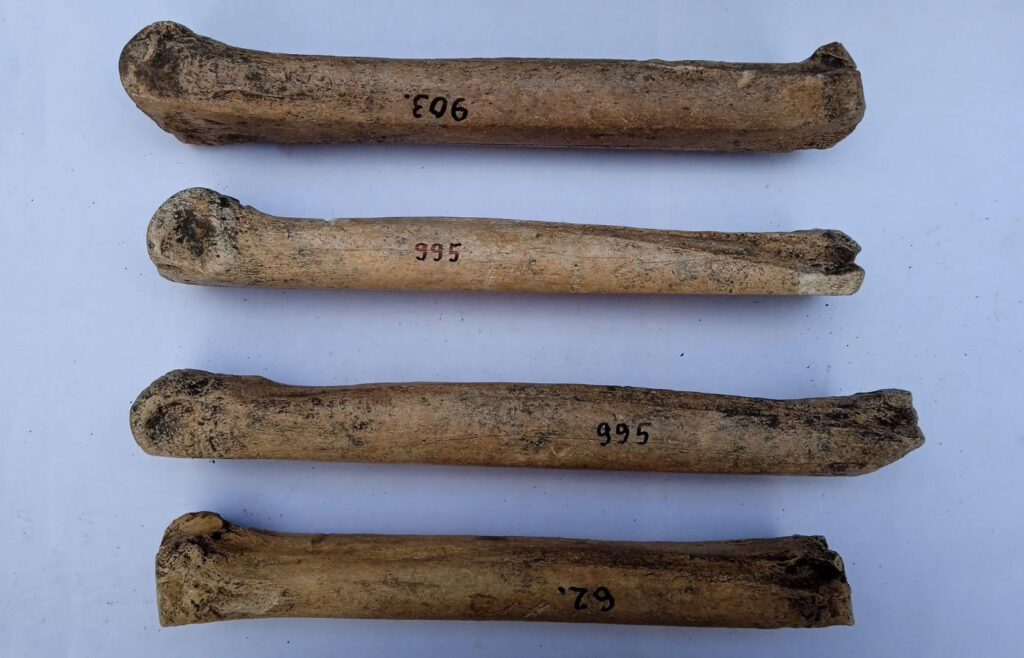
Fragments of horse metapodial bones used to make the runners for ice skates. Credit: Alexey Kasparov / Press Service of the Institute for the History of Material Culture, RAS.
Evidence of an Advanced Bone-Working Tradition
The bone skates represent only one aspect of a well-developed craft tradition in the region. Analysis of more than 2,000 animal bone fragments revealed that ancient artisans used nearly every part of domestic animal skeletons. Cattle, sheep, goats, horses, pigs, and even roe deer — now no longer native to the area — were all represented.
From these materials, craftspeople produced a wide range of items, including needles, awls, decorative fittings, knife handles, jewelry, and arrowheads. This efficient and resource-conscious approach suggests a high level of technical expertise and a deep familiarity with animal anatomy.
Reconstructing Life in the Ancient Bosporan Frontier
Beyond the artifact itself, the discovery contributes to a larger picture of life on the Taman Peninsula during antiquity. The region was a dynamic cultural crossroads, shaped by local traditions, trade networks, and interactions between steppe populations and Greek urban centers of the Bosporan Kingdom.
The findings demonstrate that communities did not simply endure their environment — they innovated to thrive within it. From animal husbandry and craftsmanship to mobility across frozen landscapes, the residents of ancient Taman displayed remarkable resourcefulness and adaptability.
Scientific Work Continues
Researchers continue to analyze the materials and compare them with other archaeological discoveries from the wider Black Sea region. Their findings have been published in the Bulletin of the Institute for the History of Material Culture, contributing to ongoing scholarly discussions about technology, environment, and daily life in antiquity.
As investigations progress, the bone skates of Taman stand as a striking reminder that even seemingly humble artifacts can reveal extraordinary stories about human ingenuity across time.
The results of the study were published in the Bulletin of the Institute for the History of Material Culture of the Russian Academy of Sciences.
Cover Image Credit: Yastrebovskoe-Berezhnoe-1 site. Press Office of the Institute for the History of Material Culture, RAS
