15 December 2025 The Future is the Product of the Past

A Big, Round, 4,000-Year-Old Stone Building Discovered on a Cretan Hilltop

During excavations for an airport on Greece’s largest island of Crete, a large circular monument dating back 4000 years was unearthed.

A statement released by the Greek Ministry of Culture on Tuesday said the structure was a “unique and extremely interesting find”.

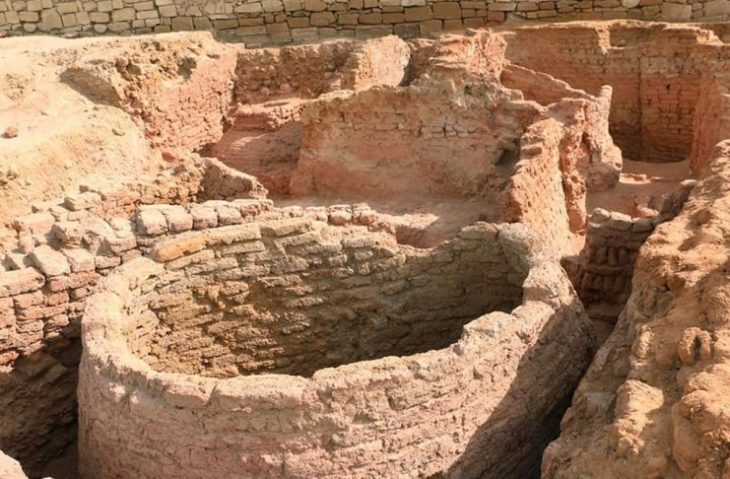
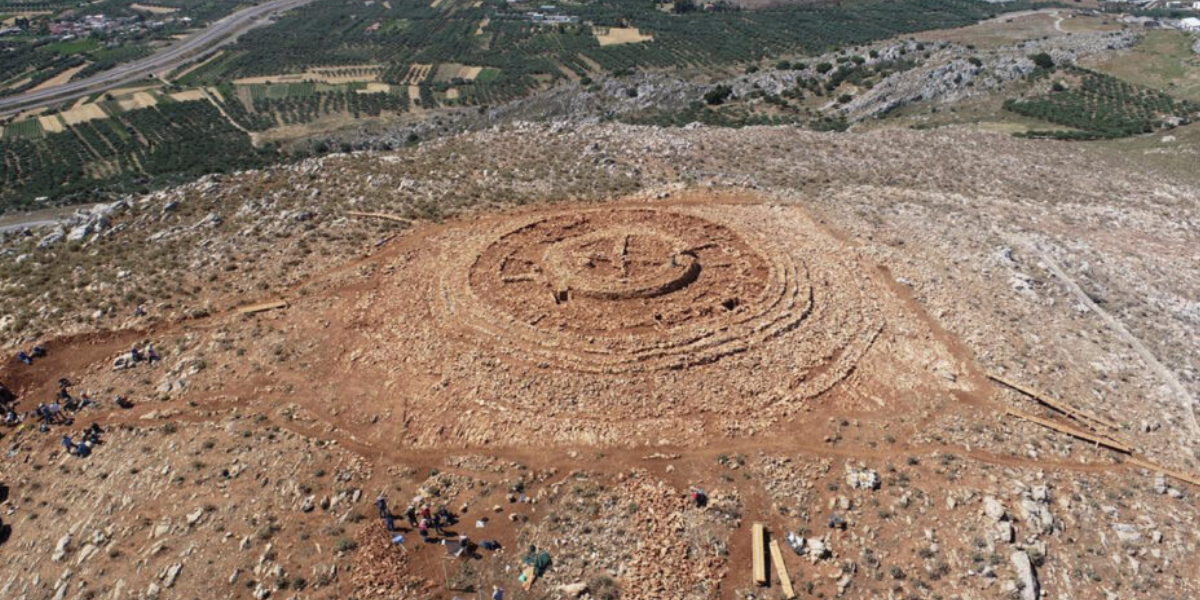
Resembling a huge car wheel from above, the ruins of the labyrinthine, 1,800-square-meter (19,000-square-foot) building came to light during a recent dig by archaeologists.

The circular monument structure dates back to the Bronze Age Minoan Civilization. It was a civilization that developed on the island of Crete during the Bronze Age and lasted from 3000 BC to 1450 BC. The Minoans were a highly advanced society in seafaring, trade, and the arts. The civilization was named after the mythological king Minos.

The ministry said the building was mainly used between 2000-1700 B.C, and was founded around the time Crete’s first palaces were being built — including at Knossos and Phaistos.


📣 Our WhatsApp channel is now LIVE! Stay up-to-date with the latest news and updates, just click here to follow us on WhatsApp and never miss a thing!!


It said some of its features were comparable with early Minoan beehive tombs that were surmounted by stepped conical roofs and burial mounds in other parts of Greece.
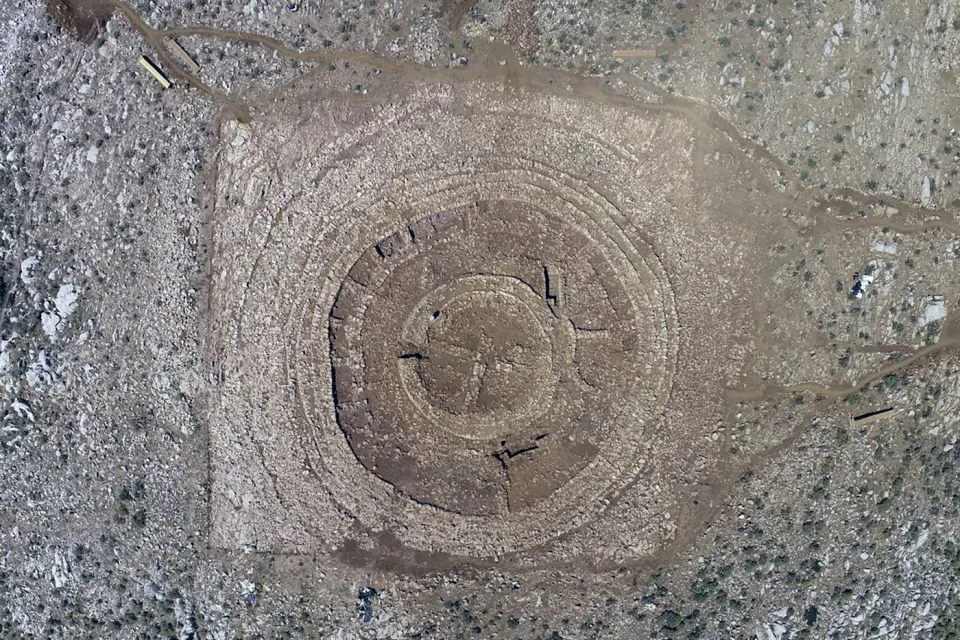
It is still unknown to archaeologists what the hilltop structure was used for. It has no known Minoan parallels and is currently being excavated. For the time being, experts surmise that it might have served a ceremonial or religious purpose. The ministry’s statement said it didn’t appear to have been a dwelling, and the finds from inside it included a large quantity of animal bones.

The ministry’s statement said, “It may have been periodically used for possibly ritual ceremonies involving consumption of food, wine, and perhaps offerings.”

The inner structure, which may have had a shallow conical roof, was divided into smaller, interconnecting spaces and surrounded by eight stepped stone walls that rose to a height of 1.7 meters (5.6 feet).

“Its size, architectural layout, and careful construction required considerable labor, specialized know-how, and a robust central administration,” the statement said, adding it was certainly some kind of communal building that stood out in the entire area.

The site was earmarked for a radar station to serve a new airport under construction near the town of Kastelli. Greece’s rich cultural heritage often results in conflicts of interest during construction projects.

However, Culture Minister Lina Mendoni, pledged that the find would be preserved while a different location would be sought for the radar station.

Greek Ministry of Culture

Cover Photo: Ministry of Culture via InTime News
Related Articles

A 2,000-year-old whistle was found in a child’s grave in the ruins of Assos, Turkey

18 October 2022

18 October 2022

A terracotta whistle believed to be 2,000 years old from the Roman era and placed as a gift in a...

In the new images, Scotland’s biggest Pictish fort is “reconstructed.’

2 November 2021

2 November 2021

Stunning new reconstructions have revealed how Scotland’s largest known Pictish fort may have looked over one thousand years ago. Three-dimensional...

Ancient Roman coin thought to be fake -certainly authentic and proves the existence of ‘forgotten’ leader Sponsian, study claims

26 November 2022

26 November 2022

History is littered with artifacts that were later discovered to be forgeries, but the opposite can also occur. A new...

A Detectorist has Discovered a Completely Unique Medieval Seal Matrix in the UK

2 December 2023

2 December 2023

A medieval seal die, described by experts as ‘completely unique’, has been found by a metal detector at a field...

A statue of God Apollo was found during sewerage works in Afyon city in western Turkey

30 May 2021

30 May 2021

A statue thought to belong to God Apollo was found during sewerage works in Afyon city in western Turkey. During...

Hungary’s Hill of Hoards: 3,000-Year-Old Metal Finds Illuminate the Bronze and Iron Age Transition

5 May 2025

5 May 2025

A treasure trove of ancient metal artifacts, dating back over 3,000 years, has been unearthed at Somló Hill in western...

Serbian Archaeologists Unearth Roman Triumphal Arch Dedicated to Emperor Caracalla

24 January 2024

24 January 2024

Archaeologists in Serbia have unearthed an ancient Roman triumphal arch dating back to the third century at Viminacium, a Roman...

Archaeologists in Israel are restoring the largest Roman Basilica in the country

6 June 2021

6 June 2021

Archaeologists in Israel are trying to rebuild a 2,000-year-old Roman-era basilica that is thought to be the country’s biggest. A...

Denmark King’s spice cabinet discovered on Gribshunden

13 February 2023

13 February 2023

The Gribshunden, a 15th-century Danish royal warship, was uncovered to have been loaded with botanical materials, including the first archaeological...

A Rare Late Neolithic Period Seal found in Domuztepe Mound

25 August 2022

25 August 2022

A rare Late Neolithic Seal was discovered during the 2022 excavations of the Domuztepe Mound (Domuztepe Höyük), located on the...

The rich-poor distinction draws attention in the nutrition of the inhabitants of the Ancient City of Pergamon

27 November 2021

27 November 2021

The hegemony of wealth to the poor, arising from the ruler, elite structure, property ownership, unjust acquisition, and distribution of...

1.8-million-year-old ‘human tooth’ discovered in Georgia

9 September 2022

9 September 2022

An ancient human tooth discovered by archaeologists in Georgia dates back 1.8 million years, firmly establishing the area as the...

Unexpected Origins of Mysterious Mummies Buried in Boats in a Chinese Desert

17 February 2024

17 February 2024

In 1990, hundreds of mummified bodies were found buried in boats in an inhospitable desert area in the Xinjiang Uyghur...

The Nightmare of the Roman Soldiers “Carnyx”

9 July 2023

9 July 2023

The Carnyx was a brass musical instrument used as a psychological weapon of war by the ancient Celts between 300...

First example of Roman crucifixion in UK discovered in Cambridgeshire village

8 December 2021

8 December 2021

In Cambridgeshire village, the earliest evidence of a Roman crucifixion has been discovered. Archaeologists investigating a previously unknown Roman roadside...