A stone once dismissed as part of an old barn foundation in South Moravia has now been identified as a rare Bronze Age casting mould, shedding new light on prehistoric metalworking and long-distance connections in Central Europe. The discovery, originally reported by Radio Prague International, reveals that the unassuming slab was used around 3,000 years ago to produce bronze spearheads in what is now the Czech Republic.
Bronze Age Spearhead Mould Discovered in South Moravia
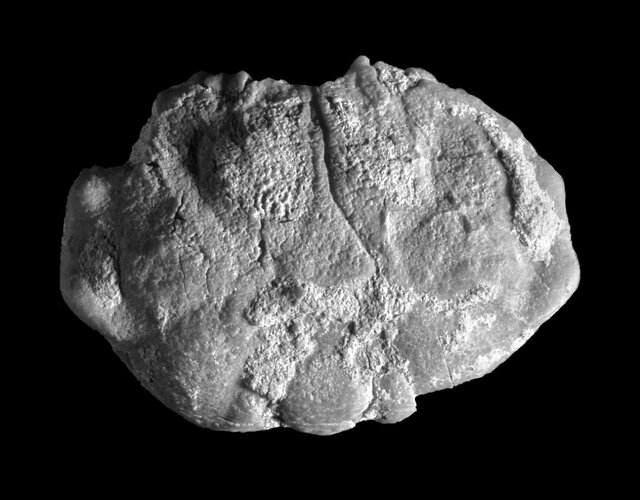
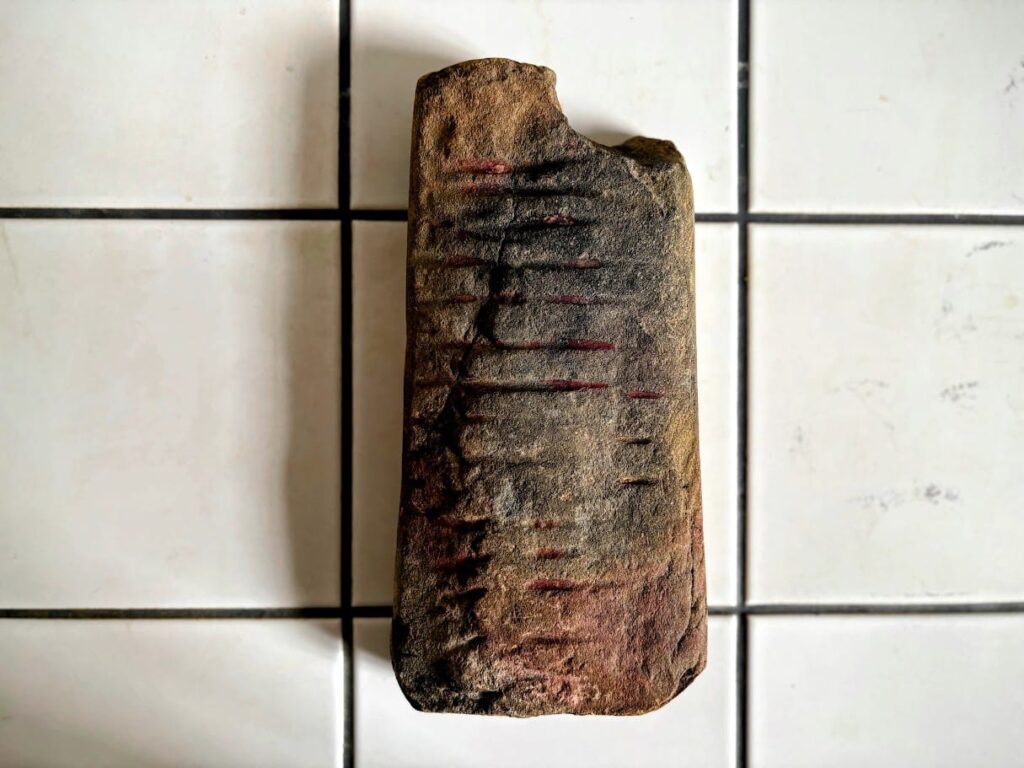
The story began in 2007 in the village of Morkůvky in south-eastern Moravia. A homeowner noticed a rectangular stone protruding slightly from the soil in his garden. For years, it appeared to be just another building stone incorporated into the foundations of an old barn. However, closer examination by specialists from the Archaeological Institute of the Moravian Museum changed everything.
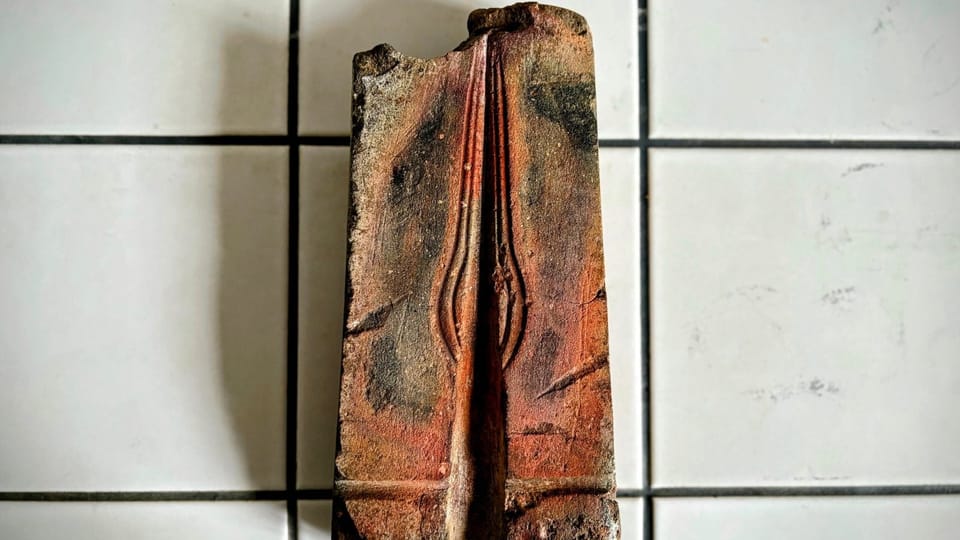
Experts determined that the object was not an ordinary stone but a casting mould—technically known as a matrix—used for producing bronze spearheads during the Bronze Age. On one face of the stone, archaeologists identified a carefully carved negative impression shaped precisely like a spearhead blade. The detailing and preservation of the cavity indicate repeated and skilled use.
The mould dates back roughly to the Late Bronze Age, a period when bronze metallurgy was highly developed across Central Europe. What makes the artefact particularly significant is both its craftsmanship and the evidence it provides of organized, possibly serial, weapon production.
Imported Volcanic Stone from the Carpathians
Geological analysis revealed another fascinating detail: the stone itself is not native to Moravia. Researchers identified it as volcanic tuff, a rock commonly found in the Carpathian region. Its likely origin is the south-eastern slopes of the Bükk Mountains in present-day Hungary.
📣 Our WhatsApp channel is now LIVE! Stay up-to-date with the latest news and updates, just click here to follow us on WhatsApp and never miss a thing!!
Transporting such heavy material over long distances during the Bronze Age would not have been a trivial undertaking. This suggests established trade routes or cultural connections between Moravia and the broader Carpathian Basin. During this era, Central Europe was far from isolated; instead, it formed part of an interconnected network of communities exchanging raw materials, finished goods, and metallurgical knowledge.
The Carpathian Basin was one of Europe’s major bronze production centers, rich in copper ores and linked to tin sources essential for creating bronze. The presence of a Carpathian stone mould in Moravia highlights how technological expertise and specialized tools circulated across regions.
How Bronze Age Casting Moulds Worked
Casting moulds like the one found in Morkůvky were essential tools in Bronze Age metallurgy. Typically, they consisted of two carefully matched halves. When aligned and secured—sometimes with copper wire—they formed a closed cavity shaped like the intended object.
Molten bronze, an alloy primarily composed of copper and tin, was poured into the mould through a channel at the top. In the case of spearheads, a core would be inserted to create a hollow socket. This hollow allowed a wooden shaft to be fitted securely into the finished weapon.
Evidence suggests that this particular mould was used intensively. Wear patterns indicate that dozens of spearheads may have been cast from it. Such repeated use implies more than occasional craftsmanship—it points to organized production, possibly serving a wider community or warrior elite.
Stone moulds were durable and reusable, unlike clay moulds that often broke after a single use. Their longevity made them valuable assets, and the decision to import suitable volcanic stone underlines the importance of high-quality casting tools.
The Bronze Age in the Czech Lands
The Bronze Age in the territory of today’s Czech Republic spanned roughly from 2300 to 800 BCE. During this time, societies transitioned from small agrarian communities to more hierarchical structures with emerging elites. Control over metal resources and weapon production likely played a crucial role in social status and power.
Moravia, in particular, was influenced by cultural groups such as the Urnfield culture, known for cremation burials and extensive metalworking traditions. Bronze artefacts from this period include swords, axes, sickles, jewelry, helmets, greaves, and spearheads.
The spearheads produced by the Morkůvky mould were characterized by ribs along the blade and a pronounced ridge on the socket—features typical of Carpathian weapon styles. This design enhanced structural strength while maintaining a sharp, penetrating edge. Such weapons were both practical tools of warfare and symbols of prestige.
Warriors of the Late Bronze Age
Bronze Age warriors were not primitive fighters but well-equipped combatants. Archaeological finds from Central Europe reveal defensive gear such as shields, bronze helmets, and greaves protecting the lower legs. Their equipment closely resembles descriptions of warriors in Homerics epics, where fighters carried multiple spears into battle—one for throwing and another for close combat.
The existence of a mould for standardized spearhead production suggests that warfare was organized and perhaps frequent. Weapons were not improvised; they were carefully designed, cast, finished, and distributed.
A Small Stone with a Big Story
At first glance, the Morkůvky stone does not appear spectacular. Yet its identification as a Bronze Age spearhead mould transforms it into a powerful piece of evidence. It demonstrates that three millennia ago, Moravia was part of a technologically advanced and interconnected world.
The artefact reveals early examples of serial weapon production, long-distance transport of specialized materials, and the diffusion of metallurgical knowledge across Central Europe. What once lay unnoticed in a garden foundation now stands as proof that Bronze Age societies in the Czech lands were far more sophisticated and globally connected than previously imagined.
Sometimes, the most extraordinary discoveries begin with what looks like nothing more than an ordinary stone.
Cover Image Credit: Marek Hensl, Czech Radio