
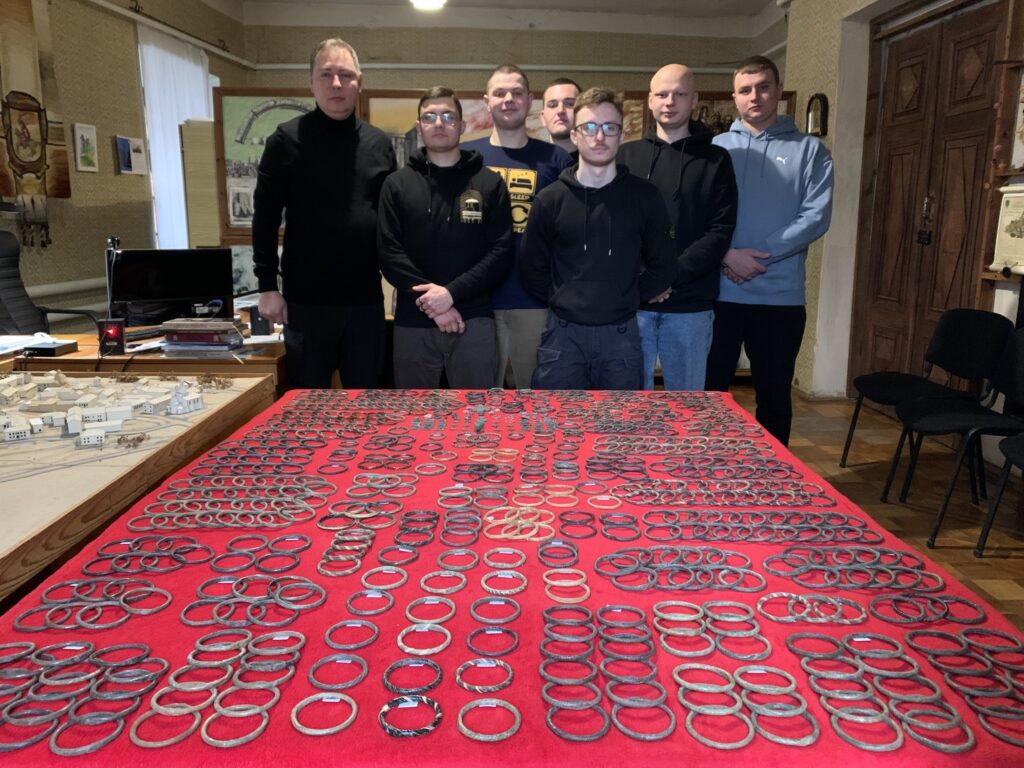
Archaeologists in western Ukraine have announced one of the most remarkable archaeological discoveries in recent decades — an unprecedented cache of 573 intact Ancient Rus’ glass bracelets and luxury items, now known as the “Merchant’s Treasure of Volodymyr.” The find, uncovered during large-scale rescue excavations in 2025 at the historic Apostolshchyna site within the princely town of Volodymyr in Volyn, offers extraordinary insight into medieval craftsmanship, trade networks, and the dramatic events surrounding the Mongol-Tatar invasion of 1241.
According to the Volyn Archaeological Expedition of the State Enterprise “Scientific-Research Center for the Protective Archaeological Service of Ukraine,” the treasure was discovered in the cache of Archaeological Object No. 187. While the site had already yielded a rich variety of cultural artifacts, this assemblage proved exceptional in both scale and preservation. The hoard includes 573 fully intact glass bracelets — the largest such concentration ever recorded in the archaeological study of the Kyivan Rus’ territories — alongside dozens of precious items associated with elite religious and mercantile life.
Among the artifacts are a massive enkolpion cross traditionally linked with the vestments of a high-ranking cleric, 9 bronze and 8 marble pendant crosses, 18 diamond-shaped buckles finished with pseudo-granulation, 5 silver temple rings, a stylized trident-falcon lead inlay, a shield-shaped silver signet ring, a bronze mace head, and seals decorated with a solar symbol of the “Dorogochyn type,” in addition to numerous fragments awaiting conservation and study.

A Once-in-a-Lifetime Archaeological Discovery
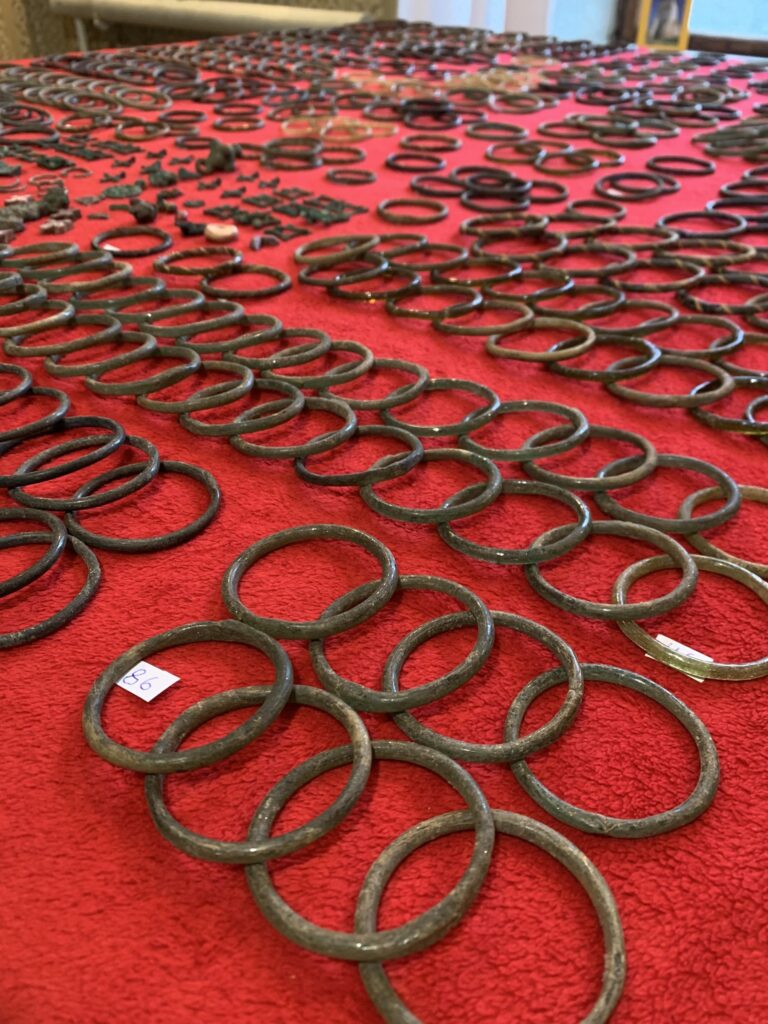
What makes the discovery truly unique, researchers emphasize, is the sheer quantity and diversity of the glass bracelets. While such bracelets were widely worn as women’s ornaments in the pre-Mongol urban culture of Kyivan Rus’, they are almost never found intact — typically surviving only in fragmentary form. The Volodymyr assemblage, by contrast, preserves hundreds of complete examples, divided into 109 distinct types.
The bracelets vary in form — twisted, smooth, and trapezoidal — and appear in a striking palette of colors, including deep greens, blues, violets, yellows, and shimmering golden hues. Their diameters range from 4.0 to 5.9 centimeters, with some series represented by 5 to 31 identical pieces, while others survive as rare single specimens. Conservation specialists note that the ongoing reconstruction of additional fragments discovered at the site is expected to expand the collection even further.
For archaeologists, the “Merchant’s Treasure” represents a breakthrough opportunity to study medieval glass production, exchange networks, and consumer culture through a comprehensive, well-preserved dataset rather than isolated finds.
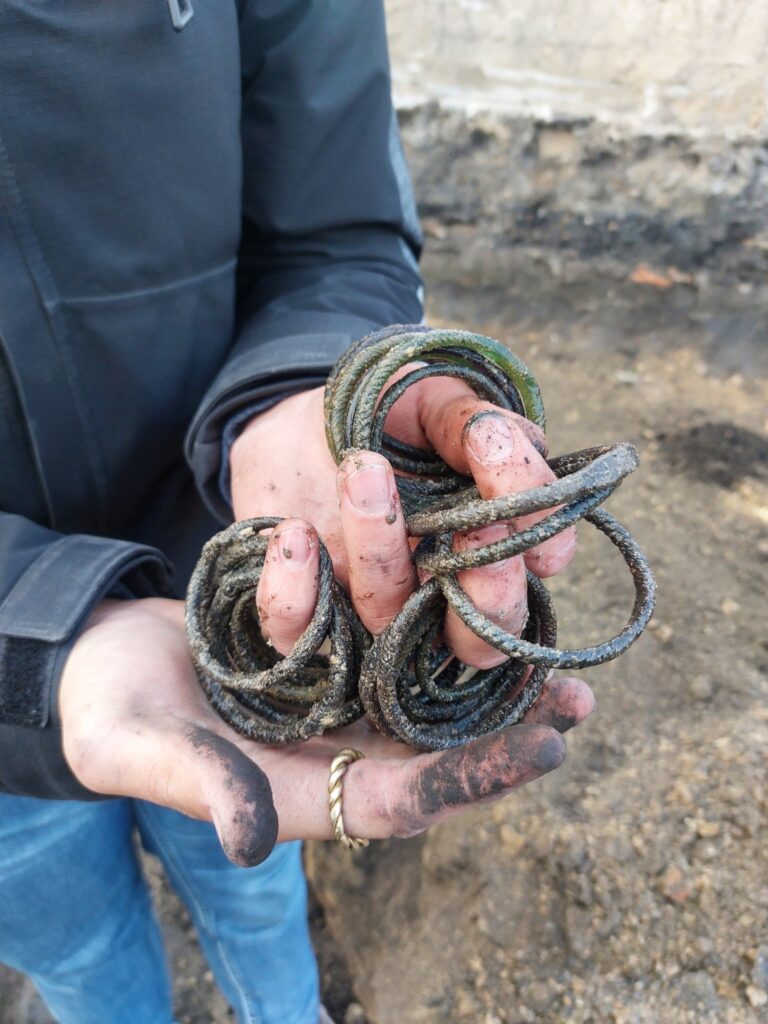
While the site had already yielded a rich variety of cultural artifacts, this assemblage proved exceptional in both scale and preservation. Credit: Viktor Bayuk via Facebook
A Treasure Frozen in a Moment of Crisis
The context of the hoard suggests that it belonged to a merchant — either a trader bringing valuable goods to Volodymyr’s market or an individual fleeing conflict while safeguarding his inventory. Evidence indicates that the treasure was concealed suddenly and never retrieved, most likely during the Mongol-Tatar campaign led by Batu Khan in late winter 1241. The Galician-Volyn Chronicle records the violent sack of Volodymyr and neighboring towns during this period, providing a dramatic historical backdrop to the find.
This frozen moment in time — goods packed together and hurriedly hidden — allows researchers to reconstruct economic and social realities on the eve of catastrophe, shedding light on how urban trade functioned in one of the key princely centers of medieval Volyn.
From Excavation to Museum Exhibition
Following scientific processing and analysis, the artifacts will be transferred to the Omelyan Dvernytsky Volodymyr Historical Museum, where they will form the core of a new exhibition dedicated to the city’s princely-era heritage. The expedition team also anticipates the possibility of future display in national-level museum institutions, reflecting the discovery’s exceptional academic and cultural value.
The research was carried out as part of legally required heritage-preservation studies prior to modern development on archaeologically significant land. The project brought together the Volyn Archaeological Expedition, Lesya Ukrainka Volyn National University, the State Historical-Cultural Reserves in Lutsk and Ancient Volodymyr, and the All-Ukrainian Archaeologists’ Union, commissioned by LLC “Volodymyr City.”
A Discovery With Global Significance
Beyond its local importance, the “Merchant’s Treasure of Volodymyr” contributes vital new evidence to the broader history of medieval Eastern Europe. The scale and integrity of the bracelet collection enable scholars to analyze production technologies, stylistic evolution, and regional trade connections across the Kyivan Rus’ world with unprecedented precision.
As researchers continue cataloguing and reconstructing the material, the discovery is poised to reshape our understanding of how people in 13th-century Volyn lived, traded, and endured — until the day history overtook them and their treasures were left buried beneath the city they once called home.
As reported by Viktor Bayuk’s Facebook account Viktor Bayuk’s Facebook account
Cover Image Credit: Viktor Bayuk via Facebook
