
More than 1,200 years ago, in an ancient Maya city in what is now Guatemala, a man known as “White-chested Fox” signed his name at the end of a remarkable mathematical text painted on the wall of a small room. His identity faded into obscurity, but the writing survived. Now, more than twelve centuries later, researchers have finally uncovered who he was—and why his name appears there.
The man was Sak Tahn Waax, a Maya mathematician who studied the movements of Venus and Mars. A new study published in Antiquity reveals that his calculations contain an unusual numerical pattern resembling the Fibonacci sequence, making him the first known Classic Maya mathematician to receive direct credit for his intellectual work.
A Mathematical Puzzle Involving Venus and Mars
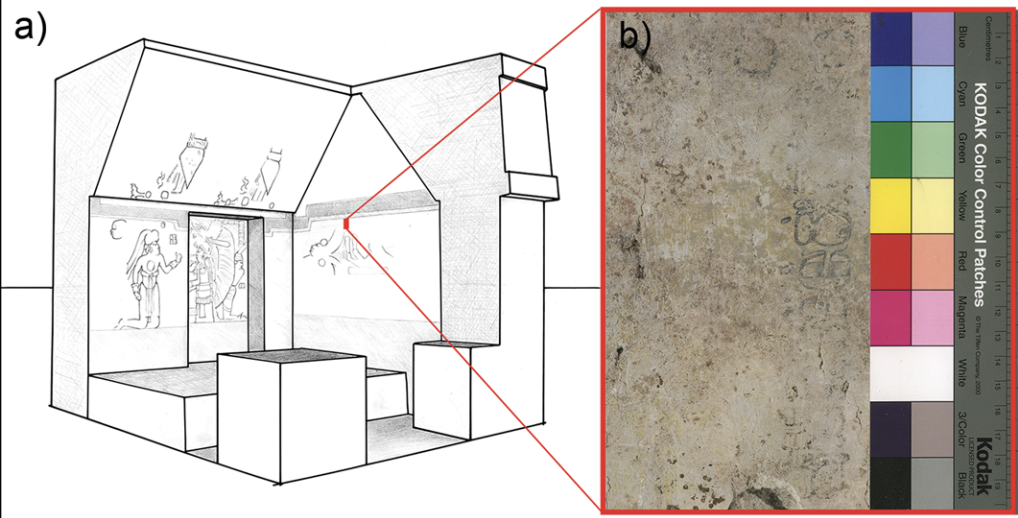
The inscription, known as Text 19, covers a small section of an interior wall at the ancient Maya city of Xultun, located in the Petén region of northern Guatemala. Though it contains only 11 hieroglyphic blocks, the calculation it records stretches across 2,920 days and weaves together several different astronomical and calendar cycles.
For Maya astronomers, 2,920 days held special significance. It equals five full cycles of Venus (each lasting about 584 days) and also matches eight solar years of 365 days. This neat alignment allowed them to link the planet’s regular appearances in the sky with the passage of years on Earth.
What makes the Xultun formula especially interesting is how its author divided that long period. Instead of simply repeating a standard Venus calculation, the scholar combined several different time units: the 20-day Maya month, the 260-day ritual calendar, a 360-day “year,” and the roughly 780-day cycle of Mars.
Researchers have found these measurements in other Maya texts, but not in this particular arrangement. The unique combination suggests the scholar was deliberately exploring mathematical relationships between different systems of measuring time, rather than merely recording a series of celestial events.
An Unexpected Connection to the Fibonacci Sequence
One of the study’s most intriguing observations concerns a familiar mathematical pattern hidden within the ancient calculation. Researchers noticed that the arrangement of calendar and planetary cycles resembles the Fibonacci sequence, a series of numbers that follows a simple rule: each new number equals the sum of the previous two.
The sequence begins 1, 1, 2, 3, 5, 8 and continues in the same way. Similar numerical patterns appear in mathematical descriptions of natural phenomena, including the arrangement of leaves and certain spiral structures in plants.
In the Xultun inscription, the pattern begins with one 20-day Maya month and one 260-day calendar cycle. The calculation then moves through two cycles of Mars, three 360-day periods, and finally five cycles of Venus. Although these intervals represent different lengths of time, the number of cycles follows the progression 1, 1, 2, 3 and 5.
This does not mean that Sak Tahn Waax discovered the Fibonacci sequence or understood it in the way modern mathematicians do. The researchers are careful to note that they cannot say whether the numerical pattern was intentional, or how widely Maya scholars recognised such sequences.
Still, the arrangement shows a creative approach to astronomy. The scholar was not simply counting days. He was exploring how different astronomical cycles and calendar systems could be fitted together into a larger mathematical framework.
A Calculation That Points to AD 781
The surviving hieroglyphs also provide a possible chronological reference for the calculation. By reconstructing damaged calendar signs and examining the intervals between recorded dates, researchers identified a starting point corresponding to November 11, AD 781, in the Gregorian calendar.
The date offers a possible starting point for the calculation, rather than an exact record of when the inscription was painted. It places the work within the eighth century, when Maya scholars had already developed a remarkable understanding of the movements of the planets.
Astronomy played an important role in Maya society. Scholars followed the movements of Venus and Mars, compared their cycles with different calendars, and used this knowledge to determine dates for religious ceremonies and royal events. Their calculations also influenced when communities dedicated temples and other important buildings.
At Xultun, archaeologists have found something rarely preserved in Maya inscriptions: the calculations themselves. The writing shows how scholars worked with different cycles of time and brought them together to understand the movements of the heavens.
The Name at the End of the Formula
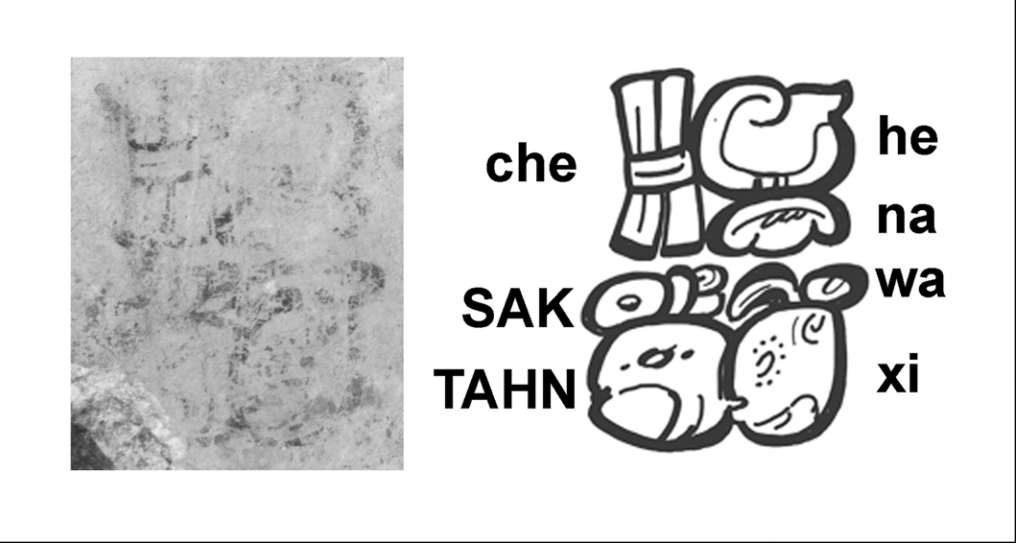
The final two hieroglyphs transform the inscription from an astronomical calculation into something more personal. After the sequence of dates and numbers, the text includes a phrase that researchers translate as “so says,” followed by Sak Tahn Waax’s name.
Although researchers have previously identified Maya artists and sculptors who signed their works, they had never found a Classic Maya mathematician whose name was directly associated with a mathematical or astronomical achievement. The inscription at Xultun provides the first known example of such an attribution, offering rare evidence of individual recognition in ancient Maya scientific traditions.
The inscription does not establish whether Sak Tahn Waax personally calculated and painted the formula. Another scribe may have recorded the work while acknowledging its original author, possibly a respected astronomer whose calculations circulated among other scholars.
Researchers suggest that the unusual structure of the formula may explain the attribution. Unlike some of the other astronomical notes found in the building, Text 19 appears to present a complete calculation that could potentially serve as a model for other periods of 2,920 days.
Inside an Ancient Maya Astronomical Workshop
Archaeologists discovered the chamber containing the inscription at Xultun in 2010. Known as Structure 10K-2, the building contains approximately 52 texts covering astronomical observations, lunar cycles, and complex numerical calculations. Its painted walls also depict seated and kneeling figures associated with different ranks within Maya court society.
Evidence of papermaking tools suggests that specialists used the building to produce books. The walls also contain both carefully executed inscriptions and less accomplished writing, suggesting that teaching may have taken place here. Experienced scholars may have trained younger scribes in astronomy, mathematics, and manuscript production. Perhaps Sak Tahn Waax himself was among those who shared their knowledge in this room, teaching others how to calculate the movements of the planets.
The Maya eventually filled the chamber and constructed another building above it. This protected portions of its painted walls for centuries, although moisture, roots, and other environmental damage left many inscriptions difficult to read.
Modern imaging techniques helped researchers recover details from the faded writing, including the name associated with Text 19. Sixteen years after archaeologists first uncovered the chamber, its walls continue to reveal how Maya scholars worked with numbers, calendars, and the movements of the planets.
For all the mathematical sophistication of the inscription, its most human detail remains the name at the end. Sak Tahn Waax may never become more than a name and a calculation in the archaeological record, but that surviving connection offers a rare glimpse of an individual contribution to ancient Maya science.
Rossi, F. D., Stuart, D., & Hurst, H. (2026). The identification and work of an eighth-century Maya mathematician. Antiquity, 100(413), 1369–1384. doi:10.15184/aqy.2026.10378
