12 December 2025 The Future is the Product of the Past

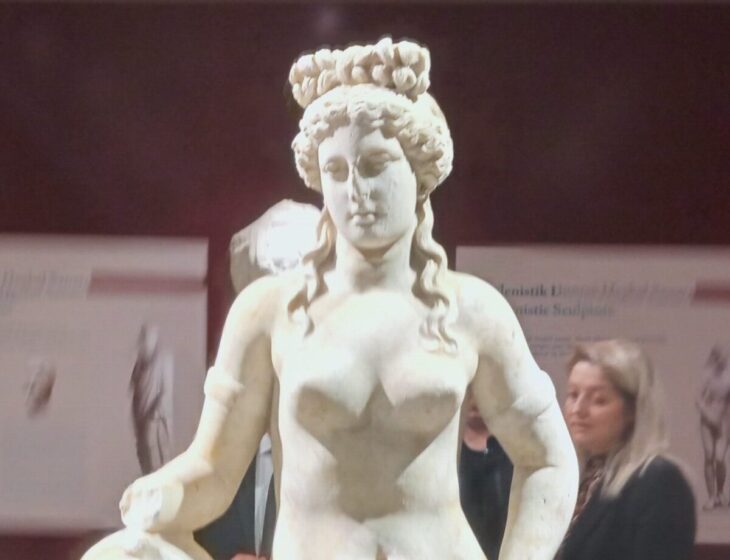
The excavations in ancient city of Aizanoi discovered the statue heads of Dionysus and Aphrodite

The heads of Aphrodite, the goddess of love and beauty, and Dionysus, the god of wine, were found in Aizanoi, located in the Çavdarhisar district of Kütahya and is home to Anatolia’s best-preserved Temple of Zeus.

The statue head of Aphrodite and the statue head of Dionysus were discovered during excavation work in an ancient city in central Türkiye.

Aizanoi Ancient City is in Kütahya Çavdarhisar district center, 50 kilometers from Kütahya.

Aizanoi was the major city of the Aizanitis people in ancient Phrygia, with a history dating back to 3,000 B.C. The territory was ruled by Pergamum and Bithynia throughout the Hellenistic period but was conquered by the Romans in 133 B.C.

The site is home to one of the best-preserved temples in Anatolia dedicated to the chief Olympian god Zeus of ancient Greek mythology.


📣 Our WhatsApp channel is now LIVE! Stay up-to-date with the latest news and updates, just click here to follow us on WhatsApp and never miss a thing!!
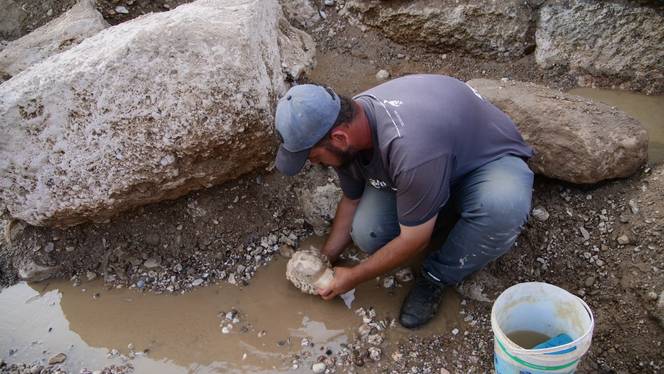


During the excavations, so far, two Aphrodite and three Dionysus statue heads were discovered. Photo: AA

Aizanoi Ancient City, Zeus Temple, Stadium-Theater Complex and Magellum (World’s First Known Stock Exchange Building), 2 Roman Baths, Antique Dam structure, Colonnaded Street, 2 Roman Bridges, is one of the most important cities of the Roman Period.

Archaeology professor and excavation team leader Gokhan Coskun told Anadolu Agency that numerous statue pieces were discovered during the excavation.

“The most exciting development for us this season is uncovering new heads of the goddess of love and beauty, Aphrodite, and the deity of wine Dionysus,” Coskun said.
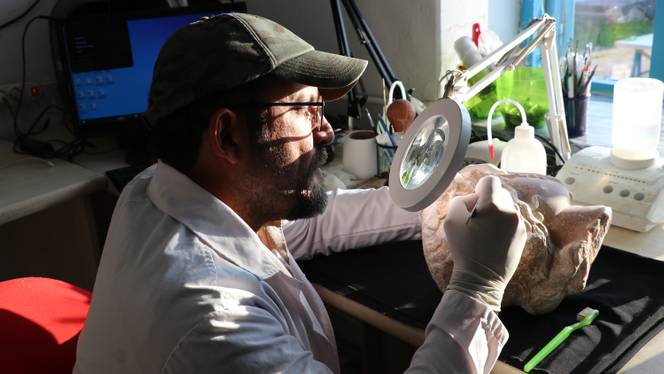
Numerous statue pieces were discovered during the excavation as well. Photo: AA

“In the excavation works we have conducted in the region so far, we have unearthed more than 100 statue pieces. Some of the heads found are from statues that are 2-3 meters long,” he noted.

“These statue heads, which we first discovered three years ago, are in very well-preserved condition. During our excavations, so far we have discovered two Aphrodite and three Dionysus statue heads,” Coskun said.

The excavation season, which began in the ancient city last April, will be completed by the end of this month, Coskun added.
Related Articles

Ancient Roman Road with Porticoes and Rare Artifacts Discovered in Switzerland

6 May 2025

6 May 2025

A major rescue excavation in Kaiseraugst, northern Switzerland, has revealed a substantial Roman road complete with porticoes, alongside poignant infant...

Evidence found of Goose domestication in Neolithic China 7,000 years ago

8 March 2022

8 March 2022

Geese may have been domesticated in what is now China as early as 7,000 years ago, according to a study...

Archaeologists discover one of the largest Phallus Relief Carving of ancient Rome

28 August 2022

28 August 2022

According to an announcement by the region’s local history museum, a large Roman-era relief carving of a phallus has been...

Grain Barns dating back 6,000 years unearthed in China

15 December 2022

15 December 2022

Chinese archaeologists have revealed a cluster of 16 ancient granaries that traced back to the mid-late period of the Yangshao...

Archaeologists uncover Europe’s oldest lakeside stilt village behind a fortress of defensive spikes

11 August 2023

11 August 2023

Under the turquoise waters of Lake Ohrid, the “Pearl of the Balkans” Scientists have uncovered what may be one of...

“Unprecedented” Phoenician necropolis found in southern Spain

28 April 2022

28 April 2022

A 4th or 5th-century B.C Phoenician necropolis has been found at Osuna in Southern Spain. A well-preserved underground limestone vault...

Early Roman Aqueduct Discovered in Turkey’s Aydın Province

27 May 2021

27 May 2021

In the Kuşadasi region of western Turkey’s Aydin, archaeologists and scholars unearthed an approximately 2,000-year-old ancient Roman aqueduct. Experts believe...

2,300 years old amazing preserved looks almost new Celtic scissors discovered in Germany

30 April 2023

30 April 2023

During a construction project in Munich’s Sendling district, Celtic cremation tombs were discovered. The quality of preservation of the grave...

New research determines portable toilets of the ancient Roman world

11 February 2022

11 February 2022

New research published today reveals how archeologists can determine when a pot was used by Romans as a portable toilet,...

New Neolithic structure unearthed at Tas-Silġ in Malta

8 October 2021

8 October 2021

Archaeologists excavating at Tas-Silġ in Marsaxlokk have discovered the remains of another Neolithic structure, Heritage Malta said. The discovery substantially...

5500-year-old pentagon structure found in North China

13 November 2021

13 November 2021

Archaeologists discovered the remnants of a pentagonal structure going back 5,500 years in Taiyuan, Shanxi Province, north China. According to...

Unprecedented Large Burial Urns in the Amazon May Reveal a Previously Unknown Indigenous Tradition

21 June 2025

21 June 2025

A remarkable archaeological discovery in the heart of the Amazon—seven giant funerary urns buried beneath a fallen tree—is offering fresh...

Britain’s first Roman funerary bed is discovered in central London after 2,000 years

7 February 2024

7 February 2024

Archaeologists excavating a construction site in London have unearthed the first Roman “flat-packed” funerary furniture – a fully intact Roman...

To The West of Turkey Ancient Quarry Found

28 March 2021

28 March 2021

Turkey is very lucky in terms of ancient settlements. It is home to many unexplored artifacts, along with well-preserved ancient...

Stonehenge’s Altar Stone May Be From Scotland, Over 700 Kilometers Away

14 August 2024

14 August 2024

Recent research led by Curtin University suggests that the Altar Stone at Stonehenge may have originated in northeast Scotland, at...