

Hidden along the limestone slopes above the Than Sa River in Thai Nguyen province, northern Vietnam, rises the monumental Nguom Rock Roof (Nguom Ngao Cave). Beneath this natural shelter, prehistoric communities lived more than 124,000 years ago, leaving behind stone tools, hearths, and plant remains that reveal some of the earliest human activity in Southeast Asia. Today, archaeologists and local residents alike are calling for this exceptional site to gain higher recognition and protection, while also becoming a gateway for sustainable cultural tourism.
A Discovery That Changed Vietnamese Prehistory
The significance of Nguom Rock Roof was first revealed in March 1980, when preliminary surveys uncovered hundreds of stone artifacts. Formal excavations in 1981 confirmed that this was once a prehistoric dwelling place, establishing what scholars came to call the “Nguom Industry” and laying the foundations for identifying the broader “Than Sa Culture.”
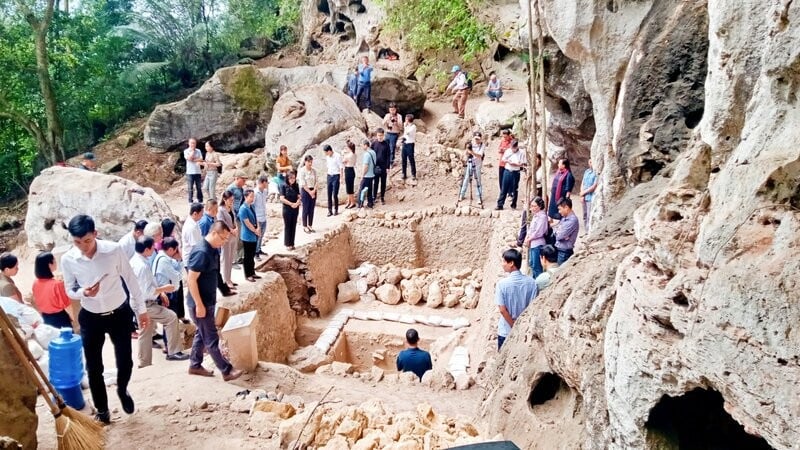
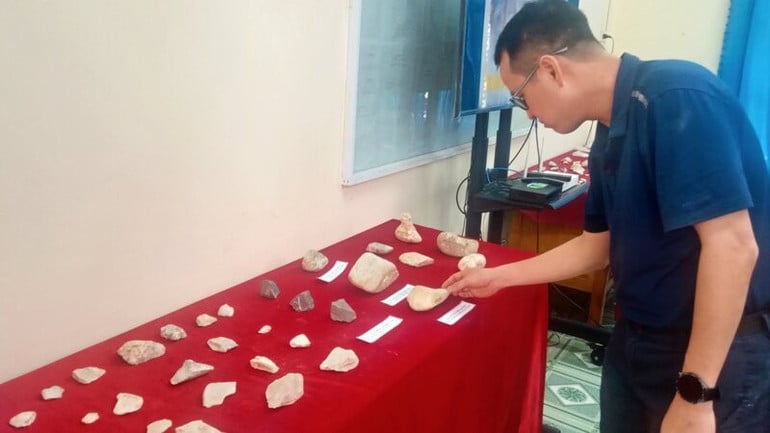
Over the decades, further excavations—in 1982, 1985, 2017, 2024, and most recently in 2025—have built a detailed picture of human occupation. Thousands of stone tools, fire traces, and animal remains confirm the site’s continuous importance. Nguom Rock Roof has since become recognized as one of Vietnam’s most significant Paleolithic sites.
The Sixth Excavation: A Breakthrough in 2025
The latest excavation campaign, led in 2025 by Dr. Pham Thanh Son of the Institute of Archaeology in cooperation with Thai Nguyen Museum and international scholars, produced groundbreaking results. Stratigraphic layers revealed evidence of human activity dating back approximately 124,590 years—the earliest traces ever documented in Vietnam and among the oldest in continental Southeast Asia.
Researchers uncovered burned animal bones, charcoal, and ash deposits deep within the sediment. For the first time in Vietnam, they also identified remains of seeds and plant consumption at such an early date. These findings confirm Nguom Rock Roof as the earliest known site of controlled fire use in Vietnam and the wider Southeast Asian region.
“The Nguom Rock Roof is more than just an archaeological site—it is a museum of human development,” said excavation leader Dr. Son. “It preserves the earliest fire use, evidence of plant and animal consumption, and a unique cultural industry that shaped prehistoric Southeast Asia.”
Scientific and Cultural Value
Archaeologists emphasize that Nguom Rock Roof is unique for three reasons:
It documents the origins and development of the distinct “Nguom Industry,” a stone-tool tradition crucial to understanding Southeast Asia’s prehistory.
It contains the oldest known evidence of fire in Vietnam.
It preserves traces of diet and daily life from over 124,000 years ago.
Together, these elements make the site a living archive of human resilience and adaptation during the deep past.
Calls for Protection and Recognition
Nguom Rock Roof was listed as a national historical and cultural monument in 1982. However, historians and cultural experts argue that this designation is insufficient. They urge local and national authorities to prepare a full nomination dossier for Special National Monument status, which would grant higher protection, funding, and international visibility.
Local leaders also see heritage recognition as a path toward community development. By linking the site to regional tourism, traditional crafts, and ecological restoration along the Than Sa River, they hope to create sustainable benefits for nearby villages—many of which are home to ethnic minority groups.
Linking Archaeology and Tourism
Beyond conservation, residents envision transforming the Nguom Rock Roof into an open-air cultural destination. Proposed initiatives include:
An exhibition space to display artifacts uncovered at the site.
Demonstration areas teaching traditional stone-working techniques.
Reconstructions of prehistoric life under the rock shelter.
Educational trails linking Nguom with surrounding scenic and cultural sites.
Such efforts would allow visitors to experience Vietnam’s earliest heritage while supporting local communities through tourism services and cultural programs.
A Prehistoric Treasure for the Future
Nguom Rock Roof embodies over 124,000 years of human history, from the first use of fire in Vietnam to the survival strategies of prehistoric communities in Southeast Asia. As a “living page of history,” it offers both scientific insight and cultural identity.
For archaeologists, the site enriches the story of human evolution and settlement in Asia. For local residents, it represents an opportunity to balance heritage protection with economic development. As calls grow louder for special national recognition, the challenge ahead is clear: to preserve Nguom Rock Roof as both a priceless archaeological monument and a sustainable heritage destination for generations to come.
Cover Image Credit: Nguom Ngao Cave. Indochina Voyages
