
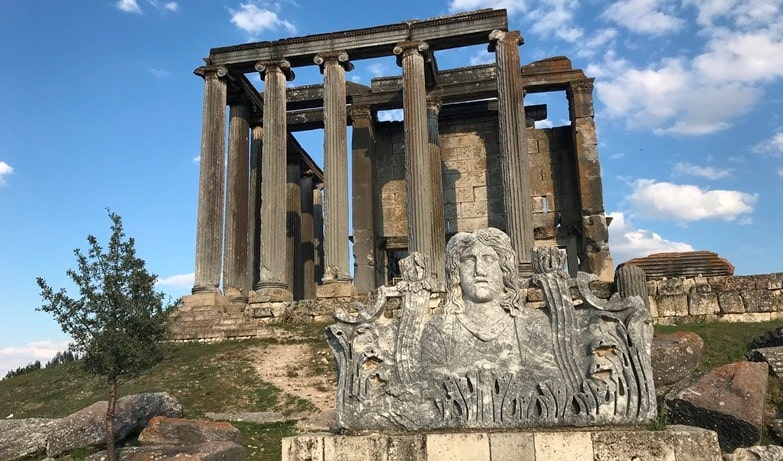
During recent digs, the monumental entrance gate of the Zeus Temple sanctuary in the ancient city of Aizanoi, located in the Çavdarhisar region of western Kütahya province, Turkey, was discovered.
Aizanoi Ancient City is in Kütahya Çavdarhisar district center, 50 kilometers from Kütahya.
The excavation coordinator, Professor Gökhan Coşkun of Dumlupnar University’s (DPU) archeology department, told Anadolu Agency (AA) that the ancient city’s history stretches back around 5,000 years.
Coşkun continued: “We started to uncover the monumental entrance with stairs of the sanctuary of the Temple of Zeus, which has been standing for 2,000 years, with our work this year. The remains of this structure are being uncovered day by day. We can determine the architectural blocks of the destroyed monumental entrance gate to a large extent. After the completion of our work here, the structure will be restored. We aim for visitors to walk through the agora and pass-through this monumental entrance gate to the temple area, just like in ancient times.”
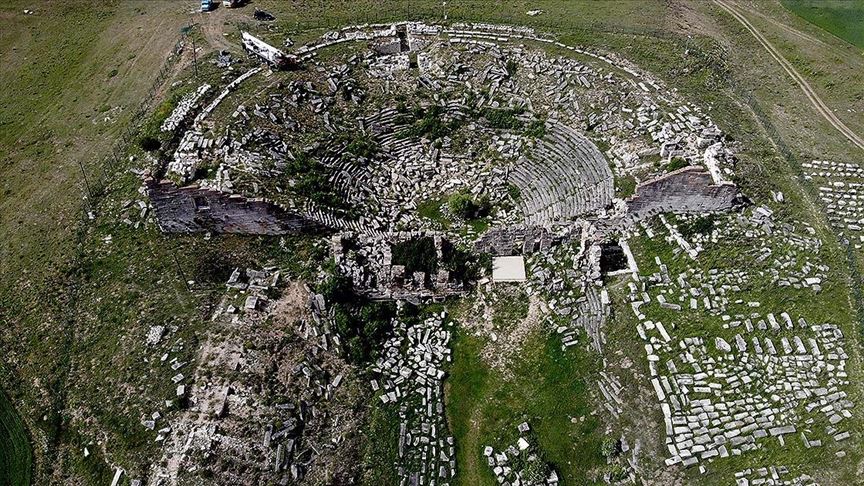
Aizanoi Ancient City, Zeus Temple, Stadium-Theater Complex and Magellum (World’s First Known Stock Exchange Building), 2 Roman Baths, Antique Dam structure, Colonnaded Street, 2 Roman Bridges, is one of the most important cities of the Roman Period.
Aizanoi Macellum, dated to the second half of the CE 2nd century, is one of the world’s first stock exchanges. On the walls of Macellum, Emperor Diocletian’s There are inscriptions on the prices of goods sold in the imperial markets, which he identified in 301 CE to combat inflation, and have been preserved in very good condition to this day.
Recent excavations near the Temple of Zeus have shown that there are several layers of settlements in the city that date back to 3000 BC. In 133 BC, it was occupied by the Roman Empire.
In 1824, European travelers rediscovered the ancient residential. Since 2011, Turkish archaeologists have been conducting work on the ancient site.
