24 February 2026 The Future is the Product of the Past

Researchers explored a rock art site near Idupulapaya in India

A rock art site was discovered near Idupulapaya in the Indian state of Andhra Pradesh.

Rock paintings from the Megalithic culture periods were discovered in Idupulapaya by a team of Yogi Vemana University history and archaeology experts.

The team led by Prof Kankanala Gangaiah of Yogi Vemana University discovered this area of rock art on September 23.

This rock shelter was found close to Idupulapaya IIIT and YSR Ghat. A water stream trail leads to the site. The main rock shelter is situated on a plateau, and it faces a local creek. At 10.5 meters above ground level, there is a cave with a narrow platform.
Rock art
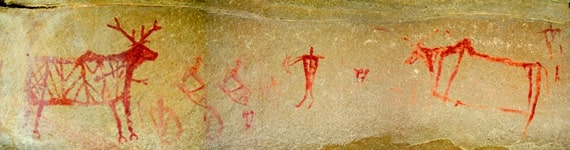
Rock art is widely found in caves and in shady parts of the rocky Vindhya hills of Central India, where the Panna Tiger Reserve is located. Deer with arrows shot into it, hunter and a long-horned bovine on the right. © Kolipaka. S.S

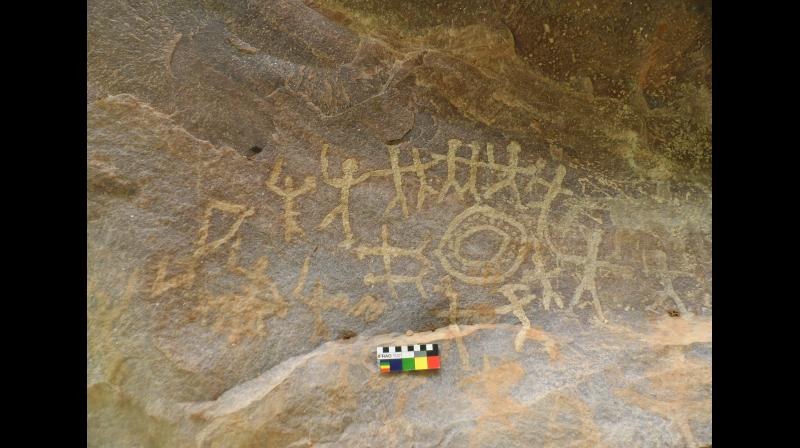
The drawing is found around the ground-level rock cave structures and on the ceiling wall of the upper deck cave structure. The upper plate is reached through a hard vertical rock climb. The route to the top plate is highlighted by several creative drawings. All the pictures on the site found by the team are painted in white ochre material using brush technique.


📣 Our WhatsApp channel is now LIVE! Stay up-to-date with the latest news and updates, just click here to follow us on WhatsApp and never miss a thing!!


Most of the paintings are in the open. The team speculates that there may be megalithic tombs in and around the rock bunker, which is covered by thick vegetation. The team studied various themes of the white paint drawings scattered throughout the shelter.

The various pictures drawn can be classified as Stick drawings of humans as individual warriors with swords, human warriors riding on horseback holding swords, humans in groups in war scenes and performing rituals, mask-decorated man, birdman or a man sacrificing a bull, drawings of elephant, horse, tiger, humped bull, religious symbols like Swastika, trident, a circle with three spikes, symbols like a ladder, circle, and Nandi pada can be found on the rocks on the bank of the stream.

Deccan Chronicle

Cover Photo: DC Image

Related Articles

Researchers found similar descriptions in the Book of Revelation and ancient curse tablets

10 February 2023

10 February 2023

A research project headed by Dr. Michael Hölscher of Johannes Gutenberg University Mainz (JGU), has uncovered that the book of...

Climate and Archaic humans caused the extinction of giant camels that lived in Mongolia 27,000 years ago, a study says

3 April 2022

3 April 2022

Camelus knoblochi, a species of giant two-humped camel, survived in Mongolia alongside modern humans—and perhaps Neanderthals and Denisovans—until about 27,000...

Genetic Analysis Reveals A Woman As The Highest-Ranking Individual In Copper Age Spain: ‘Ivory Lady’

6 July 2023

6 July 2023

According to a study published Thursday (July 6) in the journal Scientific Reports, the highest-status individual in ancient Copper Age...

As a result of an operation in western Turkey, 4 skulls belonging to the Jivaro tribe of South American origin were seized

14 December 2021

14 December 2021

In the operation held in the Aliağa district of İzmir, 400 historical artifacts belonging to various periods were seized, including...

Iron Age and Roman Skeletons Discovered on Alderney

19 May 2021

19 May 2021

Well-preserved skeletons from the late Iron Age and Roman periods were found in Alderney, one of the channel islands. The...

Ancient Roman Breakwater Discovered Underwater in Misenum: Sculptures and Architecture Reused to Tame the Sea

27 June 2025

27 June 2025

An underwater excavation off the coast of Bacoli, in southern Italy, has uncovered a remarkable Roman-era breakwater built from reused...

1,500-Year-Old Imperial Stone Inscription Unearthed in Ulanqab, Inner Mongolia

18 August 2025

18 August 2025

A newly unearthed stone inscription, tentatively named the “Stele of the Emperor’s Northern Tour,” has been discovered in the vast...

A 2,000-year-old monumental Roman villa Found Under a Seaside May Be Pliny the Elder’s house

23 January 2024

23 January 2024

Researchers have discovered the remnants of a massive Roman villa thought to have ties to Pliny the Elder while working...

A rare 3,300-year-old wooden yoke found in northern Italy

30 October 2023

30 October 2023

After eight years of complex excavation, recovery, and restoration, a rare 3,300-year-old wooden yoke discovered in a Late Bronze Age...

New Roman Settlement Discovered in Türkiye May Be Linked to the Lost City of Arsameia

17 October 2025

17 October 2025

Archaeologists in southeastern Türkiye have discovered a previously unknown Roman settlement dating to the 4th century AD — a site...

Archaeologists Discover Rare Masked Roman Oil Lamp in Cuijk, Netherlands

13 September 2025

13 September 2025

Archaeologists in Cuijk, North Brabant, have unearthed a remarkable discovery: a nearly 1,800-year-old Roman oil lamp adorned with a decorative...

Ancient Ruins of an Ancient Capital Found in Beijing

15 March 2021

15 March 2021

After two years of excavation, Chinese archaeologists recently exposed Zhongdu, the capital city of the Jin Dynasty (1115-1234) next to...

Bosphorus Was Frozen, People Crossed By Walking

14 February 2021

14 February 2021

The calendars showed the year 1954. Istanbul was experiencing an extremely freezing winter after many years. Heavy snowfall, hard enough...

Restoration of the Duomo of Florence has revealed original polychrome paint

1 December 2022

1 December 2022

During the restoration of the Porta dei Cornacchini and the marble cladding of the northern side of Florence’s Duomo, extensive...

Archaeologists uncover 850-year-old 170 silver medieval coins in an ancient grave, in Sweden

27 April 2024

27 April 2024

During archaeological excavations in a medieval graveyard in Brahekyrkan on the Swedish island of Visingsö, archaeologists uncovered about 170 silver...