
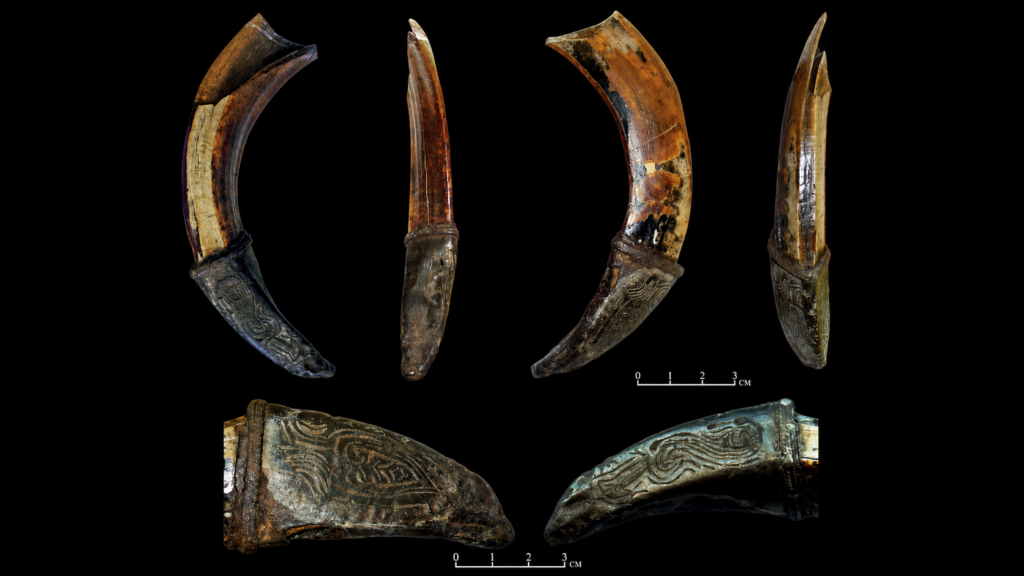
A wild boar tusk found in Veliky Novgorod in 2020 has turned out to be far more unusual than a hunting trophy. In a newly published study, researchers identify the 12th-century object as an animal-tooth amulet fitted with an ornamented metal mount — a feature not previously recorded among Novgorod’s known bone and tooth amulets.
Discovered at the Troitsky XVI excavation area, the tusk came from a large adult boar and was set in a tin-lead alloy mount made to resemble silver. The find was recovered from a high-status urban estate where weapons-related objects were also found, raising the possibility that it belonged to a hunter, warrior, or member of an elite household in medieval Rus’.
The study, published in Povolzhskaya Arkheologiya / The Volga River Region Archaeology, was carried out by Elena Tyanina, Olga Lebedeva, Viktor Singh, Natalia Eniosova, Irina Abdrashitova, and Mikhail Statkus of Moscow State University. The research combines archaeology, osteology, metal analysis, and a review of the amulet’s possible meaning.
A Tusk from a Large Adult Boar
The amulet was made from the lower right tusk of a male wild boar. Although part of the root end had already been broken before the object entered the archaeological layer, the researchers were still able to estimate the animal’s age and likely size.
Their osteological analysis indicates that the tusk came from a boar more than eight years old. By that age, male wild boars reach full physical development. The study links the animal to a large adult specimen, weighing more than 100 kilograms, and possibly around 150 kilograms if compared with modern populations from similar regions.
That detail matters. In medieval Rus’, boar hunting was not an ordinary subsistence activity. Written sources associate it with elites, princely circles, and members of the druzhina, the armed retinue. A large boar tusk could therefore have carried more than decorative value. It may have marked the owner as someone connected with hunting, warfare, or high-status masculine display.
Found in a High-Status Urban Yard
The archaeological context strengthens that reading, though it does not prove the owner’s identity.
The tusk was found within the northern estate of the Troitsky XVI excavation area, a 540-square-meter sector south of the main Troitsky excavations. In the 12th and 13th centuries, this part of Novgorod formed a quarter of urban estates near medieval streets including Proboynaya, Ryadina, and Vozdvizhenskaya. The excavated area contained two estates, conventionally identified as northern and southern.
The material from the northern estate points to a relatively wealthy household. At the same stratigraphic level as the tusk, archaeologists found weapons-related objects, including two arrowheads, a saber crossguard, and a fragment of chain mail. A tin pin decorated with a peacock was also found nearby, along with other amulets and metal fittings.
The researchers therefore suggest that the household’s inhabitants may have had links to a military environment. That remains an interpretation, not a direct identification. The amulet could have belonged to the estate owner, to someone in his household, or to a hunter or retainer associated with the property.
A Silver Look Without Silver
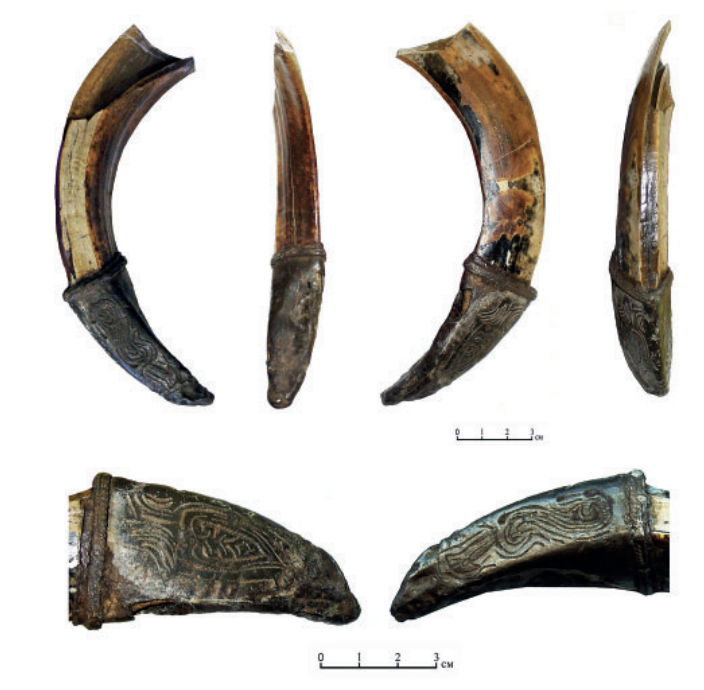
One of the most interesting results came from the metal analysis. At first glance, the mount appeared to be silver, especially because of its bright surface and dark material preserved in the engraved recesses. Laboratory testing showed otherwise.
The mount was made from a tin-lead alloy that imitated silver. The main part of the mount contained very high levels of tin, while the wire border used a different alloy with more lead and copper. The study argues that this was not accidental. The artisan likely used metals with different melting points in order to assemble the object more effectively.
The mount itself was probably cast in a two-sided clay mold made from an impression of the curved tip of the tusk. The engraving was added after the tusk and mount had been joined. The researchers note that engraving on a soft tin base had not previously been documented in Novgorod’s jewelry material.
This gives the object a double interest: it is both a ritual or symbolic object and evidence for skilled local metalworking.
A Pagan Object in a Christian City
Animal-tooth amulets were common in medieval Novgorod. Archaeologists have found amulets made from the teeth or bones of boar, bear, wolf, fox, beaver, horse, and cattle. Such objects belong to a long-lived tradition with pagan roots, even though Novgorod had already been Christianized.
The mounted boar tusk, however, stands apart. The researchers emphasize that boar tusk amulets were more common in the 10th and early 11th centuries. By the late 12th and early 13th centuries, they had become rare. The new find therefore comes from a period when the earlier symbolic system may no longer have been fully understood, but the broader idea of the animal’s protective or empowering force still remained.
The study cautiously mentions a possible older connection with Scandinavian mythology, since boar symbolism had strong associations in the Germanic and Norse world. But the authors do not argue that the Novgorod owner necessarily understood the object in that original mythological sense. By this time, the amulet may have functioned more generally as a hunting or martial charm.
A Trophy, a Charm, or Both
The researchers’ most plausible interpretation is that the tusk served as a warrior’s or hunter’s amulet. It may have symbolized the transfer of the animal’s strength to the person who killed it, while also acting as a charm for luck.
That explanation fits both the object and its context. The tusk came from a large mature boar. It was not left plain, but fitted with a carefully made metal mount that imitated a precious material. It was found in an estate with signs of wealth and possible military associations.
Still, the study leaves room for caution. Archaeologists cannot say exactly how the amulet was worn or used. It may have been carried personally, displayed, stored in a household, or passed down as a valued object. The most important point is that it was not a casual piece of waste from butchery. It was selected, modified, mounted, decorated, and kept.
For medieval Novgorod, where organic materials often survive unusually well in waterlogged layers, the amulet adds another small but sharp detail to the city’s archaeological record. It shows how Christian and older protective traditions could coexist, and how hunting, status, craft, and belief could meet in a single object: the tusk of a dangerous animal turned into a personal talisman.
Tyanina, E. A., Lebedeva, O. S., Singh, V. K., Eniosova, N. V., Abdrashitova, I. V., & Statkus, M. A. (2026). A Wild Boar Tusk in a Metal Mount from the Troitsky XVI Excavation Area in Veliky Novgorod: A Comprehensive Study. Povolzhskaya Arkheologiya / The Volga River Region Archaeology, 2(56), 166–184. DOI: 10.24852/pa2026.2.56.166.184.
Cover Image credit: Tyanina, E. A., et al., 2026
