
10 March 2026 The Future is the Product of the Past

Rare Silver Button Inscribed with the Name of a 14th-Century Novgorod Elected Magistrate Unearthed

Archaeologists in Veliky Novgorod have uncovered a rare and potentially unique artifact: a silver button inscribed with the name of a 14th-century posadnik, one of the highest-ranking officials of the medieval Novgorod Republic. The discovery was made during rescue excavations at the historic site of Yaroslav’s Court (Yaroslavovo Dvorishche)—a key political and commercial center of the city in the Middle Ages.

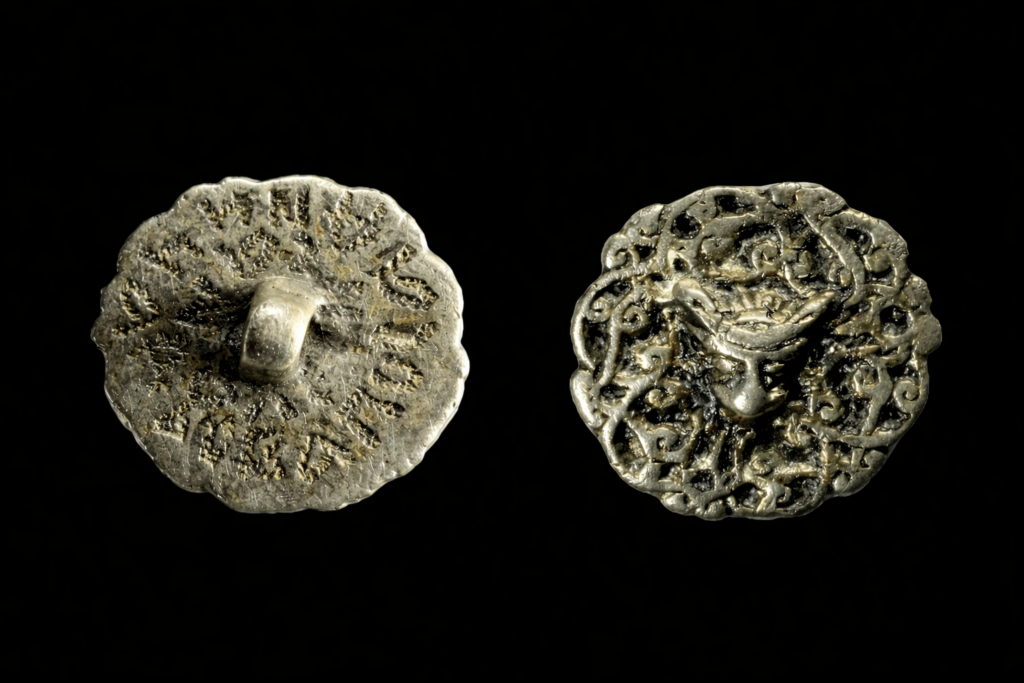
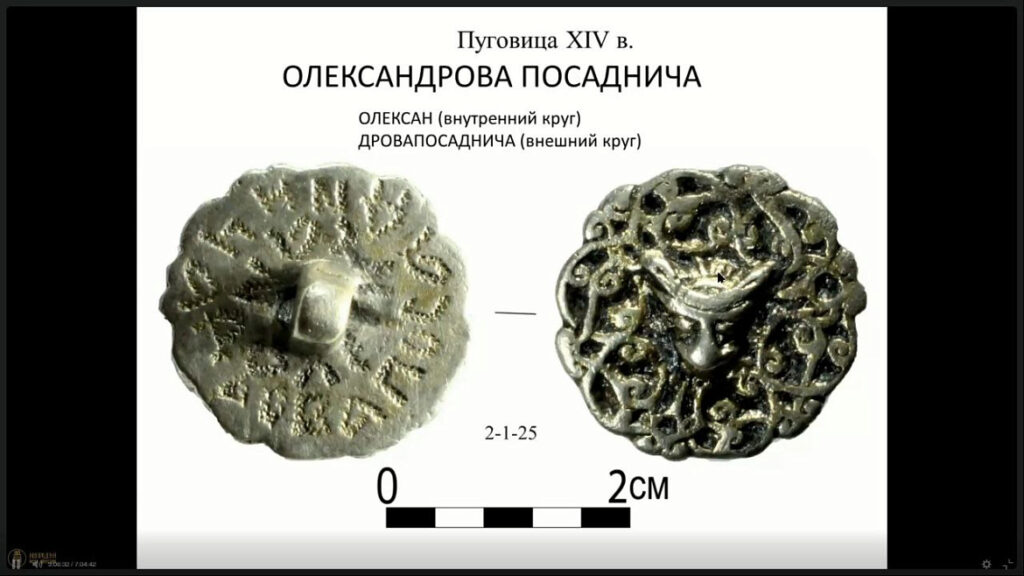
The object was found in cultural layers securely dated to the 14th century. According to researchers from the Institute of Archaeology of the Russian Academy of Sciences (RAS) and Novgorod State University (NovGU), the button bears a circular inscription reading “Olexandrova posadnicha,” which translates as “(Property) of Alexander the posadnik.”

A Western-Style Luxury Item

The silver button is described as being of Western European type, reflecting the international connections of medieval Novgorod. The city, a powerful mercantile republic, maintained extensive trade relations with the Hanseatic League and other European centers. Imported goods and Western stylistic influences were common among the urban elite.

The outer face of the button is decorated with vegetal ornamentation and features the head of an animal—possibly symbolic or heraldic in nature. The craftsmanship suggests that the piece was both decorative and functional, likely sewn onto an outer garment such as a kaftan.

On the reverse, the engraved inscription identifies ownership. In the 14th century, three Novgorodian posadniks bore the name Alexander. At present, scholars cannot definitively determine which of these officials owned the button. Further contextual discoveries from the excavation may help narrow the dating and clarify the attribution.


📣 Our WhatsApp channel is now LIVE! Stay up-to-date with the latest news and updates, just click here to follow us on WhatsApp and never miss a thing!!


Credit: Novgorod State University (NovGU)

Political Authority in Medieval Novgorod

The title posadnik referred to a senior elected magistrate in the Novgorod Republic, a medieval polity known for its relatively unique system of governance. Unlike many other Rus’ principalities ruled by hereditary princes, Novgorod operated under a semi-republican model in which key officials were elected by the veche, or popular assembly.

Posadniks exercised significant administrative and judicial authority. They presided over court proceedings, managed foreign diplomacy, and represented elite interests within the city’s complex political framework. Possession of an inscribed silver button would have signaled both status and personal identity within this highly stratified society.

Ownership and Identity

Researchers emphasize the economic and symbolic value of the find. Silver buttons were expensive items in the 14th century and not widely accessible. The engraved name likely functioned as a marker of ownership. If the garment had been lost or stolen, the inscription would have served as proof of property.

The artifact is currently considered unique in the archaeological record of Novgorod. While inscriptions are known from other categories of medieval objects—such as birch-bark letters, seals, and metalwork—personalized clothing accessories of this type are extremely rare.

Yaroslav’s Court: A Layered Historical Landscape

The excavation took place at Yaroslav’s Court, located on the Trade Side of the Volkhov River. In the Middle Ages, this district was the heart of Novgorod’s commercial life and a focal point for political gatherings. Archaeological investigations at the site have yielded wooden pavements, merchant quarters, imported goods, and written documents that illuminate the city’s economic and civic organization.

Rescue excavations in the area are ongoing, prompted by modern construction and infrastructure work. Such interventions often provide valuable opportunities to uncover well-preserved medieval strata, thanks to the waterlogged soils that characterize Novgorod’s archaeological deposits.

The discovery of the silver button adds a new dimension to our understanding of material culture and elite identity in the Novgorod Republic. Beyond its decorative appeal, the artifact offers a rare glimpse into the intersection of fashion, authority, and personal property in medieval northern Europe.

Novgorod State University (NovGU)

Cover Image Credit: Novgorod State University (NovGU)

Related Articles

Recent excavations reveal the complete water conservancy system of the nearly 5000-year-old Liangzhu Ruins

26 November 2024

26 November 2024

In recent excavations around the Liangzhu Ruins in east China’s Zhejiang Province, researchers have discovered about 20 ancient dams. Seven...

8,200-year-old lacquerware found in China

9 July 2021

9 July 2021

Archaeologists in eastern China’s Zhejiang Province have identified two items of lacquerware at the Jingtoushan ruins, the oldest ever found...

Poland’s oldest copper axe discovered in the Lublin region

30 March 2024

30 March 2024

A copper axe from the 4th to 3rd millennium BC identified with the Trypillia culture was found in the Horodło...

Amateur divers discover ‘enormously valuable’ hoard of Roman coins

27 September 2021

27 September 2021

Two amateur free divers have found one of the largest collections of Roman coins in Europe off the east coast of Spain. Luis Lens...

Long Before Zeus and Leda, Natufian People Crafted a 12,000-Year-Old Figurine of a Goose Mating with a Woman

18 November 2025

18 November 2025

Long before Greek poets imagined Zeus seducing Leda in the guise of a swan, prehistoric communities in Southwest Asia were...

Early humans appreciated geometry and symmetry and were intentionally crafting spherical shapes 1.4 million years ago, according to a new study

7 September 2023

7 September 2023

An examination of 150 round, baseball-sized stones discovered at a site where early humans lived 1.4 million years ago shows...

Early Anatolian Genes: Genetic Links Between Girmeler Mound and 17,000-Year-Old Pınarbaşı Skeletons

16 April 2025

16 April 2025

Recent archaeological excavations at Girmeler Mound, located near the ancient Lycian city of Tlos in southwestern Türkiye, have not only...

How Did a 400-Year-Old Royal Charter Nearly End Up as a Lampshade?

18 February 2026

18 February 2026

A 17th-century Royal Charter that laid the legal foundations of Leeds was once just moments away from being cut up...

One Of The Largest And Most Significant Iron Age Hoards Ever Discovered In The UK Has Been Unveiled

26 March 2025

26 March 2025

In a remarkable archaeological breakthrough, the Melsonby Hoard has emerged as one of the most significant Iron Age discoveries in...

1800-year-old marble inscription found in Turkey’s Aigai excavations deciphered

2 October 2022

2 October 2022

The 1800-year-old inscription, consisting of 3 pieces of marble, found in the excavations in the ancient city of Aigai in...

How Clean Were the Hittites? A Sophisticated Hygiene Culture 3,000 Years Ago, Revealed by New Research

29 January 2026

29 January 2026

For a civilisation that flourished more than 3,000 years ago, the Hittites may have been far more concerned with cleanliness...

Teacher unearthed stone with ancient ogham writing from Ireland in Coventry garden

9 May 2024

9 May 2024

A geography teacher, Graham Senior, stumbled across a rock with mysterious incisions while tidying his overgrown garden in Coventry, England. ...

Archaeologists Identify Previously Unknown Monumental Theater and Forum in Roman Irpinia

17 February 2026

17 February 2026

A groundbreaking archaeological campaign at the Fioccaglia Archaeological Site in southern Italy has uncovered the remains of a Roman forum...

The Mysterious Figure of Anatolia: Alexander of Abonoteichus, the False Prophet of Rome

12 February 2025

12 February 2025

In the annals of history, few figures are as intriguing as Alexander of Abonoteichus, the self-proclaimed prophet who captivated the...

Jordan’s mysterious ancient wall “Khatt Shebib”

22 October 2022

22 October 2022

The accomplishments of ancient civilizations are typically woefully underappreciated because we stereotype them as primitives who only wore loincloths, and...

Comments
Leave a Reply

Your email address will not be published. Required fields are marked *