
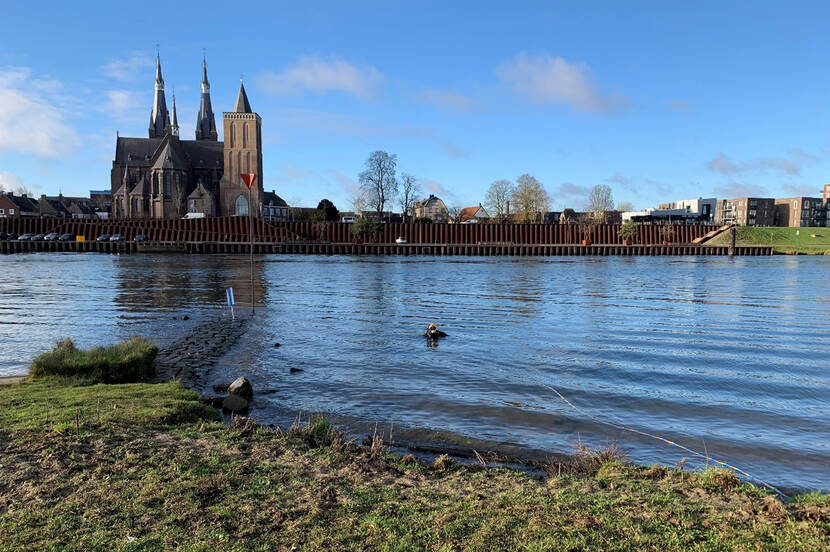
In the Dutch town of Cuijk, once known in Roman times as Ceuclum, archaeologists are currently undertaking one of the most ambitious underwater excavations in Europe. Since September 19, divers and specialists have been documenting and retrieving the remains of a 4th-century Roman harbor structure from the River Maas. What makes this project exceptional is not only the rarity of the site but also the fact that the public can follow the excavation live via online streaming—a rare opportunity to witness archaeology unfolding beneath the waterline in real time.
A Roman Harbor Beneath the Maas
The excavation covers a stretch of approximately 7 by 40 meters where archaeologists identified a series of well-preserved wooden pilings, the structural remains of a Roman quay. Dating to the 4th century AD, the harbor was part of a larger logistical system connected to the late Roman fort that once guarded this strategic bend of the river.
Alongside the timber framework, sediment layers have yielded a trove of artifacts: ceramic vessels, glass fragments, leather objects, metal tools, and even stone imports. These finds reveal the bustling exchange and supply routes that sustained both the military and civilian populations of the Lower Rhine frontier. The exceptional preservation owes much to the river itself: organic remains survived thanks to being locked under waterlogged layers directly beneath the surface.
Rare Evidence of Roman Infrastructure
While the Netherlands boasts many Roman fortresses, evidence for harbor facilities from this period is extremely rare. Military supply systems relied on waterways, yet archaeologists have seldom had the chance to study such structures in situ. The Cuijk harbor, therefore, provides an unparalleled glimpse into how Rome managed river transport and provisioning at the very edge of its empire.
“This site offers us a unique chance to study late Roman infrastructure where military presence, trade, and daily life converged,” the excavation team explained. “Few harbor-like complexes from this period are known in the Netherlands, making Cuijk a crucial discovery.”
From “Preserve in Place” to “Rescue Operation”
Originally, the Dutch Cultural Heritage Agency had planned to preserve the quay remains in situ, under protective sediment. But since 2006, increased river traffic and propeller wash have accelerated erosion. Sediment cover no longer shielded the timbers, and each passing year risked irreversible damage.
Faced with this threat, authorities approved a full-scale recovery project—an ex situ preservation effort—so that the timbers and artifacts could be studied and conserved before being lost. The decision reflects a growing national strategy on how to deal with underwater heritage in dynamic river systems, formalized in June 2025.
Cutting-Edge Underwater Archaeology
The excavation itself showcases the precision of modern underwater archaeology. Divers first mapped the extent of the site with boreholes and geophysical surveys. Once recorded, protective sediments were carefully removed. Using specialized suction equipment—often described as an “underwater vacuum”—archaeologists extracted layers of material without disturbing fragile remains. Each timber was documented, measured, and lifted to the surface for detailed analysis on deck.
The project is led by a consortium of Vestigia, Baars-CIPRO, and MSDS Marine, in partnership with the diving collective Mergor in Mosam, whose sport divers had monitored the site for years. Volunteers play a key role, assisting professionals in both surveying and recovery, highlighting how citizen science supports national heritage management.
Live-Streaming the Past
Beyond the scientific impact, what truly sets the Cuijk harbor project apart is its open window to the public. The excavation can be followed via daily video diaries and a live stream, hosted at romeinenonderwater.nl. Viewers can watch divers at work in real time, listen to archaeologists’ updates, and even see artifacts as they emerge from the Maas.
This digital outreach transforms the excavation into more than an academic exercise—it becomes a cultural event, inviting both specialists and the general public to witness Roman history being uncovered beneath the river. In an era where many excavations remain hidden from view, Cuijk demonstrates how transparency and technology can make heritage accessible and engaging.
A Harbor Reborn
As the project continues through October, the recovered timbers and artifacts will undergo conservation. They will provide fresh insights into the daily logistics of Rome’s frontier defense, its integration with river trade, and the resilience of wooden infrastructure that has survived for more than 1,600 years under water.
For Cuijk, the ancient Ceuclum, the excavation also revives a forgotten chapter of local identity. Once a hub on the Roman road and river network, the town now stands at the center of Europe’s most public underwater excavation. Thanks to livestreaming, anyone can share in the rediscovery of this rare harbor, watching history resurface plank by plank, artifact by artifact, from the depths of the Maas.
Cultural Heritage Agency of the Netherlands (RCE)
Cover Image Credit: Cultural Heritage Agency of the Netherlands (RCE).
