
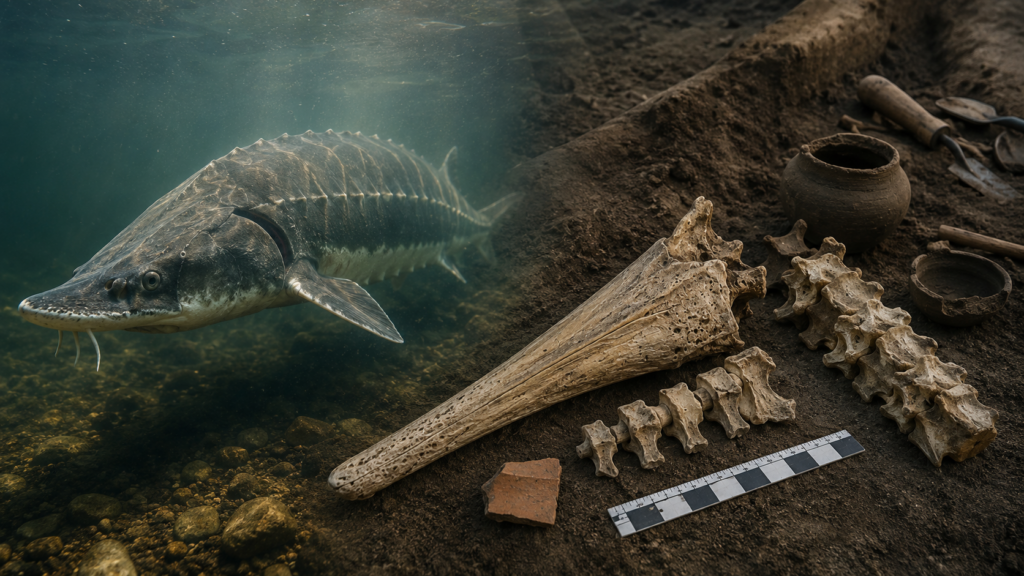
Ancient Ladoga may have owed its early rise not only to trade routes and craft workshops, but to something far more immediate: huge sturgeon moving up the Volkhov River from Lake Ladoga.
A new archaeozoological study of animal bones from the Zemlyanoye Gorodishche settlement at Staraya Ladoga in Russia’s Leningrad region suggests that fishing played a central role in the town’s food supply, economy, and perhaps even its early trade. Researchers examined more than 67,000 animal bones from cultural layers dating from the 8th to the 17th century, allowing them to trace almost a thousand years of economic change in one of northwestern Russia’s most important medieval settlements.
A river town at the edge of major trade routes
Known today as Staraya Ladoga, ancient Ladoga emerged no later than the mid-8th century near the lower reaches of the Volkhov River. Its position was strategic. From here, waterways connected the Baltic world with routes leading toward the Black Sea, Byzantium, the Caspian region, and the Islamic East.
That geography helped Ladoga grow into a major trade and craft center of the early medieval eastern Baltic. Archaeological research has long linked the settlement with merchants, artisans, Scandinavian contacts, Slavic and Finnic communities, and the wider network often associated with the early Rus world. Staraya Ladoga was one of the key trade and craft centers of the eastern Baltic during the early Middle Ages.
But the new study adds another layer to this picture. Before Ladoga became fully recognizable as an urban craft and trade hub, its early economy may have leaned heavily on large-scale fishing.
Fish were not just food
The research was carried out by Natalia Grigorieva of the Institute for the History of Material Culture of the Russian Academy of Sciences, together with archaeozoologists Olga Bachura and Tatiana Lobanova from the Institute of Plant and Animal Ecology of the Ural Branch of the Russian Academy of Sciences.
Earlier studies of animal remains from Staraya Ladoga had been selective. This project examined material collected systematically through the full depth of the cultural layer during excavations conducted in 2011–2013 under Anatoly Kirpichnikov. That complete sampling made it possible to compare different phases of the settlement more precisely.
The result is striking. In the early 9th century, fish remains sharply increase in the archaeological record. For more than 50 years, fish made up 63 to 83 percent of all animal bones recovered from the studied layers. Atlantic sturgeon alone accounted for 27 to 34 percent of the remains, while bony fish such as pike-perch, bream, and Volkhov whitefish formed another major share.
The researchers argue that such quantities exceeded household consumption. Fish was probably processed near the river, then salted, dried, or frozen. In other words, Ladoga’s fish were likely not only eaten locally, but also used as a surplus product for exchange.
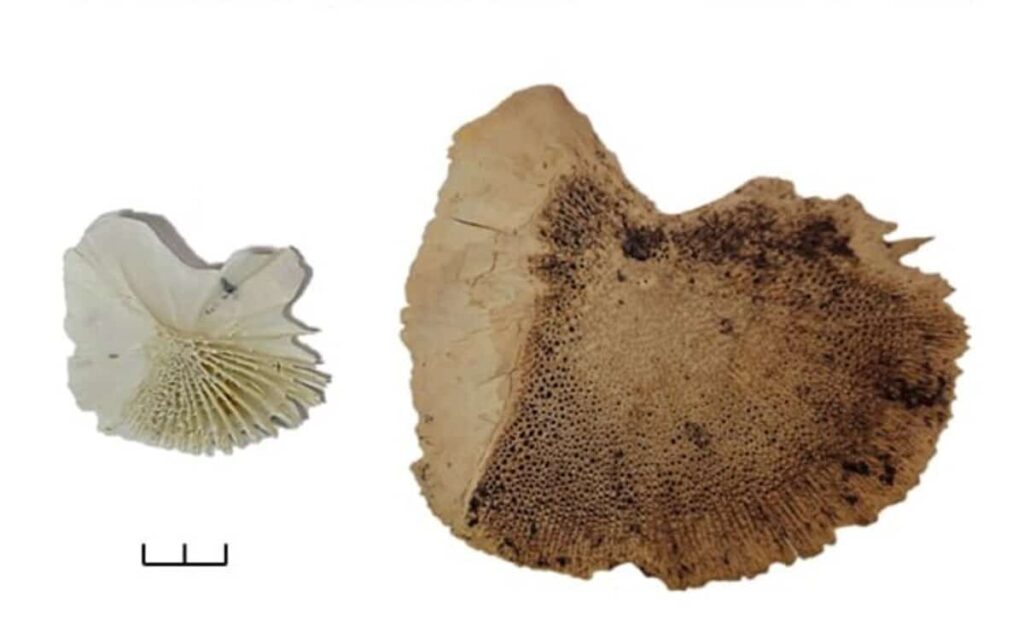
Sturgeon the size of small boats
The most eye-catching evidence comes from Atlantic sturgeon. Because much of a sturgeon’s skeleton is cartilaginous and does not survive well in archaeological deposits, the real presence of sturgeon may have been even larger than the surviving bones suggest.
Based on the preserved remains, some ancient sturgeon caught by Ladoga’s inhabitants may have reached three meters or more in length and weighed around 300 kilograms. These were not casual catches. They point to organized knowledge of seasonal fish movement, especially spawning runs from Lake Ladoga into the Volkhov River.
Natalia Grigorieva noted that fish had always been known at the site, which is expected for a river settlement. What is new, she said, is the scale shown by systematic collection from every part of the excavated cultural layer. The evidence indicates that in the first stage of the town’s life, fishing became a foundation of the economy, trade, and diet, not a minor supplement.
From fish to livestock
The pattern did not last unchanged. From around the middle of the 9th century, fish remains begin to decline, while domestic livestock becomes more prominent. By the 10th century, pigs and dairy cattle increased significantly, with sheep and horses also present.
This shift looks more like the economic profile of a developed medieval town. The reason for the decline in fish remains is still uncertain. One possibility is pressure on fish populations, especially Atlantic sturgeon, which has been almost eliminated in the region today. Another possibility is that fish processing moved to another part of the settlement as the town grew and reorganized.
Later changes also affected the archaeological record. In the 12th century, the number of animal bones in the studied area drops sharply. The researchers connect this with changes in urban topography. Around 1153, the stone Church of St. Clement was built nearby, and an administrative center formed in the area, as suggested by finds of lead seals. Animal keeping and kitchen waste may then have shifted elsewhere.
Rethinking ancient Ladoga
The study also shows what Ladoga was not. Hunting seems to have played only a limited role in the diet, since wild animal bones are rare. Dog and cat bones are also scarce, a detail that may point away from a typical rural farming settlement.
Taken together, the evidence strengthens the view that ancient Ladoga developed early as an urban center rather than a simple agrarian village. Its economy combined river resources, craft production, and long-distance exchange. The giant sturgeon bones now show that fish may have been one of the first engines behind that transformation.
Grigoryeva, N. V., Bachura, O. P., & Lobanova, T. V. (2025). Itogi arkheozoologicheskikh issledovaniy Zemlyanogo gorodishcha v Staroy Ladoge [Results of archaeozoological studies of the Zemlyanoye Gorodishche in Staraya Ladoga]. Conference proceedings article, 289–291.
Russian original format: Григорьева, Н. В., Бачура, О. П., & Лобанова, Т. В. (2025). Итоги археозоологических исследований Земляного городища в Старой Ладоге. Статья в сборнике трудов конференции, 289–291.
Cover Image Credit: This image was created with artificial intelligence for illustrative purposes. It is not an archaeological photograph or an official reconstruction.
