
15 February 2026 The Future is the Product of the Past

Lost Medieval Swedish Heraldic Stone and Rare Dagger Unearthed in Vyborg’s Sewer System

Archaeologists in Vyborg, Russia have uncovered two remarkable artifacts that reshape the city’s connection to its medieval and post-medieval past. A long-lost 15th-century Swedish heraldic stone—once belonging to the influential Tott family, governors representing the Swedish crown—was rediscovered in the most unexpected place: a sewer collector near Vyborg Castle.

Shortly afterward, workers strengthening an embankment in the city center stumbled upon a 19th-century dagger resembling the traditional Caucasian kama. Together, these chance discoveries highlight how layers of history continue to emerge from beneath Vyborg’s streets, offering fresh insight into the region’s political and cultural legacy.

According to Alexander Smirnov, director of the Monrepos Park Museum and research fellow at the Center for Rescue Archaeology of the Russian Academy of Sciences (RAS), some of the most significant finds related to Vyborg Castle were uncovered far beyond the castle walls—and purely by chance. His interview was published on November 19 by the Center’s public page “ArcheoCode.”

A 15th-Century Heraldic Stone Rediscovered After a Century

The story begins in the late 19th century, when young researcher Alfred Hackman conducted the first systematic archaeological assessment of Vyborg Castle. During his work, he sketched a mysterious stone slab embedded in one of the castle’s walls. Though his drawing survived, the stone itself was believed lost for more than 100 years.

That changed when archaeologists examined a one-story building from the 1770s located across the water from the castle. During routine excavation, they uncovered a sealed sewer collector. When the heavy stone lid was turned over and cleaned, the team made a stunning realization: the slab was in fact the long-lost heraldic stone of the Tott family, governors of the Swedish king in Vyborg. The stone originally adorned the royal chambers in the 1450s.


📣 Our WhatsApp channel is now LIVE! Stay up-to-date with the latest news and updates, just click here to follow us on WhatsApp and never miss a thing!!


This knightly coat of arms, with its helmet and feathers, likely reflects a 15th-century regional style that may differ from the more commonly depicted Tott family emblems.

“A real knightly coat of arms, complete with a helmet and feathers,” Smirnov explains. “Hackman didn’t fully understand what he had found, but his pencil drawing matches the rediscovered slab perfectly. A 15th-century knightly emblem—this is genuine, high-quality Medieval heritage that deserves a central place in the museum.
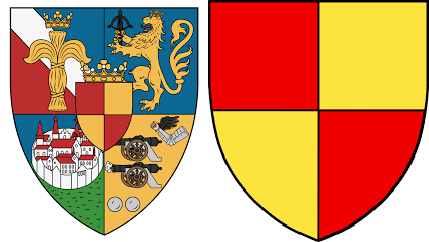
Examples of commonly depicted Tott family coats of arms. The knightly heraldic stone discovered in Vyborg, with its helmet and feathers, likely reflects a unique 15th-century regional variant differing from these standard depictions.

New Theories About Vyborg’s Early Development

Smirnov also discussed broader archaeological research that has challenged long-held assumptions about Vyborg’s emergence as a city. Years of excavations have led archaeologists to a surprising hypothesis: at the moment Vyborg officially received city status, it may not have been a true city at all. Instead, findings suggest the presence of only the fortified castle and several impoverished fishing settlements around it.

This reinterpretation of Vyborg’s early development could redefine how historians understand the region’s political and social structure during the Middle Ages.

Conservation Efforts and Another Accidental Find

Archaeological activity continues across Vyborg. Conservation work is currently underway at the Old Cathedral, where specialists are stabilizing the ancient masonry. Meanwhile, another remarkable discovery occurred during slope reinforcement on Severnij Val Street in the city center.

Workers uncovered an antique dagger at a depth of about one meter, prompting immediate interest from regional authorities. The Government of Leningrad Region confirmed the find on November 2.

“The dagger is now undergoing restoration and examination by specialists at Vyborg Castle,” said Vladimir Tsoy, Deputy Chairman of the regional government. “If its historical value is confirmed, it will become part of the museum’s collection and reveal yet another chapter of Vyborg’s past.”

Preliminary assessments indicate that the dagger dates back to the 19th century. Its shape resembles the Caucasian “kama,” a double-edged dagger whose name—borrowed from the Ottoman language—refers to this traditional weapon type.

Credit: Center for Rescue Archaeology of the Russian Academy of Sciences (RAS)

A City Where History Surfaces in Unexpected Places

The rediscovery of the Tott family’s heraldic stone and the recent unearthing of a 19th-century kama-style dagger highlight the archaeological richness of Vyborg. These finds demonstrate how traces of the city’s medieval and post-medieval life continue to surface in unexpected locations—from castle fortifications to ordinary sewer structures and urban construction sites.

As research progresses, archaeologists believe even more revelations await, promising to deepen public understanding of a city whose layered history spans Swedish knights, medieval fortresses, and multicultural influence.

Cover Image Credit: Center for Rescue Archaeology of the Russian Academy of Sciences (RAS)

Related Articles

Military Team Discovers Remarkable 2,000-Year-Old Celtic Artifacts, Including Chariot Parts and Bridle-Bit

4 February 2025

4 February 2025

Military personnel and veterans at RAF Valley in Anglesey on the island of Anglesey, Wales, have uncovered sensational Iron Age...

For the first time, researchers discovered bioarchaeological evidence of familial embalming in early modern France

16 November 2024

16 November 2024

A unique discovery has revealed new insights into the burial rituals of early modern Western Europe: For the first time,...

Archaeology Team Uncovers Major Ancient Settlement Site on University Grounds

15 February 2026

15 February 2026

A routine construction project at Technische Universität Dortmund (TU Dortmund, Germany) has led to a remarkable archaeological discovery: traces of...

Puzzling rings may be finger loops from prehistoric weapon systems

24 May 2023

24 May 2023

When many researchers looked at an astonishing group of artifacts discovered at French archaeological sites, they presumed they were ornaments...

1,500-Year-Old Stained Glass and Mosaics Discovered at Harran Cathedral Excavation in Türkiye

7 February 2025

7 February 2025

Recent excavations at the historic Harran archaeological site, which is included on UNESCO’s World Heritage Tentative List, have yielded rare...

Archaeologists have discovered sandstone blocks belonging to a pharaoh’s temple covered with hieroglyphs in Sudan

2 March 2023

2 March 2023

Polish archaeologists have discovered sandstone blocks belonging to a pharaoh’s temple covered with hieroglyphs during excavations at Old Dongola in...

Remarkably Preserved Bronze Age Urns, Thousands of Years Old, Unearthed in Germany

13 May 2025

13 May 2025

What appeared to be an ordinary stretch of County Road 17 between the towns of Moisburg and Immenbeck has turned...

Archaeologists Find 11 Sealed Middle Kingdom Burials Full of Jewelry in Luxor, Egypt

4 November 2024

4 November 2024

The South Asasif Conservation Project, an Egyptian-American mission working under the auspices of the Ministry of Tourism and Antiquities, has...

Unique Gold Ring and Crystal Amulet among 30,000 Medieval Treasures Uncovered in Sweden

7 March 2024

7 March 2024

In the Swedish medieval city of Kalmar, archaeologists from the State Historical Museums unearthed the remains of over 30,000 objects...

700-Year-Old Church Becomes a Museum

31 January 2021

31 January 2021

It was learned that the 7-century-old church in Akçaabat, Trabzon will serve as a museum from now on. St. The...

3,500-Year-Old Opal Workshop and Rare Lithophones Unearthed in Vietnam

17 August 2025

17 August 2025

Archaeologists in Vietnam’s Gia Lai province have uncovered a remarkable prehistoric site dating back more than 3,500 years. Excavations at...

An ancient necropolis and coins discovered in Kastel Fortress, a national monument of Bosnia and Herzegovina

11 November 2024

11 November 2024

During excavations at Kastel Fortress, the national monument of Bosnia and Herzegovina, students and professors of Archaeology and History found...

Researchers found similar descriptions in the Book of Revelation and ancient curse tablets

10 February 2023

10 February 2023

A research project headed by Dr. Michael Hölscher of Johannes Gutenberg University Mainz (JGU), has uncovered that the book of...

Two Durham Archaeology Students, One from Türkiye, Earn Prestigious Awards for Research on Ancient Lycia

26 July 2025

26 July 2025

In a remarkable achievement for Anatolian studies, two Durham University-affiliated archaeology students have received prestigious awards for their research on...

Archaeologists Found 1,600-year-old Burials of Noble Women and Gold Jewelry in the Mountains of Crimea

4 December 2024

4 December 2024

Archaeologists found burials of noble women filled with gold and silver jewelry in the Crimean mountains in the Bakhchisaray region...