
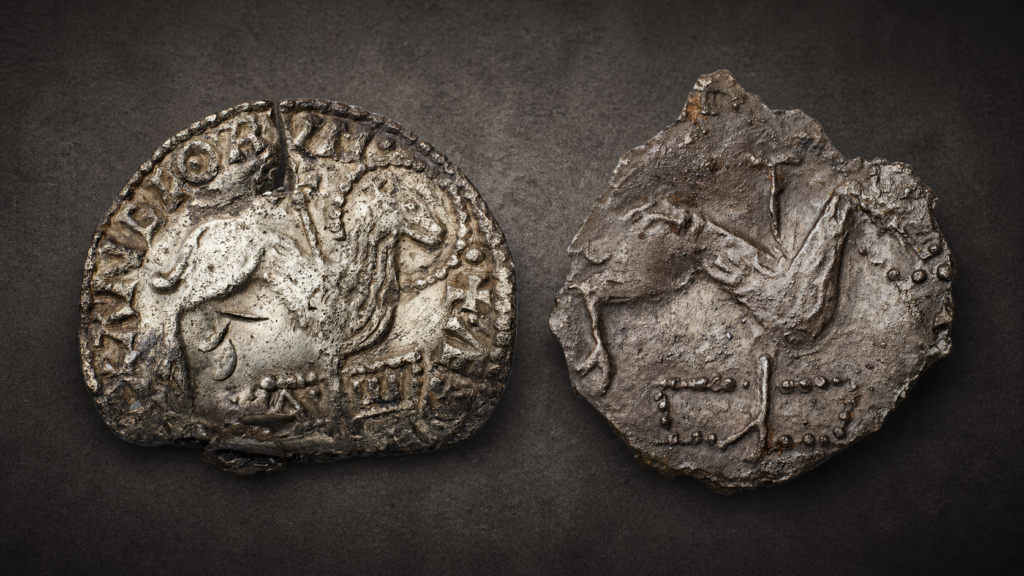
Two exceptionally rare Anglo-Saxon “Lamb of God” coins, struck more than 1,000 years ago in a desperate attempt to seek divine protection against Viking attacks, have been found in Denmark. The silver coins, also known as Agnus Dei pennies, were discovered by metal detectorists near Løgumkloster in southern Jutland and Kåstrup in Thy, and have now reached the National Museum of Denmark.
At first glance, each coin may look like a small piece of worn silver. But its imagery tells a much larger story. Instead of carrying the usual royal portrait, the coin bears the Agnus Dei, the Lamb of God, one of the most recognizable Christian symbols of the Middle Ages. For King Æthelred II of England, who ruled during one of the most turbulent periods of the Viking Age, this was not ordinary coinage. It was a political and spiritual response to crisis.
The coins were minted around 1009, when England was under severe pressure from repeated Viking raids. According to the National Museum of Denmark, Æthelred tried to mobilize both church and kingdom against the threat. Fasting, penance, prayer and a striking new coin design were all part of the same defensive effort. The idea was clear: if military resistance was not enough, perhaps sacred imagery could help protect the realm.
It did not work.
A Christian coin with a Viking afterlife
The irony is almost too perfect. Coins created to defend England from Vikings appear to have been taken, treasured and possibly worn by Vikings themselves.
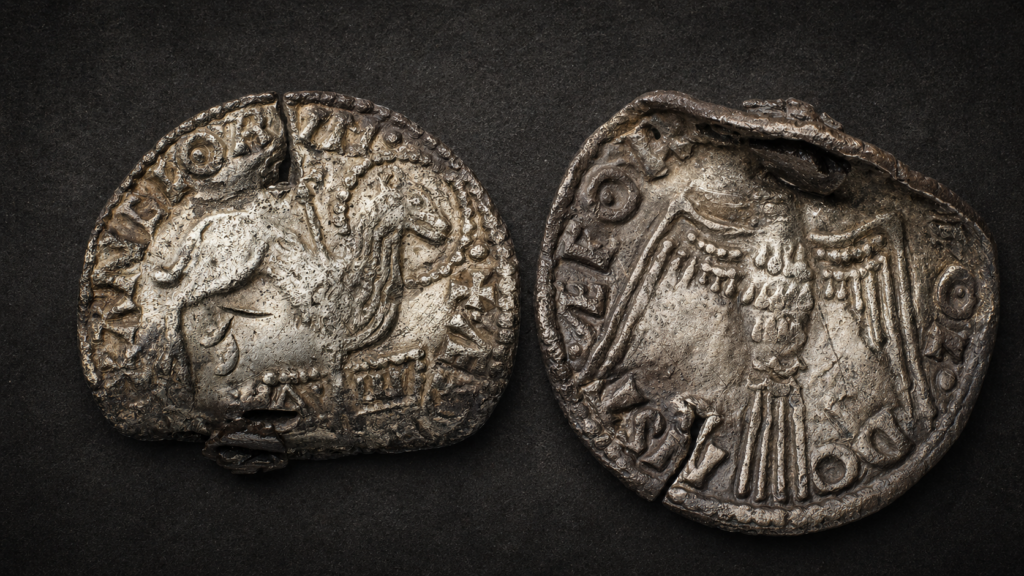
Only around 30 examples of these so-called Agnus Dei pennies are known worldwide. Very few have been found in England. Most have turned up in Scandinavia and the Baltic region, often with small loops attached, suggesting that they were converted into pendants or amulets.
That detail changes the story. These coins were not simply lost money. They may have been selected, modified and displayed. For a Viking owner, the Christian imagery may have carried prestige, exotic value, spiritual meaning or simply visual appeal. A coin intended as divine protection against raiders had crossed the North Sea and entered the material world of the people it was supposed to stop.
Gitte Tarnow Ingvardson, museum inspector at the National Museum of Denmark, described the find as both rare and paradoxical. The coins, she noted, open a path from English kings and Christianity to Danish Viking rulers, the rise of coinage in Denmark and even the formation of the Danish state.
Why the Lamb of God design matters
The Agnus Dei pennies differ sharply from typical English coins of the period. Most contemporary coins carried the king’s portrait on one side and a cross or inscription on the other. These rare pieces replaced royal imagery with sacred symbols.
On one side, the Lamb of God appears pierced by a cross, a reference to Christ’s sacrifice. The lamb stands on a tablet marked with the Greek letters alpha and omega, meaning the beginning and the end. On the other side, a dove rises upward, representing the Holy Spirit.
This was not subtle decoration. It was theology stamped into silver.
The design belongs to a moment when medieval kingship, warfare and religion were deeply connected. Æthelred’s England faced not only raids, but prolonged military pressure, tribute demands and political instability. In such a climate, a coin could become more than currency. It could act as a public message, a prayer, and a statement of royal authority.
The age of Æthelred and the Viking threat
Æthelred II, often remembered by the later nickname “the Unready,” ruled England from 978 to 1016. His reign coincided with renewed Scandinavian attacks on England, including major Danish incursions in the late 10th and early 11th centuries. The year 1009 was especially tense. Viking armies threatened the kingdom repeatedly, and English rulers had to combine military action, taxation, diplomacy and payments of tribute.
The Agnus Dei issue appears to have been short-lived. Its rarity suggests that only a limited number were produced before the design was abandoned. The continued Viking attacks may explain why. A sacred coin could express hope, but it could not stop ships, armies or political collapse.
Within a few years, England would fall deeper into Scandinavian power struggles. Sweyn Forkbeard, king of Denmark, briefly became king of England in 1013. His son Cnut later ruled a North Sea empire that included England, Denmark, and Norway. The two coins found in Denmark belong to this larger world of movement, violence, exchange, and cultural borrowing.
How English silver helped shape Danish coinage
The discovery also points to a major economic transformation in Viking Age Denmark. For much of the Viking world, silver circulated by weight. People used hacksilver, ingots and foreign coins, cutting and weighing metal during trade.
English coins changed that habit.
The large quantities of silver brought back from England through trade, tribute and raiding showed Scandinavian elites the advantages of a more organized coin system. Danish Viking kings began to adopt and adapt English models. The National Museum notes that the Danish coinage system was inspired by England’s well-ordered monetary structure.
Even the Agnus Dei imagery had a later life in Denmark. Cnut the Great and his son Harthacnut minted coins with related motifs, and Svend Estridsen also used similar designs. That continuation matters because Svend Estridsen played an important role in the development of Denmark’s church organization.
In other words, these two small coins are not only evidence of Viking raids. They also mark a transfer of ideas. Religious imagery, royal authority and monetary organization moved across the North Sea together.
A tiny coin with a wide historical reach
The two newly reported coins from Løgumkloster and Thy are valuable because they compress a remarkable historical chain into a few grams of silver. They speak of an English king under pressure, a Christian kingdom seeking divine help, Viking raiders who carried foreign wealth home, and Danish rulers who later turned imported models into their own political tools.
A coin made to stop Vikings became part of the Viking world. That is what makes the find so powerful. It is not just rare. It is a reminder that history often survives in its contradictions.
Cover Image Credit: Søren Greve og John Engedahl Nissen. National Museum of Denmark
