
A small limestone seal found near Tel Yavne in Israel is opening an unusually vivid window onto religious life in the southern Levant during the 7th century BCE, when the region stood under the shadow of the Assyrian Empire.
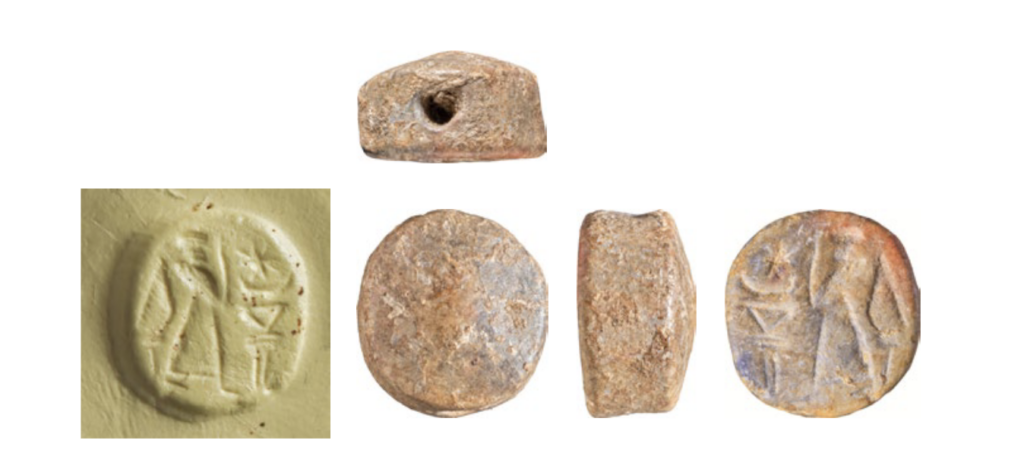
The object is tiny, only 14.6 millimeters long, but the scene carved into it carries a much larger story. It shows a bearded male figure raising his hand toward a set of sacred symbols: a cult stand, a crescent, and an eight-pointed star. According to a new study published in Tel Aviv: Journal of the Institute of Archaeology of Tel Aviv University, the crescent and star are best understood as astral symbols linked to the moon god and Venus, or a major female deity associated with the planet.
What makes the discovery especially striking is not only the image itself, but where the seal was found. It did not come from a temple, a palace, or a tomb. It was uncovered on a working surface inside a large pottery-production compound east of Tel Yavne, among the remains of an active industrial zone.
A Worship Scene Found in a Potter’s Workshop
The seal was discovered about 200 meters east of Tel Yavne, in Area U of the Israel Antiquities Authority excavations. The area belongs to the Iron IIC period, roughly the 7th century BCE.
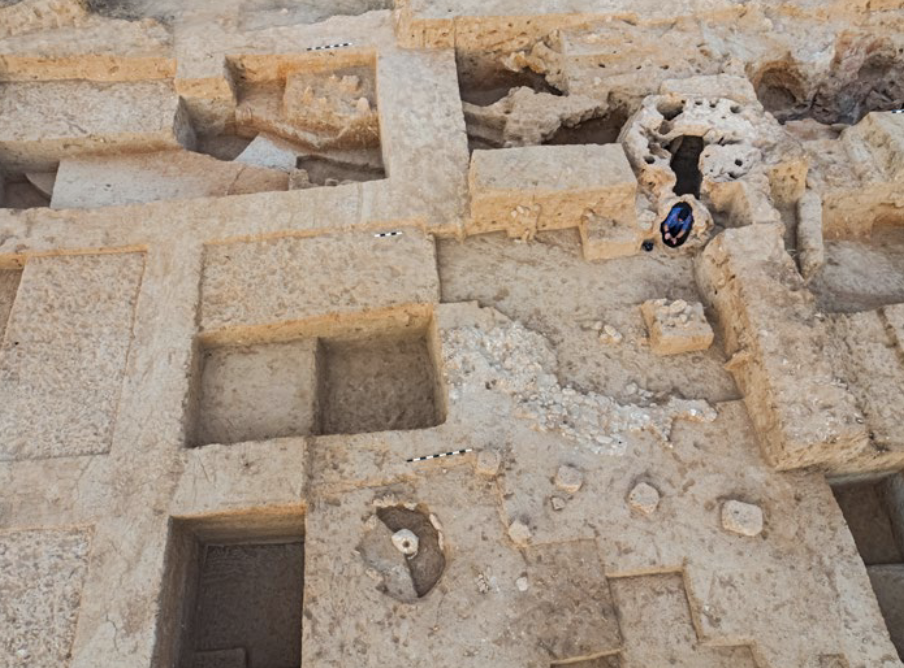
Excavators found a large pottery-production complex there, including nine kilns, potter’s wheels, working surfaces, paved floors, grinding tools, storage jars, bowls, kraters, potter’s tools, and heaps of ceramic waste. Another nearby area, Area M2, produced four additional kilns of the same general type.
This was a place of production, labor, heat, clay, and storage jars. Into that setting came a small object carrying a carefully engraved ritual scene. The seal was found on a working surface alongside storage jars, a mortar, and loom weights, close to two potter’s wheel bases and about 20 meters from the pottery kilns.
In other words, the find brings astral worship into an everyday industrial landscape. It suggests that religious images and imperial-era symbols were not restricted to formal cult spaces. They could travel with people, administrators, workers, merchants, or ritual specialists moving through the economic networks of the Assyrian period.
![‘Assyro-Levantine’ stamp seal from Yavne (photos by Assaf Peretz; drawings by Yaakov Shmidov[courtesy of the Israel Antiquities Authority] and Ulrike Zurkinden [SSSL project]). Credit: Uehlinger, C., et. al., 2026](https://arkeonews.net/wp-content/uploads/2026/07/‘Assyro-Levantine-stamp-seal.webp)
A Rare Assyro-Levantine Seal
The researchers describe the object as an “Assyro-Levantine” stamp seal, but that does not mean it was made in Assyria. The term points instead to a hybrid visual world that developed in the Levant under Assyrian influence.
The seal is a scaraboid made of reddish limestone and is preserved intact. Its base carries a vertical scene without a border. At the center stands a bearded male worshipper in a long garment. In front of him are three sacred elements: a likely cult or offering stand, a crescent, and an eight-pointed star. Behind or beside him appears a cypress-like tree.
The tree may indicate that the ritual was imagined outdoors rather than inside a built shrine. The crescent and star form the core of the scene. In the study, they are interpreted as the new moon and Venus, representing the moon god and a major female deity.
The rarity of the seal is another major point. The authors note that no exact parallel is currently known from the Southern Levant. Similar motifs appear on other seals from sites such as Akko, Tell Jemmeh, Jerusalem, Megiddo, and Shiqmona, but the Yavne example combines its elements in a distinctive way.
That makes it valuable not as a spectacular treasure, but as a well-contextualized object from a clear archaeological setting. Many comparable seals come from uncertain or unstratified contexts. The Yavne seal, by contrast, was found in a dated excavation layer inside a defined industrial compound.
Moon, Venus, and the “Host of Heaven”
The image on the seal belongs to a wider world of astral worship in the Levant during the late 8th and 7th centuries BCE. This was the period when the Assyrian Empire expanded westward and reshaped political, economic, and cultural life across the region.
The worship of the moon god and other astral deities was not simply imposed from above by Assyria. The study presents it more as a regional response to the new imperial reality. Local communities, administrators, migrants, and ritual specialists appear to have adapted new religious symbols in their own ways.
This is where the biblical question enters the story.
The Hebrew Bible contains several critical references to ritual specialists known as kĕmārîm, often translated as priests or cultic officials. In Hosea 10:5, the term appears in a polemical setting linked to the cult image of Bethel. In 2 Kings 23:5, these figures are associated with astral cults and practices that Josiah’s reforms are said to have ended in Judah and around Jerusalem. Zephaniah 1:4 also attacks rituals directed to the “host of heaven,” a phrase commonly connected with astral deities.
The Tel Yavne seal does not prove those biblical passages. It does not identify a named priest, a specific ritual, or a Judahite reform. But it does show that images of astral worship were circulating in the same broad world in which those debates took shape.
The seal gives material form to a religious environment in which the moon, Venus, cult stands, ritual specialists, and imperial-era cultural exchange all belonged to the same historical conversation.
Yavne Between Ashdod and Ekron
The location of Yavne also matters. The city lies in the southern Coastal Plain, about 15 kilometers from Ashdod and about 40 kilometers from Ashkelon. During the Assyrian period, Ashdod became a major administrative center after its conquest by Sargon II in 711 BCE.
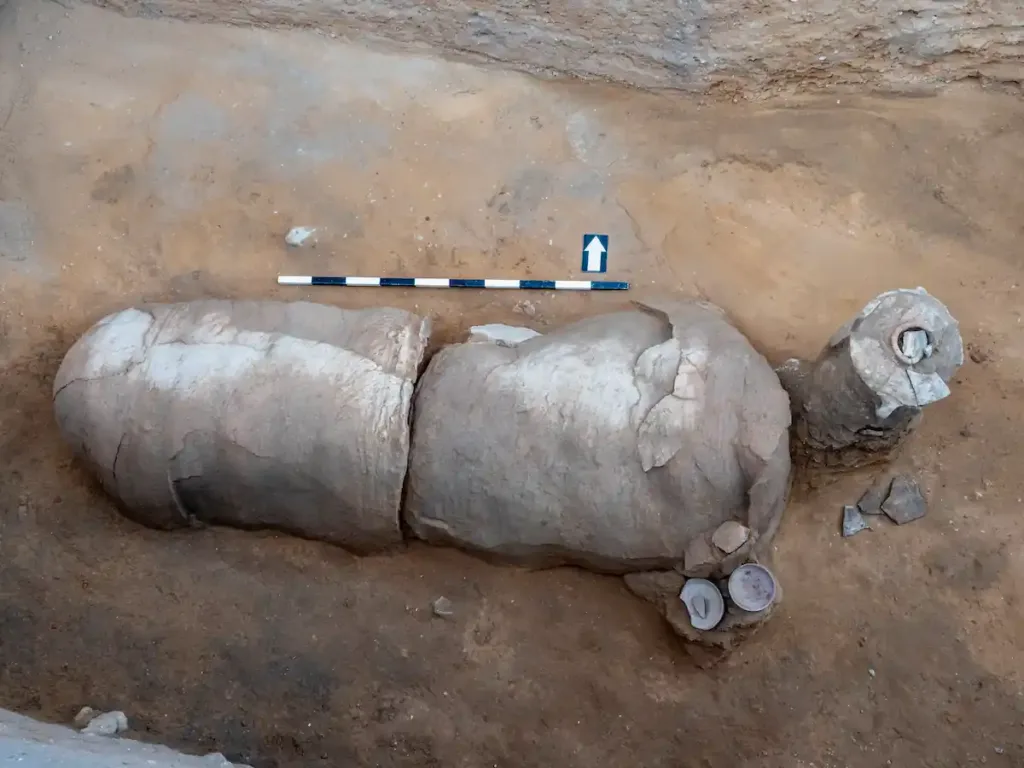
Yavne has now produced several finds that place it firmly within that Assyrian-period landscape. About 160 meters north of the pottery-production area, archaeologists uncovered Iron IIC burials with distinctly Assyrian-style features, including two “double-pot” graves and a mudbrick crypt. Such burial customs are familiar in the Assyrian world but unusual in the Southern Levant. The Yavne examples may point to non-local individuals, possibly people connected with Assyrian administration or groups familiar with Mesopotamian burial traditions.
The pottery compound adds another layer. Nearby Ekron was a major olive-oil production center under Assyrian rule, yet pottery workshops have not been found there. Yavne, by contrast, had a substantial ceramic industry capable of producing containers suitable for agricultural products. The study suggests that Yavne may have supplied pottery to Ekron or to other centers within the Assyrian economic system.
Seen this way, the seal was not an isolated curiosity. It came from a site where industry, migration, imperial administration, and religious imagery overlapped.
A Small Object from a Changing World
The Tel Yavne seal is powerful because it is modest. It is not a royal inscription or a monumental temple relief. It is a small personal object found in the dust of a working area, near kilns and potter’s wheels.
Yet its carved scene speaks to one of the major transformations of the 7th century BCE: the spread and local adaptation of astral rituals under Assyrian rule. The crescent and star on the seal are not decorative filler. They point to a world in which the sky itself was part of religious practice, political identity, and cultural negotiation.
For Tel Yavne, the find adds a rare and well-provenanced piece to a growing picture. The city was not a passive settlement on the edge of empire. It was an industrial hub with far-reaching connections, where Assyrian influence met local Levantine traditions in daily life.
Uehlinger, C., Betzer, P., Golding-Meir, R., Varga, D., & Lehmann, G. (2026). An ‘Assyro-Levantine’ Stamp Seal with a Worship Scene Found near Tel Yavne. Tel Aviv, 1–26. https://doi.org/10.1080/03344355.2026.2637186
Cover Image Credit: Uehlinger, C., et. al., 2026
