
8 December 2025 The Future is the Product of the Past

Oldest Known Tiger Figurine Unearthed in Northern Iran — 5,000 Years Old

Archaeologists have identified what may be the world’s oldest depiction of a tiger — a 5,000-year-old ceramic figurine excavated at Yarim Tepe in northern Iran. Published in Anthropozoologica by Henry P. Colburn of Bryn Mawr College, the study reveals that this figurine predates all known tiger imagery in Iranian art by nearly three millennia, offering an unprecedented glimpse into how early communities in ancient Hyrcania perceived and represented the powerful predator.

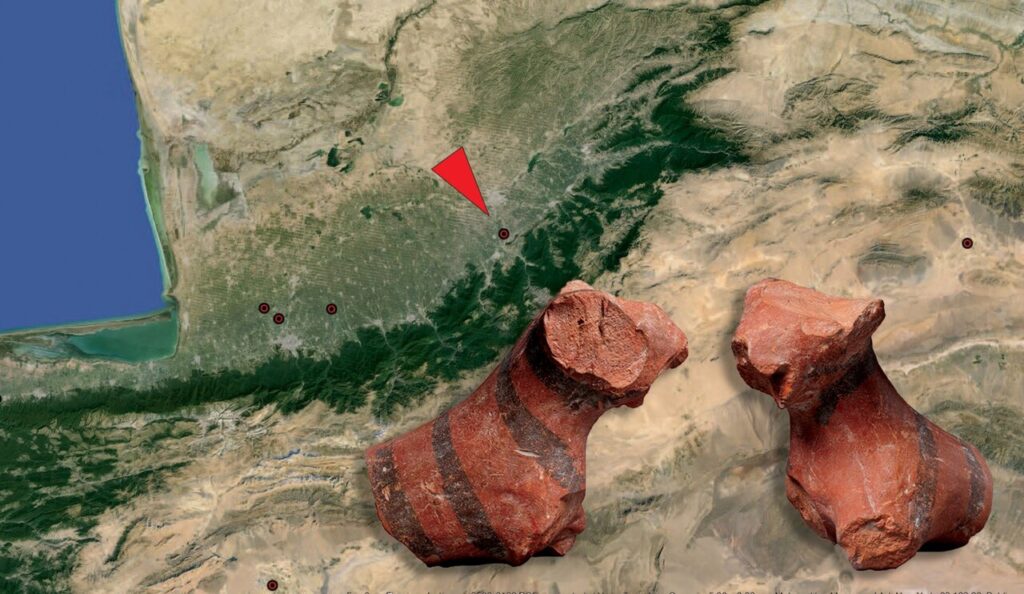
The small, reddish-brown figurine, painted with dark stripes, was unearthed in 1960 at Yarim Tepe, a prehistoric mound near modern Gonbad-e Kavus in Iran’s Golestan Province — a region once known as Hyrcania, home to the now-extinct Caspian tiger (Panthera tigris virgata).

The figurine, discovered during excavations in 1960 and later acquired by the Metropolitan Museum of Art in 1963, measures just over 8 centimeters in length. Only the animal’s chest, neck, and part of its head survive, yet its identity is unmistakable. Two dark, carefully painted stripes curve naturally along the body, with another partially visible on the neck — a deliberate artistic feature central to identifying the creature as a tiger, according to Colburn.

Based on ceramic typology known as Caspian Black-on-Red Ware, Colburn dates the artifact to between 3500 and 3100 BCE, during the Late Chalcolithic period.

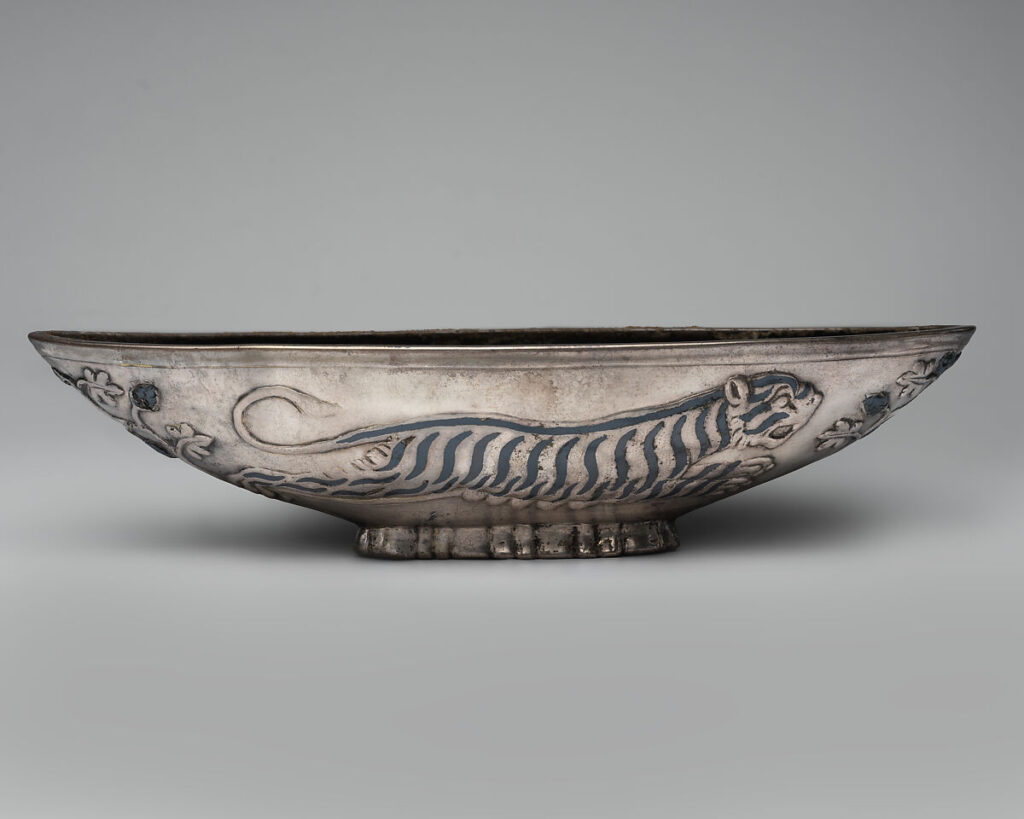
If accurate, this would make the Yarim Tepe figurine not only the earliest known depiction of a tiger in Iran but one of the oldest anywhere outside the Indian subcontinent. Until now, tigers were believed to have entered Iranian art much later — during the Sasanian Empire (3rd–7th centuries CE) — when motifs of tiger hunts and royal power became popular on silver vessels and court artworks.


📣 Our WhatsApp channel is now LIVE! Stay up-to-date with the latest news and updates, just click here to follow us on WhatsApp and never miss a thing!!


Sasanian bowl decorated with a running tiger, 6th-7th century CE. Silver, niello; 9.8 × 6.1 × 26.2 cm. Metropolitan Museum of Art, New York, 1989.281.37. Credit: Public domain image from the Metropolitan Museum of Art

Colburn’s findings challenge this assumption by suggesting that the cultural association between tigers and Iranian identity may stretch back thousands of years earlier. “Although its exact function is unknown,” he notes, “the figurine must have played a role in shaping local identity at Yarim Tepe.”

The study places the discovery within the broader ecology of ancient Hyrcania — a lush, forested region between the Alborz Mountains and the Caspian Sea. These Hyrcanian forests, now a UNESCO World Heritage Site, were once home to red deer, wild boar, and tigers, which roamed the region until the 20th century. The figurine’s naturalistic stripes and clay texture suggest that its maker had direct familiarity with the animal’s appearance — indicating local observation rather than imported myth.

Other Chalcolithic sites in northeastern Iran — such as Shah Tepe, Tureng Tepe, and Tepe Hissar — have yielded similar ceramic styles but no comparable animal representations. This makes the Yarim Tepe tiger a unique find within the archaeological record of prehistoric Iran.

Beyond its artistic value, the figurine carries deep symbolic implications. In later Persian culture, the tiger became an emblem of heroism and divine strength. In Ferdowsi’s Shahnameh, written around 1000 CE, the legendary warrior Rustam wears a tiger-skin cloak known as the babr-e bayān. Colburn argues that the Yarim Tepe figurine could represent the earliest manifestation of this enduring cultural symbol — a material echo of what would later become central to Persian mythology.

The study also reframes the relationship between Iran and Central Asia. Earlier theories attributed tiger imagery in Iran to external influences from Bactria or the Indus Valley, but the Yarim Tepe discovery points to an indigenous artistic tradition rooted in Hyrcania itself.

By connecting prehistoric craft with later imperial art and literature, Colburn’s research reveals a remarkable continuity: from a humble clay tiger crafted 5,000 years ago to the royal beasts that adorned Sasanian palaces and the poetic epics of medieval Persia.

Colburn, H. P. (2025). The first Hyrcanian tiger? A unique figurine from Yarim Tepe, Iran. Anthropozoologica, 60(10), 131–142. https://doi.org/10.5252/anthropozoologica2025v60a10

Cover Image Credit: Tehran Times

Related Articles

A well-preserved lion mosaic discovered in the Ancient City of Prusias ad Hypium

16 November 2023

16 November 2023

Archaeologists found a lion mosaic during excavations carried out in the Ancient City of Prusias ad Hypium. Excavations have been...

Saudi shipwreck excavation reveals hundreds of 18th-century artifacts on sunken ship in the north Red Sea

25 February 2022

25 February 2022

Divers from Saudi Arabia’s Heritage Authority have discovered a shipwreck in the Red Sea from the 18th century filled with...

A large hall from the time of Viking Harald Bluetooth discovered

26 December 2022

26 December 2022

A large hall from the reign of King Harald Bluetooth of Denmark and Norway was unearthed during housing construction work...

A Large Copper Age Necropolis Discovered in Italian Town

16 February 2024

16 February 2024

In the town of San Giorgio Bigarello, near the northern Italia city of Mantua, a large Copper Age necropolis dating...

Crusade period grave field and a sword discovered in Finland

15 October 2023

15 October 2023

A large cemetery from the time of the Crusades was discovered near a medieval stone church in Salo Perttel, a...

Unearthing the Birthplace of the Alphabet: Archaeologists Return After 14 Years of Silence

10 November 2025

10 November 2025

After more than a decade of silence, the ancient civilization of Ugarit, once one of the most influential trade hubs...

200 Feet to the Past: The Millennium-Old Mystery of the Himalayan Towers

8 May 2025

8 May 2025

In the remote and rugged landscapes of the Himalayas, a series of enigmatic structures known as the Himalayan Towers, or...

Archaeologists discovered 22 mummies wrapped in bundles, mainly children and newborns in Peru

7 December 2023

7 December 2023

The mummified burials of 22 people, mostly young children and newborn babies, were found in the Peruvian town of Barranca...

An Erotic Frescoes Decorated ‘Tiny House’ Has Been Discovered in Pompeii

26 October 2024

26 October 2024

During investigations at the construction site of the Insula dei Casti Amanti along Via dell’Abbondanza in the central area of...

History, geography, and evolution are rewrites thanks to an incredible dinosaur trove discovered in Italy

2 December 2021

2 December 2021

A dinosaur trove in Italy rewrites the history, geography, and evolution of the ancient Mediterranean area. Italy is not exactly...

The Largest Circular Tomb of the Ancient World Is Opening

16 February 2021

16 February 2021

The restoration of Augustus’ colossal tomb, which is expected to be opened in 2014, has been completed. The Augustus mausoleum...

In Germany, volunteers unearthed the largest hoard of Slavic coins to date and bronze-age seven swords

29 November 2023

29 November 2023

Volunteer archaeologists found bronze age seven swords and from the 11th century 6000 silver coins in the northeastern German state...

World’s Only Ancient Wooden Twin-Hulled Boats Unearthed in Vietnam

20 May 2025

20 May 2025

A groundbreaking archaeological discovery in Bac Ninh province, northern Vietnam, has brought to light two remarkably well-preserved ancient wooden boats,...

“They Depicted Lake İznik as an Ancient Woman”: Newly Unearthed Roman Mosaic in İznik

21 November 2025

21 November 2025

An extraordinary archaeological discovery in the town of İznik, Türkiye, is reshaping modern understanding of Roman art and regional mythology....

A Batavian Cavalry Mask was found on the Battlefield of Roman Comrades

22 July 2022

22 July 2022

Archaeologists have discovered that a rusty corroded plate they found 4 years ago at an old battlefield in the city...