
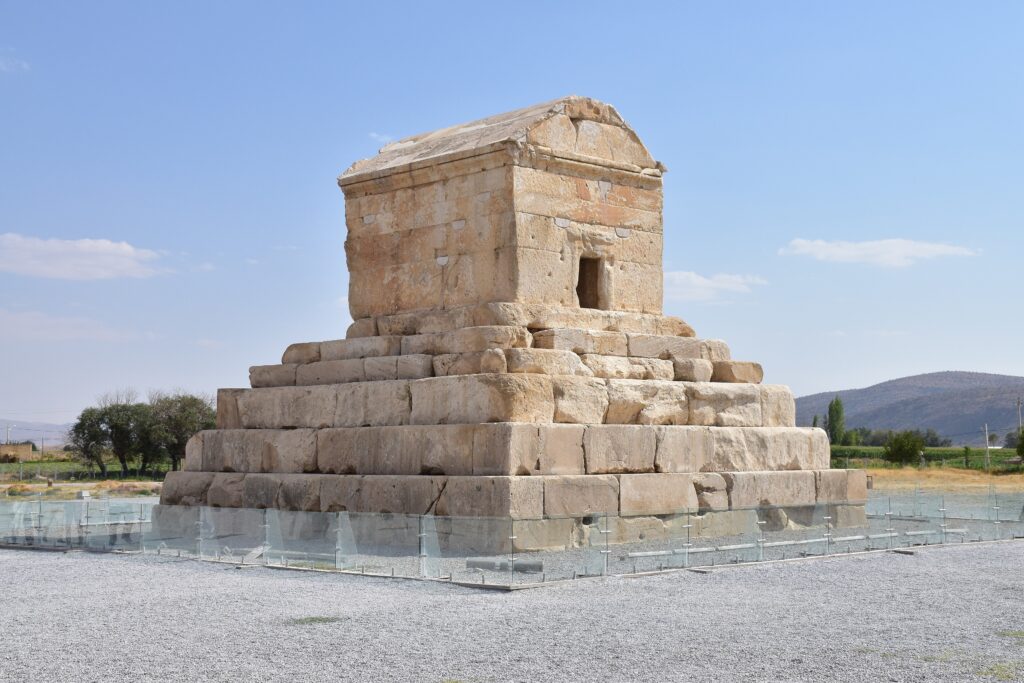
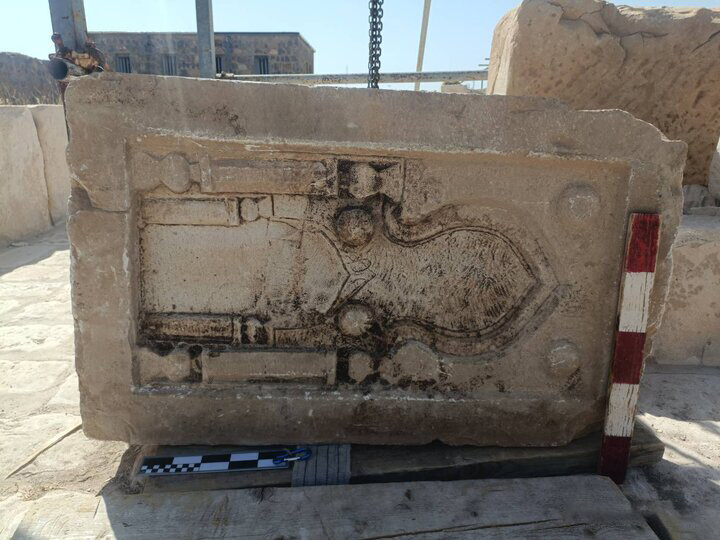
A historical mihrab has been discovered during conservation work at a caravanserai within Pasargadae, the first capital of the Achaemenid Empire in southern Iran. The find could reveal a lesser-known chapter in the site’s history, when the ancient royal landscape was reused during the Islamic period.
The architectural feature was identified during protective and restoration work at the Mozaffari Caravanserai, located near the Tomb of Cyrus the Great. Specialists documented the mihrab immediately after it came to light and began emergency conservation measures to protect its surviving decorations.
Seyyed Abdolmajid Abedi, head of the Pasargadae World Heritage site, said the structure was significant for both its architectural design and artistic details. According to Abedi, the quality of the decoration suggests that skilled craftspeople produced the mihrab and that it occupied an important position within the building complex.
Researchers are now conducting a detailed damage assessment, architectural documentation, and comparative analysis. Their primary objective is to determine when the mihrab was constructed and whether it belonged to the caravanserai’s original phase or to a later modification.
What is a mihrab?
A mihrab is a niche built into the qibla wall of a mosque or prayer space. It indicates the direction of Mecca, toward which Muslims face during prayer. Mihrabs can range from simple wall recesses to richly decorated architectural compositions covered with carved plaster, stonework, tile mosaics or inscriptions.
The presence of a mihrab does not automatically prove that the entire structure functioned as a mosque. Caravanserais, palaces, schools and other large complexes often contained small prayer rooms. Further investigation will therefore be required to establish whether the Pasargadae mihrab formed part of a dedicated mosque, a private prayer hall or another religious space.
Its orientation, construction materials and relationship with the surrounding walls may help archaeologists reconstruct the building’s changing function.
A medieval building beside the Tomb of Cyrus
The Mozaffari Caravanserai stands approximately 100 meters north of the Tomb of Cyrus. The square building measures roughly 45 by 40 meters and contains rooms arranged around a central courtyard.
The structure is generally attributed to the reign of Shah Shoja, who ruled Fars between 1358 and 1374 under the Mozaffarid dynasty. Builders reused stone blocks taken from older Achaemenid monuments at Pasargadae, a practice that physically connected the medieval building with the remains of the ancient Persian capital.
Although the caravanserai dates broadly to the 14th century, specialists have not yet assigned the newly discovered mihrab to a precise period. It may belong to the original Mozaffarid construction, but it could also represent a later phase when the building’s internal spaces were altered.
The discovery is particularly important because Pasargadae is primarily known for its Achaemenid monuments. Evidence from the Islamic period can help archaeologists understand how later communities perceived, occupied and adapted a landscape already associated with Cyrus the Great.
Pasargadae was Iran’s earliest imperial capital
Cyrus the Great founded Pasargadae in the sixth century BCE in the Persian heartland of what is now Fars Province. It became the earliest capital of the Achaemenid Empire, which eventually extended from Egypt and the eastern Mediterranean to Central Asia and the Indus Valley.
The archaeological landscape covers about 160 hectares and includes the Tomb of Cyrus, the fortified platform of Tall-e Takht, monumental gateways, audience and residential palaces, and the remains of an early formal garden system.
Pasargadae represents the first major phase in the development of a distinct Persian imperial architectural tradition. Its combination of palaces, gardens and monumental stone structures later reached a more elaborate form at Persepolis. UNESCO added Pasargadae to the World Heritage List in 2004 under four cultural criteria.
The newly identified mihrab adds another layer to that long history. Final conclusions, however, will depend on the results of the ongoing architectural and conservation studies.
Cover Image Credit: Public Domain
