
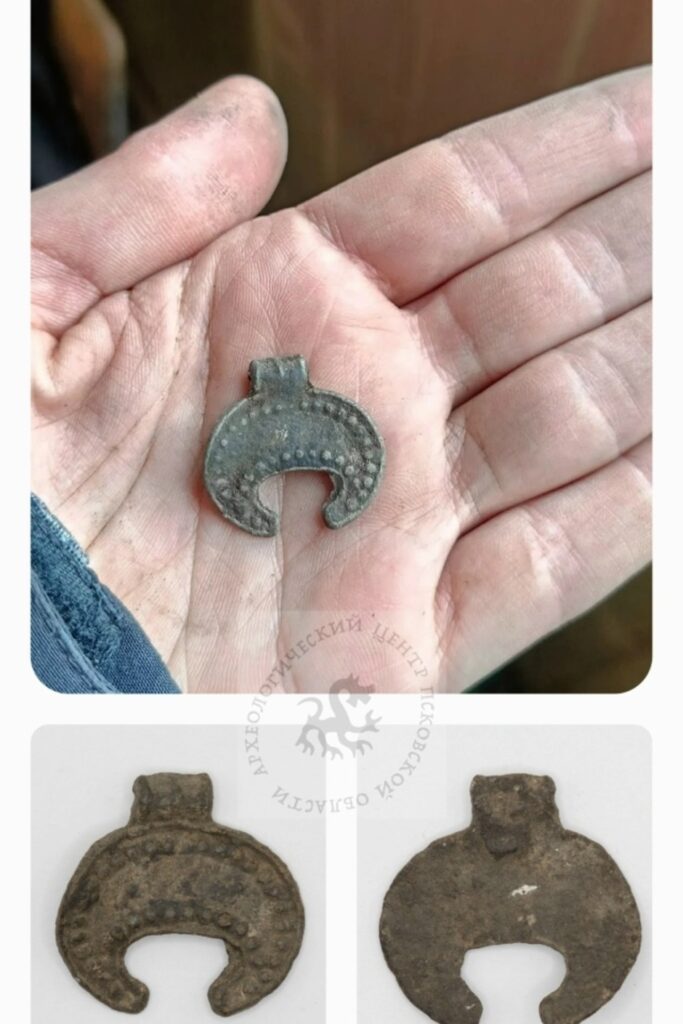
At first glance, the object unearthed in Pskov looks like a simple crescent-shaped pendant. But ornaments of this kind were rarely treated as ordinary jewellery. Worn close to the body, they were believed to guard their owners from illness, misfortune and unseen forces.
Archaeologists discovered the pendant during excavations at the Olginsky-10 site in Zavelichye, a historic district of Pskov in western Russia. The find has expanded the city’s growing collection of lunitsas—ornaments whose curved shape recalls the young or waning moon.
The Archaeological Center of the Pskov Region has not yet identified the metal used to make the object. Laboratory analysis will take place after the field season, and the center has not announced a precise date for the pendant.
Its shape, however, connects it with a tradition that crossed continents, survived religious change and remained visible in women’s jewellery for thousands of years.
A Moon Worn Against the Skin
The Russian word lunitsa refers to crescent-shaped pendants and ornaments. Their defining feature is the curved outline of the moon, usually with two pointed ends facing downward or outward.
Similar jewellery appeared as early as the Bronze Age and was worn in different forms across Europe, Asia and Africa. Crescent pendants were known in the ancient Mediterranean, in Byzantine territories and among communities living in Eastern Europe long before the large-scale expansion of the Slavs.
Some were cast from inexpensive metals and worn in everyday necklaces. Others were made from silver and decorated with filigree, granulation or stamped patterns. They could hang from necklaces, form part of elaborate headdresses or appear as earrings.
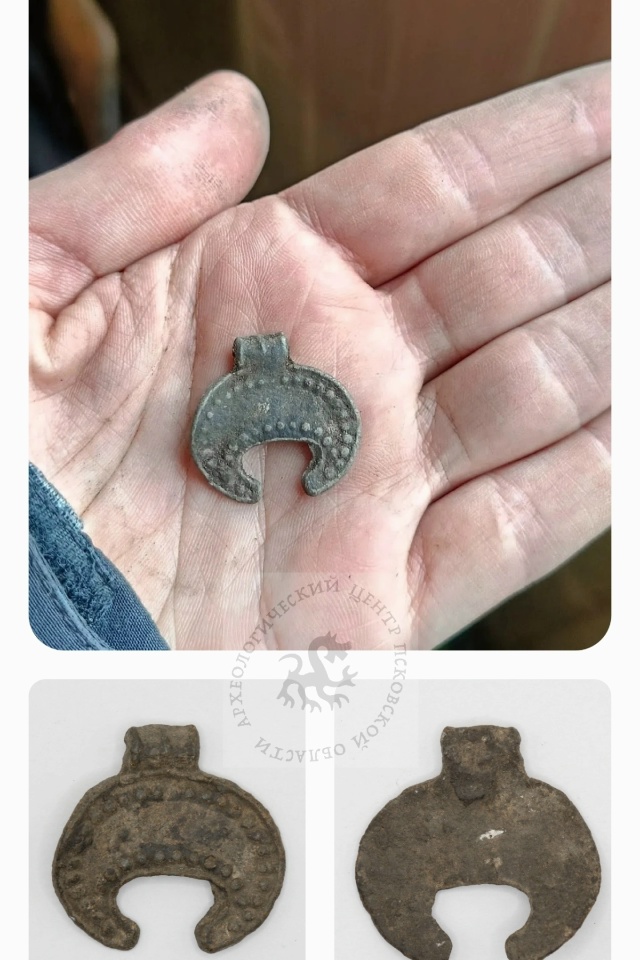
The newly discovered Pskov lunitsa has a suspension loop at the top and a broad crescent body decorated with small circular impressions. Its form suggests that it was made to be displayed rather than hidden beneath clothing.
For the woman who wore it, the pendant may have been decorative, protective or both.
A Talisman Against an Uncertain World
The moon’s changing shape made it one of the most powerful symbols in many ancient societies. It was connected with the passing of time, fertility, birth, death and renewal. The crescent also belonged to the night—a world associated with both protection and danger.
This symbolism encouraged archaeologists to interpret lunitsas as apotropaic amulets: objects intended to repel evil or shield the wearer from harmful forces.
Such protection would have felt practical rather than abstract. Medieval life was marked by high infant mortality, difficult childbirth, disease, crop failure and sudden violence. A small object worn around the neck could carry family tradition, religious belief and the hope that misfortune might be kept at a distance.
Women’s jewellery in the ancient and medieval worlds often reflected a wider cosmic order. Solar symbols, stars and crescents could be combined with beads, animal motifs and religious objects. The body became a place where beauty, identity and protection met.
Yet the meaning of the lunitsa was never fixed. The same crescent could carry different associations in different centuries, regions and families.
The “Pagan Slavic Amulet” Problem
Because lunitsas became widespread across Slavic lands between the 10th and 13th centuries, they were long described as distinctly Slavic pagan amulets.
The archaeological evidence tells a more complicated story.
Two-horned lunitsas are absent from securely dated Slavic archaeological contexts of the sixth and seventh centuries. Their appearance among Slavic communities appears to have followed the arrival of new jewellery styles from the Byzantine world during the late seventh and early eighth centuries.
The form spread through cultural contact rather than emerging from a single shared Slavic belief system. Byzantine fashion, trade and elite jewellery traditions played an important role in bringing crescent ornaments into Eastern and Central Europe.
By the 10th century, lunitsas were common across the lands of early Rus’. Some were finely made silver ornaments. Others were cheaper cast copies that imitated more elaborate decoration.
Their popularity coincided with the gradual Christianisation of the region—not with a purely pagan past.
Crescents Beside Christian Crosses
One of the most intriguing details in the history of lunitsas is where archaeologists sometimes find them: beside Christian crosses and devotional images.
In necklaces and burials dating from the late 10th century onward, crescent pendants appear alongside cross pendants. Craftsmen also created composite ornaments that combined the crescent and the cross in a single object.
A 12th-century burial at Kotorsk in the Pskov region contained a sharp-horned lunitsa together with small devotional icons depicting the Dormition of the Virgin and Christ the Saviour.
The woman buried there was not forced to choose between a crescent amulet and Christian devotion. She wore both.
Such discoveries resist simple labels. A lunitsa found in a Christian burial does not automatically prove the survival of a secret pagan cult. The crescent may have been reinterpreted within Christian culture, retained as a family heirloom or worn because its protective reputation had outlived the beliefs that first shaped it.
It may also have been fashionable. Medieval people, like people today, did not always separate personal appearance, inherited custom and religious belief into neat categories.
A Tradition That Refused to Disappear
Lunetsas gradually became less common in medieval archaeological layers, but the crescent did not vanish from Russian jewellery.
Crescent-shaped earrings and ornaments continued to be worn in some regions during the 19th and early 20th centuries. By then, their owners may have known little about Byzantine jewellery or the amulets of medieval Rus’. The shape survived because it remained familiar, beautiful and, perhaps, reassuring.
The new pendant from Zavelichye now enters that long history.
Analysis of its alloy, manufacturing technique and archaeological context may eventually reveal when it was made and whether it belonged to a local workshop or a wider jewellery network. Its precise meaning will be harder to recover.
The woman who wore it left no explanation. What remains is a small metal moon, carried against the body as jewellery, protection or a quiet combination of both.
Cover Image Credit: Archaeological Center of the Pskov Region / VKontakte
