
23 January 2026 The Future is the Product of the Past

Rediscovering the Lost Gods: Ancient Slavic Pagan Sanctuary Reborn in Noginsk Forests

An unexpected discovery deep in the forests near Noginsk has led to the restoration of a unique cultural and ethnographic site. According to REGIONS, local enthusiasts uncovered a carefully crafted Slavic pagan sanctuary known as “RuskoLad”, created by members of the local “ROD” community. What began as a chance encounter has now grown into one of the region’s most intriguing heritage findings.

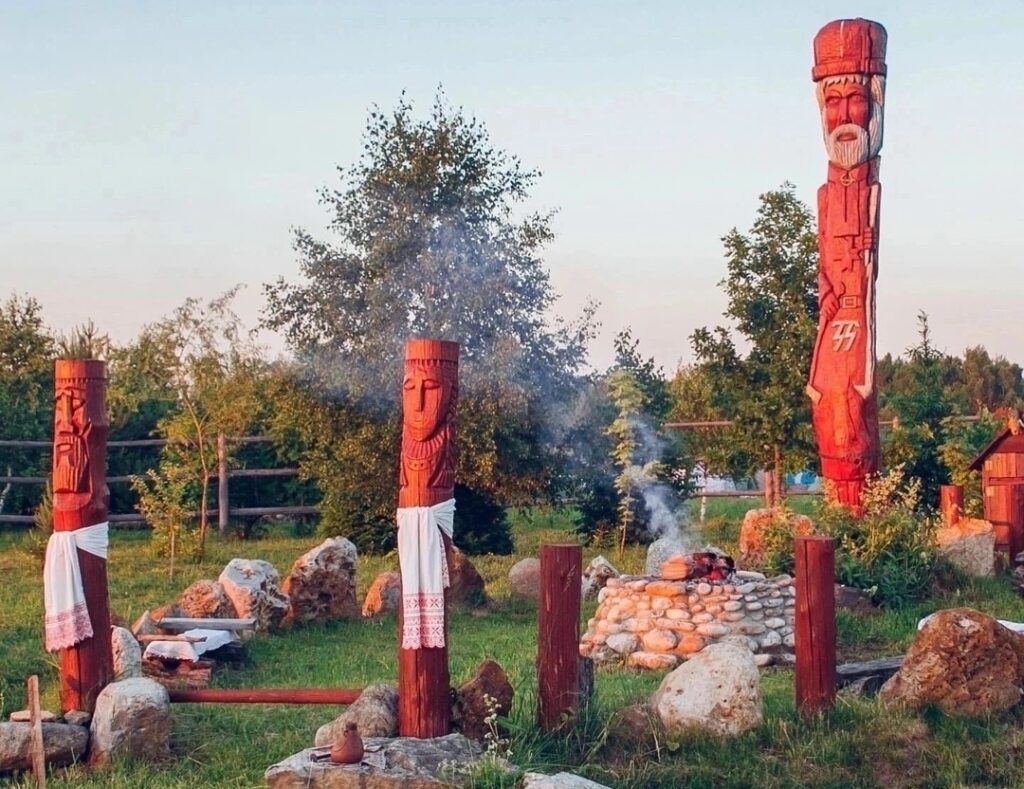
The first person to stumble upon the sanctuary was explorer and enthusiast Roman Ivanevsky. He recalls being completely stunned when he first saw the mysterious wooden figures standing silently among the trees. At first glance, the carved shapes seemed almost supernatural, but curiosity eventually won over his hesitation. As he approached and inspected the sculptures, the truth became clear—he had found representations of ancient Slavic deities, lovingly recreated by skilled local artisans.

Rediscovering the Gods of the Old Slavic Pantheon

Ivanevsky recognized several iconic figures from Slavic mythology. Among them stood Perun, the fearsome god of thunder and lightning, often compared to Thor or Zeus in Indo-European traditions. Perun is widely regarded as the chief deity of many Slavic tribes, symbolizing strength, justice, and the eternal struggle against chaos.

Nearby was the figure of Svarog, the celestial blacksmith and creator of the universe. In Slavic lore, Svarog is believed to have forged the world and set the sun in motion. His presence in the sanctuary highlights the importance of cosmic order and craftsmanship in early Slavic belief systems.

Another striking sculpture depicted Morena (also known as Marzanna or Morena), the goddess associated with winter, death, and the cycle of rebirth. Though often misunderstood as a symbol of fear, she traditionally represents transformation and the natural end of seasons. Her effigy was historically burned or drowned during spring rituals to symbolize the end of winter and the renewal of life.


📣 Our WhatsApp channel is now LIVE! Stay up-to-date with the latest news and updates, just click here to follow us on WhatsApp and never miss a thing!!


The discovery of these deities in the RuskoLad sanctuary suggests that the community behind the project sought to reconstruct not just physical monuments, but also the spiritual atmosphere of early Slavic worship.
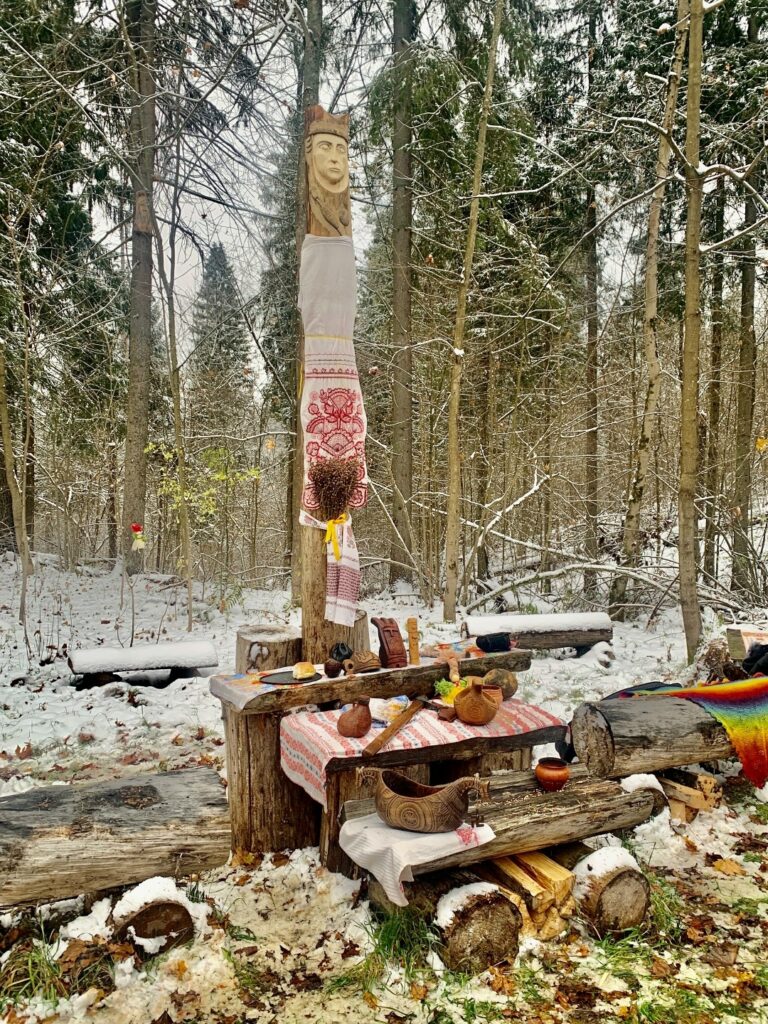
Representing the earthly element, Makosh embodies Mother Earth, one of the most ancient Slavic sacred figures. The Slavic people have long held a deep, almost filial reverence and gratitude toward the Earth Mother—“From the earth a person is born, and by the earth they are sustained.” Credit: Union of Slavic Communities of the Slavic Native Faith

A Carefully Recreated Pagan Sacred Space

Religion scholar Evgeny Ignatenko provided detailed insight into the architectural concept of the sanctuary. According to his explanation, traditional Slavic holy sites—called kapishche—consisted of clearly defined ceremonial areas. The innermost circle served as a space for prayer, reflection, and the burning of a ritual fire. Fire, in Slavic paganism, is not only a symbol of purity but also a sacred medium through which offerings were delivered to the gods.

Surrounding the inner circle is the outer zone, known as the trebische. This area functioned as a communal gathering place where celebrations, feasts, and seasonal rituals took place after religious ceremonies. Such events often coincided with major pagan festivals like Kupala Night, Koliada, or Dazhbog’s Day, marking important agricultural and cosmic cycles.

The RuskoLad sanctuary demonstrates an impressive level of historical accuracy. Every carved figure, every placement of stones, and every ceremonial space was recreated by members of the “ROD” community—an organization dedicated to the preservation and revival of Slavic cultural heritage. Their craftsmanship turned an ordinary forest clearing into a living open-air museum of mythology.

Cultural Revival and Modern Interest in Slavic Heritage

The discovery highlights a growing interest in exploring pre-Christian Slavic traditions across Eastern Europe. While much of the ancient Slavic pantheon was suppressed or absorbed during medieval Christianization, researchers and cultural enthusiasts have been working to piece together myths, rituals, and symbols from archaeological remains and folklore.

Sites like RuskoLad serve multiple purposes:

Educational, by offering a tangible representation of Slavic mythology;

Cultural, by reviving rituals and artistic traditions;

Historical, by preserving knowledge that might otherwise fade into obscurity.

Local residents have expressed fascination with the forest sanctuary, noting that it provides a rare opportunity to step into the worldview of ancient Slavic peoples. For many visitors, the sanctuary inspires reflection on how deeply nature, seasons, and celestial phenomena shaped early belief systems.


Morena, the Slavic goddess of winter, darkness, and transformation, symbolizing the cycle of death and rebirth in nature. Credit: Union of Slavic Communities of the Slavic Native Faith

A New Landmark in Noginsk’s Cultural Landscape

What began as a surprising forest encounter has transformed into one of Noginsk’s most compelling cultural landmarks. The restored RuskoLad sanctuary stands not only as a tribute to ancient Slavic spirituality but also as a reminder of the region’s diverse historical roots.

As interest continues to grow, experts predict that the sanctuary may become a significant destination for ethnographers, tourists, and anyone seeking to connect with the mythic past of Eastern Europe. Through dedicated community effort, the forgotten gods of thunder, creation, and winter have been brought back into the light—offering a powerful new chapter in the story of Slavic heritage.

Union of Slavic Communities of the Slavic Native Faith

Cover Image Credit: Union of Slavic Communities of the Slavic Native Faith via VK

Related Articles

Mystery of the 1,700-year-old Mosaic Solved: The Medallion in the Mosaic uncovered to be the Symbol of a Roman Military Unit

10 August 2024

10 August 2024

The mystery of the 1,700-year-old mosaic, which was found during excavations in Amasya province in northern Turkey 11 years ago...

Massive Roman Military-Industrial Complex Discovered in Northern England on the River Wear

9 January 2026

9 January 2026

Archaeologists in northern England have uncovered evidence of a previously unknown Roman military-industrial complex, revealing how the Roman Army prepared...

Early Anatolian Genes: Genetic Links Between Girmeler Mound and 17,000-Year-Old Pınarbaşı Skeletons

16 April 2025

16 April 2025

Recent archaeological excavations at Girmeler Mound, located near the ancient Lycian city of Tlos in southwestern Türkiye, have not only...

1,600-year-old Hunnic double burial found in Poland

15 June 2024

15 June 2024

In 2018, archaeologists uncovered a 1,600-year-old double burial in the village of Czulice near Krakow, Poland, containing the remains of...

Archaeologists Uncover a 2,300-Year-Old Fortress City in Uzbekistan’s Kashkadarya Oasis

23 November 2025

23 November 2025

The windswept hills of Uzbekistan’s Kashkadarya Oasis, long known as one of the cradles of human settlement in Central Asia,...

Lost 14th Century Church Discovered under a Tennis Court in Hungary

14 May 2024

14 May 2024

During an archaeological excavation in Visegrád, a fortified medieval castle on a hill overlooking the Danube in northern Hungary, the...

4,500-Year-Old Dog Teeth-Adorned Bags Found in Germany May Have Been Elite Baby Carriers

11 July 2025

11 July 2025

Archaeological excavations near Krauschwitz reveal rare decorated leather bags buried with women and infants—shining new light on Neolithic burial customs...

Two new fragments of the Fasti Ostienses, a kind of chronicle engraved on marble slabs, have been found in the Ostia Antica Archaeological Park

19 August 2023

19 August 2023

Two new fragments of the Fasti Ostienses have been discovered in the Ostia Antica Archaeological Park, following investigations carried out...

Discovery of 1,500-Year-Old Mosaic at Ancient City of Dara in Mardin, Türkiye

7 July 2025

7 July 2025

According to information provided by Anadolu Agency, archaeologists have recently uncovered a remarkably well-preserved 1,500-year-old mosaic decorated with drop and...

Hidden Gold and Silver Treasures Found Beneath 1,300-Year-Old Buddha Statue in Thailand

17 October 2025

17 October 2025

Archaeologists in Thailand have made an extraordinary discovery, unearthing a hidden trove of gold and silver treasures beneath a 1,300-year-old...

Unexpected finds under the Tel Aviv Suburban

21 August 2021

21 August 2021

In preparation for a planned residential building project in suburban Tel Aviv, archaeologists from the Israel Antiquities Authority have begun...

Egypt unearths 2,300-year-old remains of Greco-Roman town in Alexandria

28 August 2021

28 August 2021

An Egyptian archeological team discovered the ruins of a Greco-Roman residential and commercial town in the north coast city of...

Unbroken After 10,000 Years: Lake Biwa in Japan Unveils One of the World’s Oldest Pottery Artifacts

26 November 2025

26 November 2025

A team of Japanese researchers has announced a remarkable archaeological discovery at the bottom of Lake Biwa: a nearly intact...

Rare Medieval Seal with Roman Chariot Gemstone Discovered in Essex, southeast England

4 January 2026

4 January 2026

A rare medieval silver seal set with an ancient Roman carved gemstone has been discovered near Braintree, Essex — a...

2-Meter-Long Stone Block Found at 12,000-Year-Old Boncuklu Tarla Site in Southeastern Türkiye

18 December 2024

18 December 2024

A remarkable 2-meter by 20-centimeter processed stone block was discovered during the archaeological excavations at Boncuklu Tarla (Beaded Field), which...