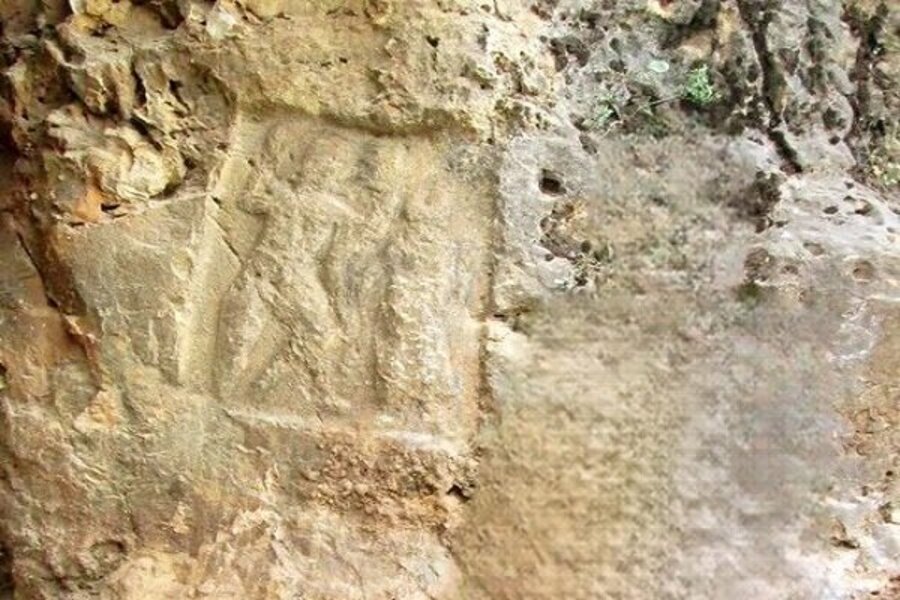
A newly discovered Elymaean rock carving in southwest Iran is drawing significant scholarly attention for its unusual iconography and its possible parallels with the mythological battle between Hercules and the Hydra, a motif famously depicted on Greek coins dating to around 325 BC. The carving, identified in the highlands of Kuh-e Manar in Andika County, Khuzestan Province, may provide fresh insight into the religious beliefs, artistic traditions, and cultural interactions of the Elymaean civilization in the central Zagros region.
The discovery was announced by Ayyoub Soltani, director of the Masjed Soleyman Cultural and Industrial Landscape National Base, who described the relief as one of the most distinctive Elymaean rock carvings identified to date. According to Soltani, the panel’s imagery and composition suggest it could represent a ritual or mythological scene, potentially influenced by wider Mediterranean traditions while remaining rooted in local belief systems.
The Elymaean Civilization and Its Cultural Role
The Elymaeans (also known as Elymais or Elamais) formed an autonomous or semi-autonomous polity between the 2nd century BC and the early 3rd century AD, primarily in the region of Susiana, corresponding largely to modern-day Khuzestan. While frequently under Parthian political influence, the Elymaeans maintained a strong regional identity and developed a distinctive artistic language.
Archaeological and historical evidence indicates that the Elymaeans were direct heirs to the ancient Elamite cultural tradition. At the same time, they played a key intermediary role in transferring Elamite and Achaemenid artistic elements into the Parthian and later Sasanian periods. Many motifs, compositional strategies, and religious symbols found in Sasanian art may have reached that era through Elymaean and Parthian reinterpretations.
Andika as a Cultural Interaction Zone
Soltani emphasized the importance of the Andika region, describing it as a “connecting link between the mountainous and lowland ecosystems of the Zagros.” This geographical position made the area a natural corridor for cultural exchange between central and southern Zagros communities.
📣 Our WhatsApp channel is now LIVE! Stay up-to-date with the latest news and updates, just click here to follow us on WhatsApp and never miss a thing!!
Over the past decades, researchers have identified an increasing number of Elymaean settlements, tombs, shrines, and rock carvings across the Bakhtiari highlands. These findings demonstrate not only the breadth of Elymaean territory but also the continuity of their cultural and religious practices. The newly discovered Manar carving stands out within this corpus due to its distinctive subject matter.
Description of the Rock Carving
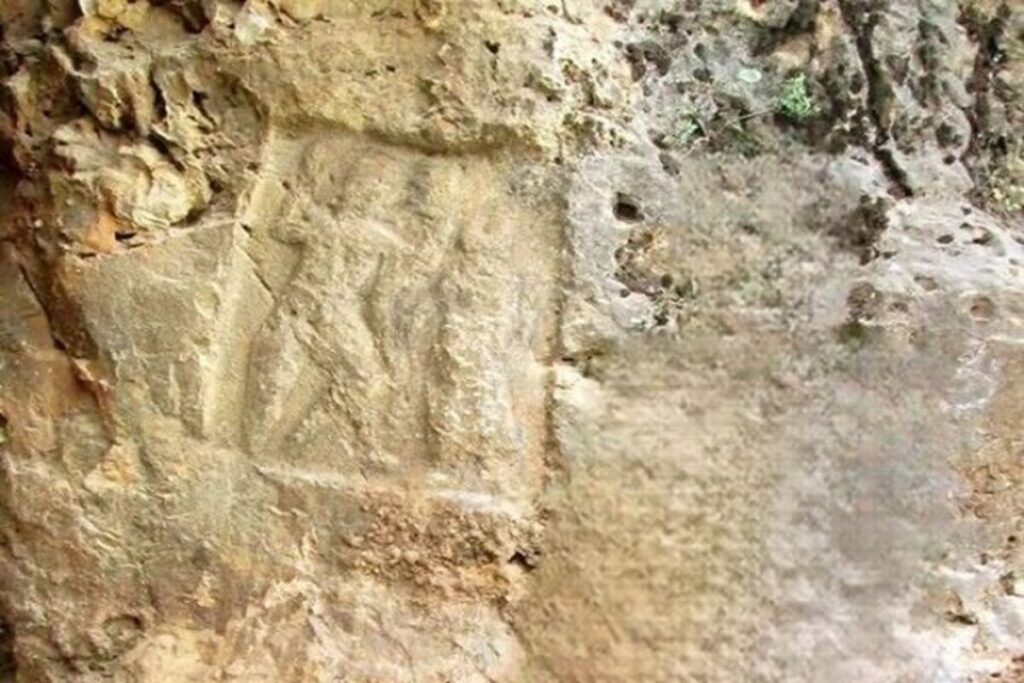
The relief is carved onto an irregular, roughly trapezoidal rock surface measuring approximately 70 by 81 centimeters. Although parts of the panel have suffered from natural erosion and intentional damage, three figures remain clearly discernible.
On the left, a muscular, nude male figure is shown in three-quarter profile. He raises a large, round object—possibly a ritual mace or symbolic weapon—in his right hand while gripping the throat of the central figure with his left. The emphasis on the torso, arms, and thighs suggests a deliberate focus on physical strength and heroic power.
The central figure is a serpent-like creature with three heads, extending roughly 83 centimeters in length. Multi-headed serpentine beings are rare in known Elymaean rock art, making this element particularly important for interpreting the scene’s symbolic meaning.
On the right, a male figure dressed in Parthian-style clothing appears in full frontal view. He wears a long garment with clearly defined folds and adopts a posture comparable to priestly figures seen in other Elymaean reliefs, such as those at Shirenu, Khung Azhdar, and Khung Yaralivand.
Mythological Interpretation and Possible Parallels
According to Soltani, the composition, figural modeling, and gestures indicate a conscious emphasis on heroic struggle and ritual significance. While no definitive identification can be made, the scene shows possible parallels with the myth of Hercules battling the Hydra, a narrative well known in the Hellenistic world and depicted on the reverse of Greek coins issued around 325 BC.
Rather than suggesting direct copying, researchers propose that the Elymaean artist may have been inspired by widely circulating mythological themes, adapting them to local religious and cultural frameworks. Such selective appropriation reflects the Elymaeans’ broader role as cultural intermediaries between Iranian, Mesopotamian, and Mediterranean traditions.
Preservation and Future Research
Experts stress that the carving is scientifically significant and unique within the known body of Elymaean rock art. However, the relief is vulnerable due to surface erosion and material loss. As a result, specialists recommend urgent physical protection, high-resolution digital documentation, and advanced laser scanning to preserve the remaining details.
The discovery has been formally presented to Iran’s Ministry of Cultural Heritage and published in the international academic journal Sinos Persicus, underscoring its importance for future studies of Elymaean art, religion, and cross-cultural interaction.
As further research continues, the Manar rock carving is expected to contribute substantially to our understanding of how the Elymaeans expressed myth, ritual, and identity within the dynamic cultural landscape of the ancient Zagros Mountains.