
13 June 2026 The Future is the Product of the Past

The Tomb of Prince with a Monumental Pink Granite False Door Unearthed in Saqqara

In a remarkable archaeological discovery, an Egyptian team has unveiled the tomb of Prince Waser-If-Re, son of Pharaoh Userkaf, the founder of Egypt’s Fifth Dynasty, at the Saqqara necropolis, located south of Cairo. This significant find offers an extraordinary insight into the royal life and burial practices of ancient Egypt, dating back approximately 4,500 years.

The excavation, led by renowned Egyptologist Dr. Zahi Hawass in collaboration with the Supreme Council of Antiquities and the Zahi Hawass Foundation for Archaeology and Heritage, revealed that the tomb, originally constructed during the Old Kingdom, was later repurposed during Egypt’s 26th Dynasty. This dual usage highlights the tomb’s historical significance and the evolving practices surrounding royal burials.

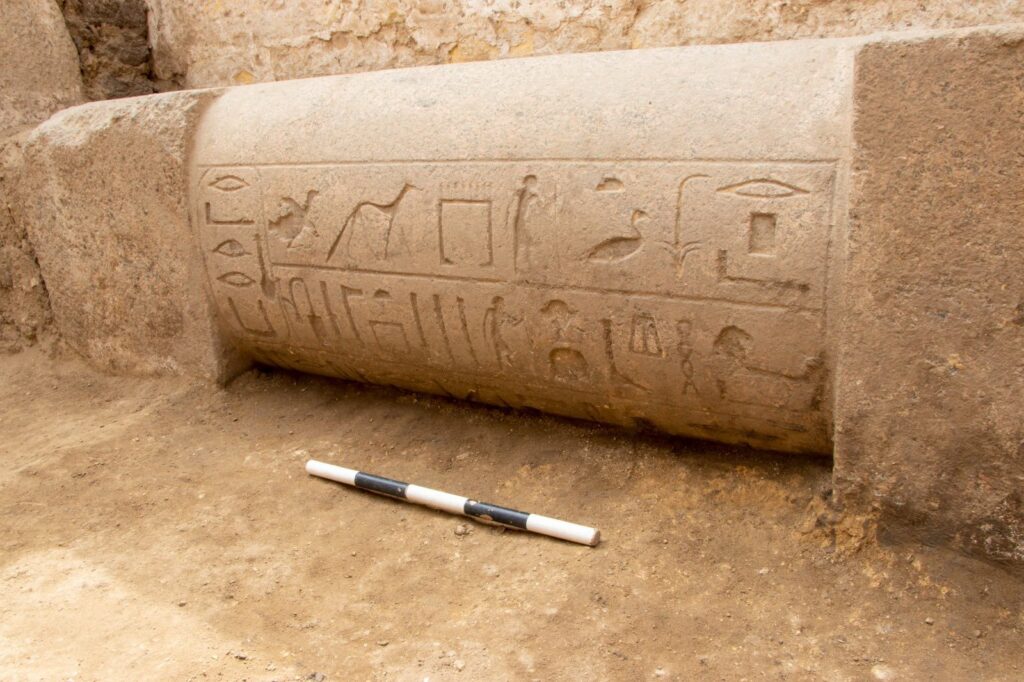
One of the most striking features of the tomb is a monumental false door crafted from pink granite, measuring an impressive 4.5 meters in height and 1.15 meters in width. This door, the largest of its kind ever discovered, is adorned with intricate hieroglyphs that enumerate Prince Waser-If-Re’s numerous titles, including “Hereditary Prince,” “Royal Scribe,” “Vizier,” and “Chanting Priest.” The presence of a second entrance, inscribed with the prince’s name and the cartouche of King Neferirkare, further confirms the tomb’s reuse in later periods.
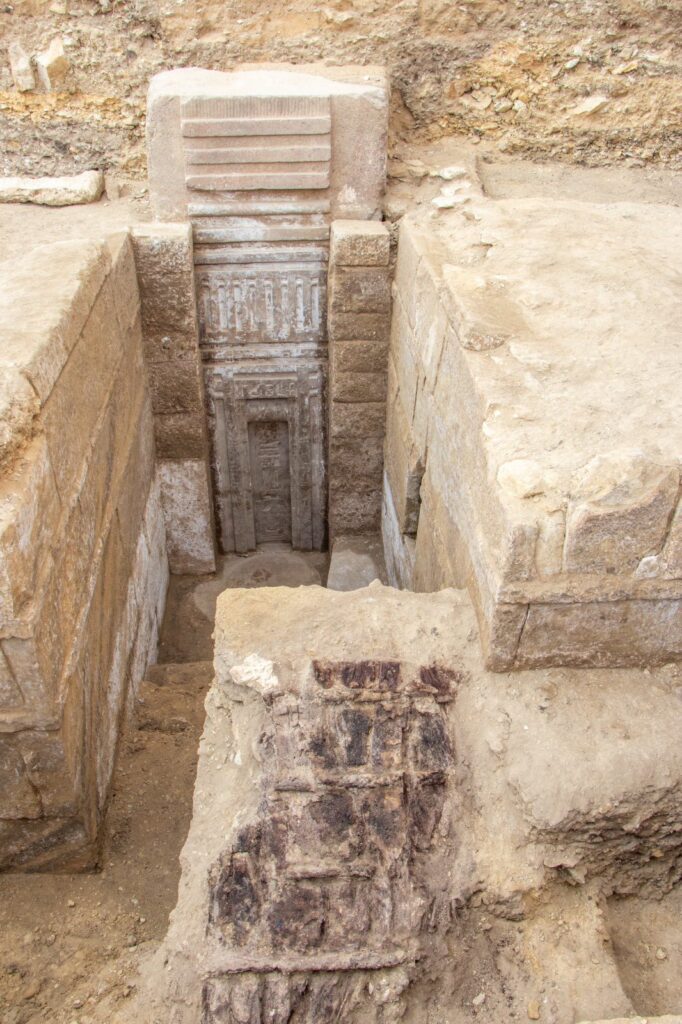
The monumental pink granite false door. Credit: Ministry of Tourism and Antiquities of Egypt

Among the most dramatic findings are thirteen pink granite statues seated on high-backed chairs, believed to represent the prince’s wives, with some figures notably headless. Additionally, archaeologists uncovered a striking black granite statue, standing 1.35 meters tall, positioned face down, alongside a red granite offering table inscribed with ritual items. These artifacts provide a glimpse into the funerary practices and social structures of the time.

The excavation team also discovered a black granite statue, 1.17 meters high, which bears the owner’s name and titles, dating back to the 26th Dynasty. This discovery supports the theory that the tomb was not only a resting place for Prince Waser-If-Re but also a site of continued reverence and ritual long after its initial construction.


📣 Our WhatsApp channel is now LIVE! Stay up-to-date with the latest news and updates, just click here to follow us on WhatsApp and never miss a thing!!


Dr. Zahi Hawass expressed excitement over the findings, emphasizing the importance of this discovery in understanding the rituals and social hierarchies of the Fifth Dynasty. He noted that the tomb’s unique structure and contents make it a significant example of ancient Egyptian burial practices.
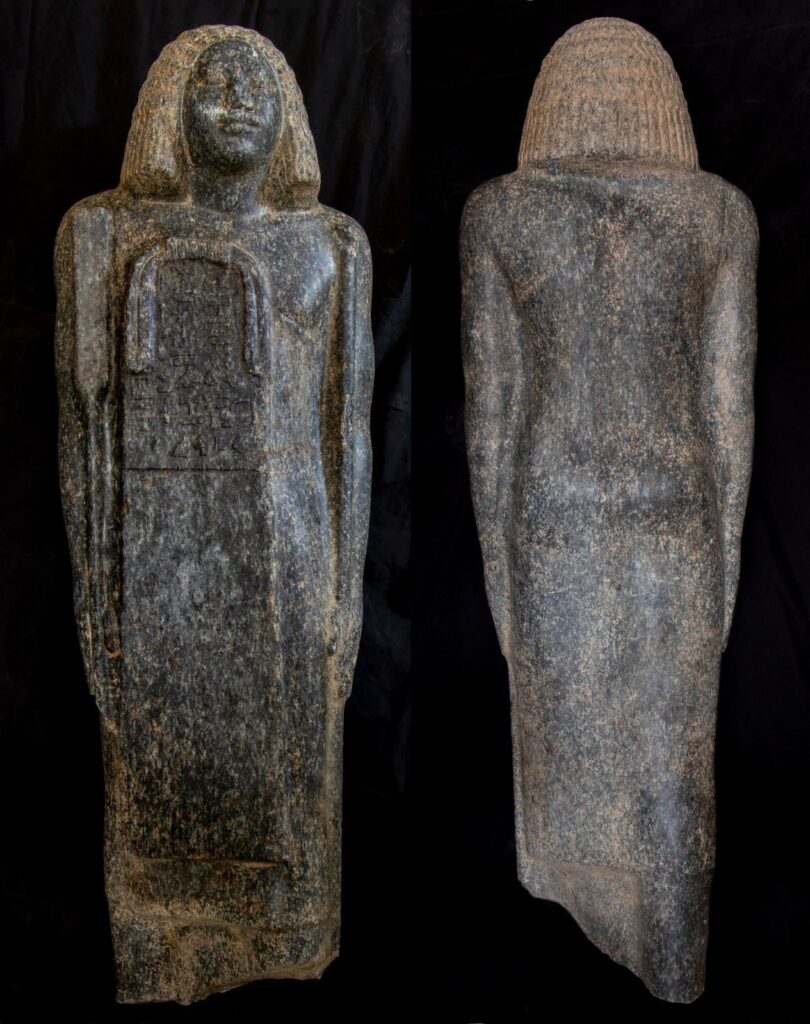
Credit: Ministry of Tourism and Antiquities of Egypt

The Minister of Tourism and Antiquities celebrated the achievement, highlighting the entirely Egyptian-led excavation team, which reinforces the local role in the field of Egyptology. As excavations continue, further chambers and artifacts are expected to be uncovered, promising to shed light on the mysteries surrounding the tomb’s later usage and the reasons behind the relocation of royal statues.

This groundbreaking discovery not only enriches our understanding of ancient Egyptian history but also underscores the enduring legacy of the civilization that flourished along the banks of the Nile. As the excavation progresses, archaeologists remain hopeful that more insights into the life, death, and beliefs of Egypt’s ancient rulers will emerge from this remarkable site.

Ministry of Tourism and Antiquities

Cover Image Credit: Ministry of Tourism and Antiquities

Related Articles

Intricate Design Revealed on 1100-Year-Old Gold-Inlaid Ritual Spear from Japan’s Island of the Gods

13 June 2025

13 June 2025

A recent archaeological breakthrough on Japan’s sacred Okinoshima Island has unveiled an ornately decorated iron spear from the late Kofun...

A 1,500-Year-Old Roman Settlement Discovered in Bulgaria

21 March 2025

21 March 2025

In a remarkable turn of events, a team of archaeologists conducting preliminary excavations ahead of a transit gas pipeline project...

3.300-year-old Hittite Inscription was Used in Gate Construction

10 May 2021

10 May 2021

Our cultural assets become victims of ignorance one by one. The works that will illuminate the darkness of history continue...

New Findings from 3,000-year-old Uluburun shipwreck: Uzbekistan Nomads Supplied a Third of the Bronze Used Across Ancient Mediterranean

5 December 2022

5 December 2022

A new study of the 3,o00 years old Uluburun shipwreck revealed a complex ancient trading network during the late bronze...

A Rock-Cut Temple and Inscriptions from the Neolithic period discovered in Saudi Arabia

6 August 2022

6 August 2022

In a project led by the Saudi Heritage Commission, a multinational team of archaeologists has discovered an 8,000-year-old archaeological site...

A newly Discovered Church in Sudan could be a Cathedral

2 June 2021

2 June 2021

Archaeologists have found the remains of the largest church known from medieval Nubia in old Dongola (Sudan). Dongola was the...

The first Dutch Neanderthal’s ‘Krijn’ face was reconstructed

7 September 2021

7 September 2021

World-renowned “paleo-artists” Kennis brothers have reconstructed the face of the first Neanderthal in the Netherlands. After more than 50,000 years,...

Archaeologists in the Tangier Peninsula Discovered Three Ancient Cemeteries, Including a Stone Burial Dating to Around 4,000 Years Ago

17 May 2025

17 May 2025

A significant archaeological discovery in northern Morocco’s Tangier Peninsula, situated just south of the Strait of Gibraltar, has led to...

A Rare Glass Jewel Depicting the Crucifixion Found in an Abandoned Anglo-Saxon Village

18 January 2026

18 January 2026

Archaeological investigations ahead of the Sizewell C nuclear power station project in Suffolk have revealed a remarkable discovery: a rare...

Grave Dig Uncovers 1,500-Year-Old Mosaic with Star of David and Cryptic Greek Petition in Türkiye

3 August 2025

3 August 2025

During a routine grave dig in Türkiye’s Diyarbakır province, archaeologists uncovered a remarkable 1,500-year-old mosaic featuring the Star of David...

Rescue work begins on a 160-year-old shipwreck, the largest and best-preserved wooden shipwreck ever discovered underwater in China

3 March 2022

3 March 2022

Rescue work has begun on a 160-year-old shipwreck in China, the largest and best-preserved wooden wreck ever discovered underwater. This...

6,000-Year-Old “Kołobrzeg Venus”: A Remarkable Neolithic Discovery on the Baltic Coast

20 June 2025

20 June 2025

A remarkable archaeological discovery has emerged from the sandy shores of Poland’s Baltic coast near Kołobrzeg—a 6,000-year-old female figurine now...

Pharaonic Hieroglyphic Inscription of Ramses III Found in Southern Jordan

20 April 2025

20 April 2025

In a remarkable archaeological breakthrough, a hieroglyphic inscription bearing the royal cartouche of Pharaoh Ramses III (1186–1155 BC) has been...

6th-Century BC Houses and Earthquake Evidence Discovered in Davti Blur, an Urartian Fortress City in Armenia

28 January 2025

28 January 2025

An Armenian-Polish archaeological team has uncovered remnants of 6th-century BC houses, a cremation cemetery, and signs of a significant earthquake...

Spanish Water Worker discovered 2,500-Year-Old two Gold Necklaces

14 September 2023

14 September 2023

A worker at a local water company in Spain discovered two gold necklaces thought to date back 2,500 years. Sergio...